

Trading 90 mins session for a living || It’s a rigged game ||
Joined September 2021
- Tweets3.6K
- Following140
- Followers20.3K
- Likes9.6K


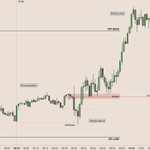


Built something for my 9:00–10:30 model.
No arrows. No bias. Just where price was likely going, and when.
Been testing it for few weeks now.
Next week I will show you more.


So the European Central Bank just published its Financial Stability Review.
AI is the first risk on its list.
1. The whole market is a bet on AI.
The ECB calls AI "the central theme shaping global equity markets." Prices assume extraordinary earnings growth for AI firms. If that growth doesn't show up, it warns of "an abrupt repricing."
2. The spending is insane.
US big tech is projected to spend around $5.5 trillion on AI by 2030. Data centres, chips, energy. A lot of it is paid for with debt. AI infrastructure bond issuance is at record highs this year.
3. Nobody fully knows who owes what.
The ECB says AI financing "remains opaque." Companies invest in each other, buy from each other and fund each other. Circular money makes the numbers look stronger than they might be.
4. It smells late cycle.
IPOs are on track to pass the dotcom peak as a share of US GDP. The ECB reads that as late-cycle exuberance.
5. The risk is spreading outside tech.
European funds and other non-banks have increased their AI exposure a lot. Banks are less exposed directly, but they're linked to those funds. A shock in AI doesn't stay in AI.
6. AI is also a new kind of risk.
Better models mean more powerful cyber attacks. And most of the system depends on a small cluster of tech providers. One failure, everyone feels it.
What this means for the economy:
AI is driving a big part of growth right now. Investment, markets, confidence. That's great while expectations hold. But when an economy leans this hard on one story, the story becomes the risk.
I'm not calling a crash. I'm saying the people whose job is to watch the system are telling you where the cracks are.
Dropping a strategy after 4 losses in a row is quitting before the sample even started.
50% win rate, 20 trades: you'll see 4 straight losses almost half the time.
Do the math.
The pragmatic retweeted
Going against the crowd feels terrible in the moment.
That's exactly why it works.
Social media rewards agreement. Post what everyone thinks and you get likes. Post what nobody sees yet and you get silence. So most people learn to chase the likes. They stop saying what they see and start saying what gets approved.
The market works the same way. When the whole timeline is buying the same breakout or the same stock, the trade feels safe. The comfortable side is the crowded side, and the crowded side is where the stops sit.
Life too. Same school, same job, same 30-year plan. Safe because everyone does it. Until everyone finds out at the same time that it wasn't.
So how do you win? You do what most people won't.
Wait when everyone is clicking.
Study when everyone is scrolling.
Save when everyone is spending.
Build when everyone is watching.
Not different for the sake of it. Different where it's hard.
Being early feels like being wrong. No validation. No proof yet.
That feeling is the entry fee.
Pay it, or be the liquidity.
Going against the crowd feels terrible in the moment…


Going against the crowd feels terrible in the moment.
That's exactly why it works.
Social media rewards agreement. Post what everyone thinks and you get likes. Post what nobody sees yet and you get silence. So most people learn to chase the likes. They stop saying what they see and start saying what gets approved.
The market works the same way. When the whole timeline is buying the same breakout or the same stock, the trade feels safe. The comfortable side is the crowded side, and the crowded side is where the stops sit.
Life too. Same school, same job, same 30-year plan. Safe because everyone does it. Until everyone finds out at the same time that it wasn't.
So how do you win? You do what most people won't.
Wait when everyone is clicking.
Study when everyone is scrolling.
Save when everyone is spending.
Build when everyone is watching.
Not different for the sake of it. Different where it's hard.
Being early feels like being wrong. No validation. No proof yet.
That feeling is the entry fee.
Pay it, or be the liquidity.

Things are getting weird. And I think this is just the beginning.
We've had a lot of warnings about AI.
Not saying that's what this is.
But one day, it will be. And nobody will be ready.

13
1,672
The pragmatic retweeted
As some of you know, I hold a degree in finance and applied economics.
So I wrote this week's market the way it should be read: as a research paper.
Stocks just had their first green week since October. Bonds, the dollar and the Fed are saying the opposite.
The Pragmatic Research · Week of Nov 16 ↓


As some of you know, I hold a degree in finance and applied economics.
So I wrote this week's market the way it should be read: as a research paper.
Stocks just had their first green week since October. Bonds, the dollar and the Fed are saying the opposite.
The Pragmatic Research · Week of Nov 16 ↓
Lot of people say trading is gambling.
They're right.
For anyone with no rule for when, where & how much.
The casino doesn't gamble. It runs the math.
If I could talk to myself at the 9:30 open in 2021..
1. The first candle isn't for you. Let it run someone else's stops.
2. You don't need 6 hours. You need 90 minutes & the discipline to leave.
3. Size is the risk. Not the stop.
4. A green day with broken rules is worse than a red day with clean ones.
5. Journal the time of every entry. The pattern will embarrass you.
6. Stop hunting new strategies. Pick one model. Study it for a year.
It took 2 years & a lot of red days to write that list.
Took you 30 seconds to read it.
Roy Cohn's 3 rules:
1. Attack, attack, attack
2. Admit nothing, deny everything
3. Always claim victory
Great in a courtroom only tho
1
21
1,824
1.01^365 = 37.8
0.99^365 = 0.03
Nobody changes their life in a day.
One more page read. One more rep. One less excuse.
Small enough to do today. Big enough to not recognize yourself in a year.

Tight stops don't lower your risk.
Size does. 2 NQ contracts with a 10 point stop risk the same $400 as 4 contracts with a 5 point stop.
The tight one just gets tagged by the volatility more often.

Going against the crowd feels terrible in the moment.
That's exactly why it works.
Social media rewards agreement. Post what everyone thinks and you get likes. Post what nobody sees yet and you get silence. So most people learn to chase the likes. They stop saying what they see and start saying what gets approved.
The market works the same way. When the whole timeline is buying the same breakout or the same stock, the trade feels safe. The comfortable side is the crowded side, and the crowded side is where the stops sit.
Life too. Same school, same job, same 30-year plan. Safe because everyone does it. Until everyone finds out at the same time that it wasn't.
So how do you win? You do what most people won't.
Wait when everyone is clicking.
Study when everyone is scrolling.
Save when everyone is spending.
Build when everyone is watching.
Not different for the sake of it. Different where it's hard.
Being early feels like being wrong. No validation. No proof yet.
That feeling is the entry fee.
Pay it, or be the liquidity.
