Nicholas Bellono retweeted
A Chance Discovery Reveals an Unexpected Twist in One of Biology's Oldest Molecular Machines
mcb.harvard.edu/department/n… @NBellono @Harvard @DanaFarberNews
Nicholas Bellono retweeted
A newly discovered change in ribosomal RNA makes protein production more precise, potentially safeguarding these cephalopods’ complex nervous systems
spklr.io/6011EuTJZ
Nicholas Bellono retweeted
Octopuses are among the strangest creatures on Earth—right down to their molecules.
A new study has found that octopuses of a certain lineage have a mutation not seen in any other organism that makes their cellular machinery extremely accurate at creating proteins. As a result, their proteins are less likely to form toxic clumps.
Learn more: scim.ag/4wxHUb9
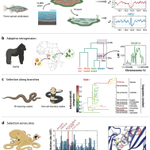
How did octopuses evolve novel traits? Rishav Mitra, Richard Han, Trey Scott, et al serendipitously discover a unique ribosome adaptation that increases the accuracy of protein synthesis and evolved alongside their elaborate nervous systems. biorxiv.org/content/10.64898…
How did animal senses evolve? Max Coyle et al. used choanoflagellates to uncover TRPW, ancient ion channels predating animal somatosensory receptors. TRPW links microbial ecology to evolution of receptor structure, organelles, & multicellular processing.
biorxiv.org/content/10.64898…
Pablo Villar et al discover male octopus mating arms are sensory organs used to find females, navigate internally to the oviduct & deliver sperm. From behavior to structure, these findings offer a framework for how sensory systems shape reproduction & species barriers
Male octopuses use a specialized arm that acts as both a sensory and reproductive organ to navigate the female’s mantle, locate oviducts, and transfer sperm. These findings reveal how sensory systems shape reproductive behavior and drive speciation.
Learn more this week in Science: scim.ag/4clal4S

ALT Animals rely on sensory cues to choose mates before reproduction. Male octopuses use a specialized arm that acts as both a sensory and reproductive organ to navigate the female’s mantle, locate oviducts, and transfer sperm. These findings reveal how sensory systems shape reproductive behavior and drive speciation. This image shows courtship during mating.
Nicholas Bellono retweeted
Study Reveals Octopus Mating Arm Doubles as a Chemical Sensor #research
mcb.harvard.edu/department/n… @NBellono @KTHuniversity @HarvardChanSPH
@harvardmed @harvardbrainsci @OISTedu @Stockholm_Uni @ucsdneurodept
Nicholas Bellono retweeted
Evolutionary Clues Reveal How a Key Hearing Protein Adapted for Function
mcb.harvard.edu/department/n… @NBellono @minerva2 @HarvardOEB @CellPressNews @harvardmed
Nicholas Bellono retweeted
Wendy Valencia Montoya Receives Weintraub Graduate Student Award for Groundbreaking Thesis on the Evolution of Sensory Worlds
mcb.harvard.edu/department/n… @wendyssae @NBellono @HarvardGSAS @fredhutch @HarvardOEB
Wendy Valencia-Montoya and team uncover thermal infrared as one of the most ancient pollination signals uniting plants and animals. From the field to single proteins. @wendyssae
Long before flowers dazzled pollinators with brilliant colors and sweet scents, ancient plants used another feature to signal insects: heat. The findings in Science offer new insights into what shaped the earliest eras of plant-animal coevolution.
Learn more in this week's issue: scim.ag/4iVZtfM

ALT Cycad plants use thermogenesis to warm their reproductive cones. A beetle dusted with pollen and fluorescent dyes lands on the warm cone of a cycad. High concentrations of dye have been deposited on the cone’s hottest regions during previous visits by other labeled beetles. Beetle pollinators use these thermal infrared patterns as a guide to locate host pollen and ovulate cones.
Nicholas Bellono retweeted
Rebecka Sepela Receives L’Oréal USA For Women in Science Fellowship #STEM #sciencenews
mcb.harvard.edu/department/n… @RebeckaSepela @NBellono @RachelleGaudet @LOrealUSA @Harvard @harvardbrainsci @DulacLab @mlgredler @RivasElenaRivas @VMurthyLab @JeeyunC @MicrobiomeTcell
Nicholas Bellono retweeted
Anastasiia Sukalskaia Awarded Swiss National Science Foundation Fellowship @asukalskaia @NBellono @UZH_en @snsf_ch @RachelleGaudet @DulacLab @mlgredler @RivasElenaRivas @VMurthyLab @Harvard mcb.harvard.edu/department/n…
Nicholas Bellono retweeted
Bellono Lab Research Featured on Two September Cell Covers @CoreyAHAllard @RebeckaSepela @NBellono @AnikGrearson @RachelleGaudet @EdSoucy @mlgredler @DulacLab @RivasElenaRivas @Harvard @HarvardGSAS @MicrobiomeTcell @rnett42 @JeeyunC @VMurthyLab mcb.harvard.edu/department/n…
Nicholas Bellono retweeted
New issue alert👉cell.com/cell/current
On the cover: Allard et al. discover “solar-powered” sea slugs use specialized kleptosome organelles to store and maintain foreign chloroplasts for photosynthetic energy and eventual digestion for starvation resistance.
Nicholas Bellono retweeted
The new issue is out👉cell.com/cell/current
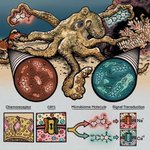
On the cover: Sepela et al. find that octopuses detect signals from microbes in their environment. This helps them distinguish prey or progeny from seafloor rocks and crevices, and drives predation and parental behavior.
Sea slugs steal foreign chloroplasts for photosynthesis and starvation resistance. Photo by Anik Grearson. #evolution #symbiosis. #cellbiology. @CellPressNews
Nicholas Bellono retweeted
🎉It’s #CephalopodWeek! Our annual celebration of all things octopus, squid, and cuttlefish 🐙🦑 To kick things off: A new study looks into how octopuses use the suckers on their arms to “taste” harmful microbes on surfaces they touch.
buff.ly/PhTxTnr
Octopuses sense environmental microbiomes to drive predatory and parental behaviors. Artwork by Lily Soucy. #evolution #sensation #microbiome @CellPressNews
Nicholas Bellono retweeted
Wendy Valencia Montoya – Bridging Natural History and Molecular Biology @wendyssae @NBellono @RachelleGaudet @HarvardOEB @rnett42 @mlgredler @JeeyunC @MicrobiomeTcell @MaxPrigozhin @RivasElenaRivas @DulacLab @VMurthyLab mcb.harvard.edu/department/n…
Nicholas Bellono retweeted
Ryan Nett Named Pew Scholar for Innovative Research on Plant-Derived Molecules @rnett42 @RachelleGaudet @mlgredler @DulacLab @RivasElenaRivas @HekstraLab @JeeyunC @MicrobiomeTcell @VMurthyLab @MaxPrigozhin @NBellono @fleshball @Harvard @pewresearch mcb.harvard.edu/department/n…