

Promoting patient safety by enhancing provider quality.
Joined August 2012
- Tweets2.1K
- Following137
- Followers2.2K
- Likes50
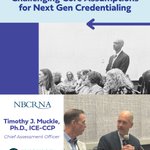






This week, NBCRNA attended the 2026 I.C.E. Exchange conference in Providence, Rhode Island. Chief Assessment Officer, Timothy J. Muckle, Ph.D., ICE-CCP, presented on "Challenging Core Assumptions for Next Gen Credentialing." Dr. Muckle also joined Shahid A. Choudhry, PhD, for the presentation of their e-poster "From Innovation to Evidence: Which Simulation Modalities Are Ready for High-Stakes Certification?"
NBCRNA Assessment Development Analyst, Eric Deutz, MEd, ICE-CCP, discussed the longitudinal assessment model of the MAC Program alongside co-presenters in "A Longitudinal Assessment Journey Across Organizations."


Congratulations to all the 2026 graduates! We're excited to welcome you to the profession and see all that you accomplish in the future. #CRNA #ClassOf2026 #NurseAnesthesia


This World Anesthesia Day, we’re celebrating the CRNAs and SRNAs advancing anesthesia care and making a difference in the lives of their patients – your confidence, compassion, and commitment to lifelong learning ensure that patients can trust the CRNA credential in their most vulnerable moments. #WorldAnesthesiaDay #NurseAnesthesia #CRNA
MAC Check is designed as a longitudinal assessment (LA), meaning it aims to measure the knowledge of CRNAs over time instead of in a single high-stakes exam, providing a more comprehensive picture of a CRNA’s learning and development over time. Click here to learn more about LA: ow.ly/CB1i50ZYa0u


What is the appropriate size laryngeal mask airway selection for a 15-kg patient? #CRNA #NurseAnesthesia
0%1.5
100%2
0%2.5
0%3
1 votes • Final resultsWe recently hosted the 2026 MAC Check Subcommittee at NBCRNA headquarters in Chicago. This subcommittee is comprised of CRNAs from across the country who volunteer their time and expertise toward creating and reviewing MAC Check questions for their fellow practitioners.
We’d also like to recognize subcommittee Chair Joanne Rush, DNP, CRNA, and subcommittee members Kimyatta Brent, DNP, CRNA, Patricia Sarcona, DNP, CRNA, and Mandy Broussard, DNP, CRNA, for 4 years of service. Thank you for volunteering your time towards improving the profession.
#CRNA #NurseAnesthesia

NBCRNA retweeted
What is the appropriate size laryngeal mask airway selection for a 15-kg patient? #CRNA #NurseAnesthesia
0%1.5
100%2
0%2.5
0%3
1 votes • Final resultsHappy #MACMonday! Heather Bair, DNP, ARNP, CRNA, CHSE, FAANA, explains how missing MAC Questions provides CRNAs with an opportunity to identify areas for additional learning. #CRNA #NurseAnesthesia
At the 2026 Annual Congress, we asked CRNAs to tell us how they fit the MAC Program into their real-life practice. Whether you complete your questions first thing in the morning, on a lunch break, or on the go, MAC Check offers CRNAs flexibility to ensure their certification maintenance blends easily into busy schedules. #CRNA #NurseAnesthesia

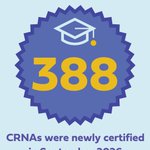
NBCRNA congratulates and welcomes to the profession the 388 individuals who earned their #CRNA certification in September 2026! View monthly lists of new credential holders here: nbcrna.com/students/certific…

Happy #MACMonday! Sarah Reynolds, DNAP, CRNA, shares her experience with the MAC Program. #CRNA #NurseAnesthesia
In a new article for Modern Healthcare, NBCRNA Chief Executive Officer John C. Preston, DNSc, CRNA, APRN, FAANA, FNAP, FAAN, examines the role of certification in building trust, strengthening the healthcare workforce and supporting safe patient care. Preston highlights how the CRNA credential serves as both a standard of professional competence and an important component of workforce infrastructure. Read the full article here: ow.ly/IX7S50ZScLX

The anesthesia provider starts an anesthetic and turns the ventilator on after the patient has been intubated. Immediately the oxygen low-pressure alarm begins to signal. What is the FIRST step in management of this incident?
A. Activate the oxygen flush valve
B. Adjust the oxygen flowmeter to low-flow
C. Fully open backup oxygen cylinder and disconnect pipeline
D. Inspect the oxygen analyzer for proper function
The flexibility of the MAC Program, designed with CRNAs in mind, allows continuing education to fit easily into their real-life practice. Click here to learn more about the MAC Program: nbcrna.com/MAC. #CRNA #NurseAnesthesia
NBCRNA retweeted
The anesthesia provider starts an anesthetic and turns the ventilator on after the patient has been intubated. Immediately the oxygen low-pressure alarm begins to signal. What is the FIRST step in management of this incident?
A. Activate the oxygen flush valve
B. Adjust the oxygen flowmeter to low-flow
C. Fully open backup oxygen cylinder and disconnect pipeline
D. Inspect the oxygen analyzer for proper function
Happy #MACMonday! Here's some advice from Parissa Razmjou, MSN, CRNA, for CRNAs starting the MAC Program. #CRNA #NurseAnesthesia