
The official X account for the NASA Hubble Space Telescope, managed and operated by NASA's Goddard Space Flight Center.
- Tweets8.5K
- Following44
- Followers8.9M
- Likes1.2K





ALT Black-and-white, comic-style illustration of several NASA mission satellites grouped around a large table laden with traditional Thanksgiving foods. Starting from the very left and going clockwise around the table, the satellites are: Webb, Chandra, NICER, Hubble, NuSTAR, Roman, and TESS. The foods on the table include a Thanksgiving turkey, snacks, bread rolls, casserole, stuffing, a pie with the Fermi telescope baked onto it as decoration, and finally, both canned cranberry sauce and fresh cranberries. The background of the illustration is a black starry field. Credit: NASA's Goddard Space Flight Center


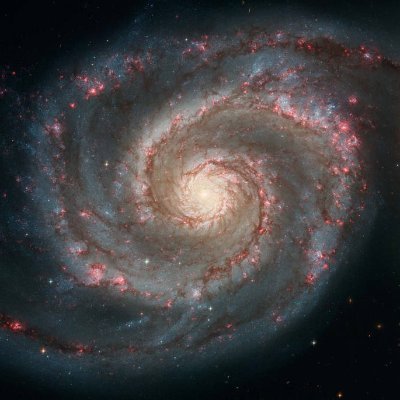
ALT Description: An image of the galaxy pair NGC 4676 shows space dotted by small stars and galaxies. The pair appear in white, blue, and brown hues at the center of the image, a long trail of blue-white streaming outward to the top right of the frame. Credit: NASA/H. Fort (JHU)/G. Illingworth (USCS/LO)/M. Clampin (STScI)/ G. Hartig (STScI)/ ACS Science Team/ESA

ALT Two people in head to toe white clean room suits stand in Goddard's large white clean room, staring up at Roman. Fully integrated, the telescope towers over them. Three irregular, elongated hexagon-shaped solar panels are the most striking part of Roman from this angle. The solar panels are gold with black squares covering almost their entire surface. Below the solar panels, which are several feet above the floor, the rest of the telescope is a silver cylinder, with various instruments protruding from its sides.


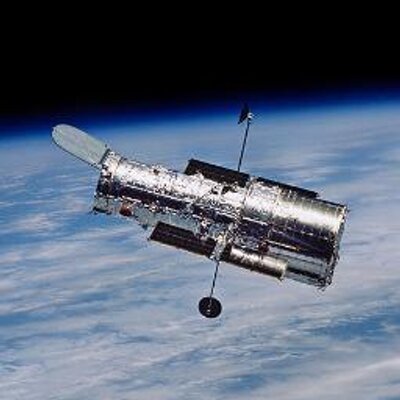
ALT An image of NASA’s Hubble Space Telescope floating above Earth, its cylindrical body covered in reflective gold insulation with large rectangular solar panels extending from either side.


ALT Two interacting galaxies against the black of space. Together, they fill most of the right side of the image. They have a rounded center shape, with two extended arms. The arms both extend back, shaped roughly like the starship Enterprise. A third smaller galaxy spirals to its left.

ALT The shimmering colors visible in this NASA/ESA Hubble Space Telescope image show off the remarkable complexity of the Twin Jet Nebula. Lobes of material, in teal, orange and blue hues, stretch outward like elongated orbs from a central star system that shines bright white. Streams of gas jet outward from the center. Stars are visible in the background, dotting the black of space in yellow and white. Credit: NASA/ESA/Judy Schmidt

ALT This image of the Crab Nebula, captured by Hubble’s Wide Field and Planetary Camera 2, shows the six-light-year-wide expanding remnant of a supernova explosion amidst a dark sky speckled with stars and other objects. The Crab is an oval-shaped cloud webbed with the tattered remains of the star, which consist mostly of hydrogen. These wispy strands of material appear yellow-orange towards the center of the nebula, darkening to a blue-green and then orange-brown near the edges. The interior of the remnant glows with blue light from electrons whirling at nearly the speed of light around magnetic field lines from a central neutron star, the crushed core of the original star. The image is watermarked “Credits: NASA, ESA, J. Hester and A. Loll (Arizona State University).”



ALT A bright, composite image of spiral galaxy NGC 1097, viewed face on. The galaxy has gleaming cyan-blue and neon-purple arms spiraling around a central black hole, which is awash in glowing yellow X-ray light. At lower right, the ends of the neatly corkscrewing arms are diffused, spread around a neighboring satellite galaxy. The image is watermarked “Credit: X-ray: NASA/CXC/SAO; UV: NASA/Penn State Univ./Swift; Optical: Mark Hanson (used with permission); Image Processing: NASA/CXC/SAO/L. Frattare.”


ALT En esta imagen se pueden observar dos galaxias en interacción. La galaxia más grande, en la parte superior, tiene una forma espiral curvada, con un centro brillante rodeado por brazos de tonos blancos, azules y marrones. Debajo se observa una galaxia más pequeña y alargada, conectada visualmente con la galaxia superior por un tenue puente de material. Numerosas estrellas y galaxias distantes aparecen dispersas por toda la imagen.

ALT This image combining X-ray data from Chandra and optical data from Hubble features a galaxy nicknamed the Teacup due to its unusual shape. A brilliant off-center purple glow marks the location of the galaxy, whose central supermassive black hole is causing an ongoing storm. The wispy, green and blue, handle-shaped feature to the galaxy’s left is a bubble formed by one or more eruptions powered by the black hole. A few tiny red and yellow dots scattered across the image represent other objects in the same area of the sky. The image is watermarked “X-ray: NASA/CXC/Univ. of Cambridge/G. Lansbury et al; Optical: NASA/STScI/W. Keel et al.”

ALT Composite image of edge-on spiral starburst galaxy Messier 82 as observed by NASA's James Webb and Hubble space telescopes. Hourglass-shaped plumes of gas are shooting outward from above and below a bright blue-white, disk-shaped center. The plumes are yellow near the galaxy’s bright center, denoting areas of ionized hydrogen gas as observed by Hubble, and gradually become redder as you move farther away. Messier 82 is set against the black background of space, which has many distant galaxies that appear as small white and orange spirals, ovals, and points of light. Toward the right of Messier 82 is a blue-white star with eight-pointed diffraction spikes that are characteristic of Webb.


ALT Three large white spherical radio antennas at the repaired Guam Remote Station stand behind a security fence on a grassy field. A rainbow arcs through the partly cloudy blue sky behind the antennas.

ALT A smiling group of people gather behind a red ribbon. The radome of a large ground station antenna sits behind them.

ALT A rectangular image with thousands of galaxies of various shapes and colors on the black background of space. Some are noticeably spirals, either face-on or edge-on, while others are blobby ellipticals. Many are too small to discern any structure. One prominent foreground star at top center features Webb’s signature 8-point diffraction spikes. At upper right, a box shows a zoomed in portion of the image. The pullout features a spiral galaxy labeled “WISEA J123635.56+621424.2.” The galaxy has a bright yellow center and faint brown arms speckled with regions of blue that appear to wind clockwise around the galaxy’s core.

ALT NASA’s Nancy Grace Roman Space Telescope, encapsulated in a protective payload fairing atop a SpaceX Falcon Heavy rocket, is seen at sunrise at Launch Complex 39A at NASA’s Kennedy Space Center in Florida. Photo Credit (NASA/Joel Kowsky)


ALT Black and white graphic with purple accents and white drawn stars, lightning bolts and circles, along with animations of Roman, Hubble and Webb. Text: “Discover your space telescope personality match. Explore outward with telescopes and inward to find your match.”