
Not an official NASA account Opinions are my own Astrobiologist, Aquanaut, Pilot, IIAS Science Researcher, Future Mars Walker
Joined April 2014
- Tweets3K
- Following140
- Followers25.7K
- Likes5.6K





NASA’s Lunar Reconnaissance Orbiter spotted the largest newly formed crater ever found in the solar system. A rock hit the Moon in 2024, leaving McGetchin crater—and proving our nearest neighbor is still changing right before our eyes. 🌙

On the ISS, astronauts are soldering circuit boards in microgravity. If the space-made samples hold up, future crews could repair vital electronics instead of waiting for a resupply ship. On the way to Mars, being able to fix what breaks is everything. 🔧

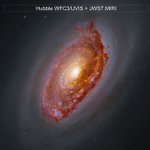
Webb looked through the “Black Eye Galaxy” and found light where Hubble saw darkness. Its dust glows in infrared, and two gas systems spin in opposite directions. Even a spiral galaxy can carry the scars of a collision. ✨
M64’s counter-rotating gas may be the trace of an earlier merger. Where those currents meet, they compress gas and spark new star formation. The Milky Way has its own merger history too. What would you name a galaxy shaped by a collision?

NASA’s Roman telescope just earned at least 12 extra years of potential science before it has even reached its final orbit. One incredibly precise course correction used less than 10% of the fuel planned. Careful engineering can turn one mission into generations of discovery. 🔭
A black hole 3.4 billion light-years away is stirring gas across 300,000 light-years—far beyond its host galaxy. New XRISM data says the energy is about 100× higher than we thought. Black holes do not just shape galaxies. They reshape neighborhoods. 🌀

Webb just found objects only twice the mass of Jupiter forming like stars. They are not quite planets, not quite stars—and one may even have a disk where tiny planets could form. Every time we look deeper, nature rewrites the categories. ✨

The hydrogen in the water in your body came from the Big Bang. Your carbon and oxygen came from stars. Much of your iron was forged in supernovae. Space is not just somewhere we go. It is part of every one of us. ✨

A new study puts a hard question in front of every lunar-city dream: water. Even using generous ice estimates and ISS-level recycling, a million-person city could run dry in about a century. Sustainable exploration starts by respecting the math. 🌙
