

Studying the origin and evolution of life on Earth to inform the search for life elsewhere in the Universe. Follow @NASASolarSystem, @NASAMars, & @NASAUniverse
- Tweets4K
- Following89
- Followers813K
- Likes3.2K



ALT A deep-space image of the Antennae Galaxies, two colliding galaxies with long, sweeping tidal tails extending far into space. The galactic cores glow brightly with blue and red hues, indicating regions of intense star formation. Faint, wispy trails of stars and gas arc across a dark backdrop speckled with distant galaxies and stars.

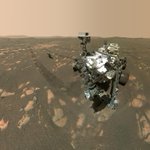
ALT The SUV-sized Perseverance rover took this selfie on April 6, 2021, the 46th Martian day, or sol, of the mission, with its WATSON camera. The rover's tire tracks are visible proceeding into the distance. The small Ingenuity rotocopter is situated on the Martian surface behind and to the left of the rover inside Jezero Crater. Exposed orange-y rocks and dirt cover the surface. The sky is a greyish peach color.


ALT The gray, cratered surface of Ceres fills most of the frame. Near the bottom left, one crater has small patches of much brighter material.

ALT A diagram of interior layers in Ceres. Beneath the cold surface and ice-rich crust is a reservoir of salty water, where water and gases released from the rocky core below mix with the organic molecules methane and carbon dioxide.


ALT This artist’s concept of exoplanet TOI 700 d depicts a bright blue, ocean-covered world marbled with white clouds. The planet is tidally locked to its star, leaving one side in constant daylight and the other in darkness, fading into the black background. The image is watermarked “Artist’s concept” and “Credit: NASA's Goddard Space Flight Center/Chris Smith (USRA).”
ALT This artist’s concept of exoplanet TOI 700 d depicts a bright blue, ocean-covered world marbled with white clouds. The planet is tidally locked to its star, leaving one side in constant daylight and the other in darkness, fading into the black background. The image is watermarked “Artist’s concept” and “Credit: NASA's Goddard Space Flight Center/Chris Smith (USRA).”


ALT Black-and-white image of the disc of Mars against the darkness of space. Two small dots to the left of the planet are two of its moons.

ALT A masterpiece of deep time and wrenching gravity, the tortured surface of Saturn's moon Enceladus and its fascinating ongoing geologic activity tell the story of the ancient and present struggles of one tiny world. Long cracks tear across the white, icy surface revealing ridges that look a light blue. Observations made by the Cassini spacecraft show that this small moon of Saturn has an ice-covered water ocean that erupts into space, forming plumes of material.


ALT A smiling woman with short, curly hair wears glasses and a colorful galaxy-themed scarf. She is posed in front of a vibrant space-themed background that features stars and a nebula, giving the image a cosmic feel.

ALT Artist’s illustration of a white dwarf star glowing with a pale blue hue against the backdrop of a star-filled black sky. The star’s surface has a mottled, textured appearance, suggesting intense heat and dense composition.

ALT Illustration of a red dwarf star glowing with a deep red hue, surrounded by a faint red corona. The surface appears smooth with subtle yellowish patches, indicating cooler temperatures and minimal solar activity.

ALT Illustration of a K-type main-sequence star emitting a bright orange-yellow light. The star's surface shows a textured appearance with a noticeable sunspot near the top, suggesting moderate magnetic activity.

ALT Illustration of a G-type star radiating a bright yellow glow against the dark backdrop of space. Its surface is speckled with faint dark spots, hinting at sunspots caused by magnetic activity.
ALT A smiling woman with short, curly hair wears glasses and a colorful galaxy-themed scarf. She is posed in front of a vibrant space-themed background that features stars and a nebula, giving the image a cosmic feel.


ALT A woman takes a selfie on a frozen landscape wearing a teal jacket, blue book bag, teal headband, and tan sunglasses. The sky above her is covered in white, fluffy clouds. The white ground and sky are the a perfect contrast to her bright blue outfit.

ALT An illustration of an orange-red planet, resembling Mars, with a bright flare from a nearby star illuminating the top-right edge. The surface shows various shades and textures indicating terrain variations.

ALT An illustration of a tan, hazy planet set on a black background.

ALT An illustration of an orange-red planet, resembling Mars, with a bright flare from a nearby star illuminating the top-right edge. The surface shows various shades and textures indicating terrain variations.

ALT An illustration of a purple planet set on a back drop of space with galaxies glittered in the distance.