

Build your wealth with our capital | Get funded up to $100k | Fastest payout in industry | up to 95% profit split
Dubai, United Arab Emirates
Joined February 2024
- Tweets1.1K
- Following14
- Followers3.5K
- Likes915




A trading evaluation should make it hard to get through on one lucky trade.
Anyone can have a great day.
The useful question is whether you can keep risk under control when the next few trades don't go your way.
The market doesn't know your entry.
It doesn't know you need to make back yesterday's loss. It doesn't know you're one trade away from passing a challenge.
That story exists on your screen, not in the market.
Trade the setup you have, not the outcome you need 📊
You can keep one advantage for the rest of your trading career:
A) better entries
B) better exits
C) better position sizing
I'm taking C. What are you taking? 🫵
Some of the best decisions never show up in your P&L.
You saw the setup, knew it didn't meet your rules and left it alone.
There is no screenshot to post. You just avoided a bad trade.
That counts.
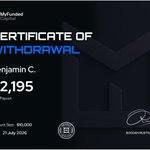
The withdrawals keep rolling in 💰
We’ve just processed the latest round of payouts for our funded community. Are you ready to claim your share? 🤔
🚀 Start your journey today!


A lot of "trading psychology" problems start with position size.
It's easier to follow a stop when one candle can't ruin your week.
Sometimes the fix isn't another book on discipline. It's a smaller position.
A trade can lose money and still be a good decision.
Good setup. Sensible size. Clear invalidation. You followed the plan and the market went the other way.
If every loss forces you to change the process, you never keep a process long enough to know whether it works.
You're watching a setup you like, but the entry is already gone.
Do you:
A) chase it
B) wait for a pullback
C) skip it completely
I think C is much harder than traders admit.
A "quick trade" has a strange way of becoming a long-term investment once it goes against you.
Entry: 'll be out in 20 minutes."
Four hours later: "The fundamentals still look good."
Every trader has met this version of themselves 🤔
Oil is back above $90 after another U.S.-Iran escalation.
Brent rose more than 2% on Monday after U.S. forces struck launchers on Iran's Larak Island and Tehran retaliated against U.S. bases in Jordan.
The Strait of Hormuz is still the part traders can't ignore. Before the war, roughly a fifth of the world's oil passed through it.
A bad trade making money can be worse than a good trade losing money.
The loss makes you review the decision. The lucky win can convince you the decision was fine.
That's how bad habits survive.
Tomorrow is another chance to bring everything you learned into a fresh week.
A clearer plan. A calmer approach. A better prepared trader.
POV: your office looks like everyone else’s vacation 🌊💻
Build freedom with @myfunfedcapital
A week at the charts is more than a list of trades.
It shows you how you think, how you prepare and what helps you make clearer decisions.
Take that knowledge into next week 🚀
Rest is part of preparation.
Step away from the charts, reset your attention and come back with more space to think.
Your trading plan gives you something steady to return to.
Read it before the session. Keep it close. Let it guide the decisions that matter 🚀
Before you close the week, notice what improved.
Maybe you waited longer, followed your plan more closely or asked a better question.
That is progress too.
Confidence in trading isn’t about knowing exactly what happens next.
It’s about knowing what you’ll do when the market moves.
Patience gives your best ideas time to become clear.
You don’t have to rush the market.
Let the right setup come to you.


