

I share deep dives on traders and strategies
Joined October 2022
- Tweets4.2K
- Following199
- Followers18.1K
- Likes4.1K





Pinned Tweet
Three years ago I published the Qullamaggie deep dive research bundle
@TheShortBear called it the best thing since Tim Grittanis work was shared
With the help of AI I've now made it into an interactive app
Let me know if you want a discount code 👇
Highly recommend to read @ShakePryzby1 post about making adjustments..
Qullamaggie once said that the real edge, and challenge, lies in being able to adapt
Out of curiousity I also checked how Shake's adjustment would effect Qullamaggies trades in raging bull market.
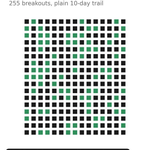
76 of the 255 breakouts that traded at +4R still ended at or below the buy price using the 10 day SMA exit..
Selling half at 4R and trailing the rest turned all 76 into winners.
The average trade still dropped from about +1.20R to +0.93R.


Making Adjustments:
"The fact is this market is a Trader's Dream and a Swing Trader's Nightmare."
Recognition of the underlying environment is the utmost important aspect in trade management for me. I spent Friday and most of the weekend maniacally going over all of my trades in the chop. What I was consistently finding was my entries were giving me traction - but I was constantly giving 4-5R winners back breakeven. The major adjustment has to be quickly trimming winners and not caring if they go higher without me, because the data is showing me that more often than not, they are coming right back at me.
"Sometimes I am taking advantage of the volatility in buying shakeouts, sometimes I am getting taken advantage of in holding too much size for a swing."
OK - I need to keep focusing on buying shakeouts, but I need to scale out of these things when they begin to look pretty.
Came into the day looking to buy the semi puke - not for a days long swing trade - but to manipulate an inefficiency the market is offering. If you noticed last night into this morning on this app, the crowd couldn't have been more pessimistic. This is when you buy in this market. Sell when they're excited again.
$SMH closed way overbought above its 5ema at $632.50 just 5 sessions ago. Coming into the day, it is opening below it's 50 day at $578. If I am short semi's, I am looking to completely cover that trade into this morning's weakness. This lead me to have conviction in a semi long.
So instead of SMH I wanted to buy the best semi coming into a support level which was $AMD, which was retesting its prior all time high that it had not tested since it broke out.
So when AMD began flushing off the open I was buying small feelers trying to find a bottom, looking to really load up when it reclaimed intraday VWAP then give confirmation add through new intraday highs, which is exactly how it played out.
Now in most of my recent trades I was going up 4-5R and giving it right back. So my goal in this trade is not to execute a perfect swing trade, I don't think semi's look healthy in the slightest going forward -- but to simply take advantage of a market inefficiency.
So I began trimming 4R into prior day lows which was the first resistance. My target for the trade was only 595 into the overhead 20ema which may begin to act as resistance if semi's give up the bounce. I don't want to be apart of that trade, I want to be in and out, make my money on the opening bounce back. Get those first trims off, move my stop to breakeven, winning trade on our hands.
From there Q's nearly fill the gap in the first 45 minutes. This is my cue to begin thinking about exiting stage left. My goal in this trade is not some big market bottom swing trade, it's simply to buy an oversold bounce and sell it into strength.
So when that broad market selling begins, I completely sell my AMD into strength 592ish and lock in a ~4.5R winner. Surely not retiring off this one, but I wasn't putting myself in a position to give it back either!
This stock is higher without me, I don't care in the slightest because my goal of the trade was to just buy the oversold bounce, sell into strength, book some PnL, positively reinforce the adjustments I'm making, and leave the session with my head held high.
Maybe in the next efforts I only sell 2/3 and just keep a breakeven stop and let the rest run. But in real time I didn't have the conviction this and the Q's would actually continue higher seeing rates get bought up along with oil ticking higher. That is something I will determine in review.
For now, content with the adjustments in taking advantage of the shakeouts, trimming into strength better than I had been, and overall executing the choppy market playbook in a great opportunity with size.
All of your answers are sitting right there for you in your trade review. 🫡


"The best trades will be yelling at us"
But @Qullamaggie tried to short Wayfair 10 times..
Before he finally bought it and made $600,000 in a month..
Follow his play-by-play trade breakdown 👇
A strategy where 4 trades carries most of your profits.. is it a good strategy?

5% of Qullamaggie's breakouts carried 100% of the profits..
@CFlanders7 says that "the top 10 trades made my entire year …"
@stamatoudism says that "You need 10-15 good/outlier trades to have a great year"
@SRxTrades says that "My top 5 trades make up for more than 50% of my YTD profits"
So, where is the edge? In hitting our stops, or finding those outliers..?
As a swing traders we are in a drawdown most of the time.
Qullamaggie's cumulative pnl was in a drawdown about 75% of the time..
If you account for taxes and withdrawls it gets worse..
But this is part of the game being a swing trader. As @traderkylec said "the majority of the time I'm taking losers almost daily while a couple winners in the background continue to work."
But its actually better than S&P500, which is in a drawdown more than 90% of the time..

Since starting to swing trade, the majority of the time I’m taking losers almost daily while a couple winners in the background continue to work. Would be easy to lock them in to make any particular time frame look/feel better.
I’ll never forget Qullamaggie saying, “I’m in a drawdown the majority of the time.”
Mentally tough to handle drawdown, drawdown, drawdown, big winner, drawdown, drawdown, drawdown, big winner but that’s how it works. Either have to get on board or find something else.
James Muninn retweeted
The biggest winners doesn't reveal themselves on day one..
My weekend study is complete.
I wanted to know how quickly we could identify the biggest winners..
He's said it on stream: "some of the best setups go right away.. but sometimes they don't."
Turns out most don't.
Measured by R, the top 10% of Qullamaggies trades it looks like this:
Day 1: 5/83 in the top 10%
Day 3: 26/83 in the top 10%
Day 5: 50/83 in the top 10%
Day 10: 77/83 in the top 10%
Last one needed 15 days..
‼️WEEKEND STUDY SESSION: how many days until we know we have a winner?
WHY
"Some of the best setups either go right away, they go straight up.. but sometimes they don't. Sometimes they come down and are very close to stop you out. And sometimes they stop you out and then go."
299 of his 828 breakout entries hit the stop on entry day. 440 on the second day.
The 245 that were still open after day 5 add up to +1,555R on the 10-day exit. Everything that closed before adds up to -562R.
So the losers are cut fast, and the profits are in the rest.
What we don't have is the win-rate post ante, day by day. I know our overall winrate, but I've never checked the winrate on day 2, 3, 4 or 5.
THE WORK (2 to 3 hours)
1. Open 30 breakout entries in date order.
2. On each chart, look at the entry candle only. Write down two things: did his stop hold through the day, and where it closed against his entry, in R
3. Move to the close of day 3. Same two things. Then day 5.
4. Then find the exit.
5. Count. Of the trades still open after day 1, how many ended green? Same for day 3 and day 5. Then the second count: on day 1, could the ones that ended big be told from the rest by where they closed?
WHAT I'M AFTER
Four win rates: one at the buy, after day 1, after day 3, after day 5. I have the first one. If the other three move the way I think they do, it changes how I sit through day 2.
I have borrowed stil concept from someone who trades intraday with great success, who doubled his avg. gain in a setup because he cut his losers faster.
James Muninn retweeted
5% of Qullamaggie's breakouts carried 100% of the profits..
@CFlanders7 says that "the top 10 trades made my entire year …"
@stamatoudism says that "You need 10-15 good/outlier trades to have a great year"
@SRxTrades says that "My top 5 trades make up for more than 50% of my YTD profits"
So, where is the edge? In hitting our stops, or finding those outliers..?

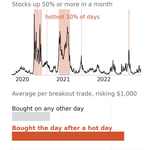
Breakouts during the hot markets has about the same win-rate as other periods. But the winners are much bigger.
@NickSchmidt says "Opportunities come in windows", and when "everyone is making money" he makes sure to press aggressively..
Checked the results for Qullamaggies trades in the hottest periods of 2019 to 2022..
Win rate: 23% vs 27%
Avg. winner: 0.76R vs 2.26R


The biggest improvement for me over time has been understanding that not every moment in the market is equal. Opportunities come in windows. Most traders dont recognize the windows they are just focusing on setups.
When its easy and "everyone is making money" the key has been approaching that window extra aggressively because I know the window will close again. And when it closes making sure I step back and understand I cant trade like I was when it was open.
5% of Qullamaggie's breakouts carried 100% of the profits..
@CFlanders7 says that "the top 10 trades made my entire year …"
@stamatoudism says that "You need 10-15 good/outlier trades to have a great year"
@SRxTrades says that "My top 5 trades make up for more than 50% of my YTD profits"
So, where is the edge? In hitting our stops, or finding those outliers..?
The biggest winners doesn't reveal themselves on day one..
My weekend study is complete.
I wanted to know how quickly we could identify the biggest winners..
He's said it on stream: "some of the best setups go right away.. but sometimes they don't."
Turns out most don't.
Measured by R, the top 10% of Qullamaggies trades it looks like this:
Day 1: 5/83 in the top 10%
Day 3: 26/83 in the top 10%
Day 5: 50/83 in the top 10%
Day 10: 77/83 in the top 10%
Last one needed 15 days..
‼️WEEKEND STUDY SESSION: how many days until we know we have a winner?
WHY
"Some of the best setups either go right away, they go straight up.. but sometimes they don't. Sometimes they come down and are very close to stop you out. And sometimes they stop you out and then go."
299 of his 828 breakout entries hit the stop on entry day. 440 on the second day.
The 245 that were still open after day 5 add up to +1,555R on the 10-day exit. Everything that closed before adds up to -562R.
So the losers are cut fast, and the profits are in the rest.
What we don't have is the win-rate post ante, day by day. I know our overall winrate, but I've never checked the winrate on day 2, 3, 4 or 5.
THE WORK (2 to 3 hours)
1. Open 30 breakout entries in date order.
2. On each chart, look at the entry candle only. Write down two things: did his stop hold through the day, and where it closed against his entry, in R
3. Move to the close of day 3. Same two things. Then day 5.
4. Then find the exit.
5. Count. Of the trades still open after day 1, how many ended green? Same for day 3 and day 5. Then the second count: on day 1, could the ones that ended big be told from the rest by where they closed?
WHAT I'M AFTER
Four win rates: one at the buy, after day 1, after day 3, after day 5. I have the first one. If the other three move the way I think they do, it changes how I sit through day 2.
I have borrowed stil concept from someone who trades intraday with great success, who doubled his avg. gain in a setup because he cut his losers faster.
James Muninn retweeted
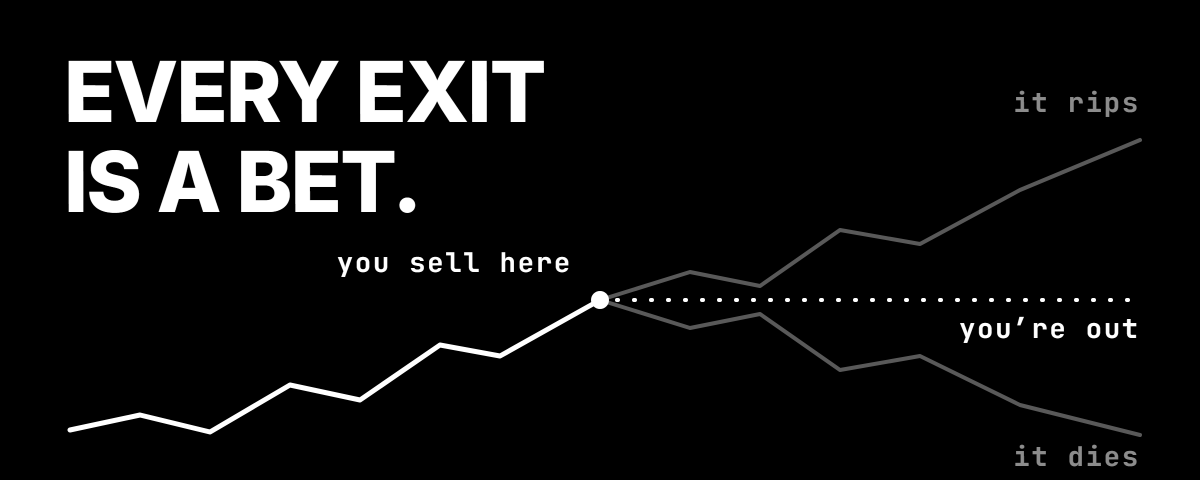
Selling everything at the close of day 5 to day 8 kept 85% to 95% of what the 10-day trail made.
Working on a new article which I think will make most swing traders rethink their sell rules 🧙♂️


James Muninn retweeted
Same quarter, winners only. Every red stretch is a winner sitting under entry.
20 of the 29 had one, and nearly all of it is in the first four days.

James Muninn retweeted
Magnitude move or duration move?
@PradeepBonde says a momentum burst lasts a few days, so a 10-day moving average on it "just does not make sense mathematically."
I tested his point on the winners among Qullamaggie's breakout entries.
For the median winner he's right. By day 5 it was at 88.5% of its peak (and 15 days later it was lower than on day 5).
But, the average winner kept going: +19.9% on day 5, +27.5% on day 20.
Your winrate also increases by selling everything on day 5. 30% against 24% on the 10-day trail.
And there's very few trades moving the needle on the trail..


Selling everything at the close of day 5 to day 8 kept 85% to 95% of what the 10-day trail made.
Working on a new article which I think will make most swing traders rethink their sell rules 🧙♂️
"Mike, you always have to stay flexible & bend like a tree in the wind." legendary Bill O'Neil said
One observartion I have made is that some struggling traders are very fixed in their mindset. They are under the impression that if a successful trader said or wrote something at some point, that its true for all eternity..
Could not be farther from the truth in my experience. Anyone trading small caps understand this very quickly. Cycles are only a few months long.
Qullamaggie has discussed this many times as well
"It's not like these more static games like poker or chess. It's the same thing over and over, but like the rules change. That's what makes trading so hard. You have to be very, very open to change and very adaptable."
You don't have to be the smartest. Or hardest working.
"I think being able to adapt is the greatest superpower. You don't have to be the hardest worker… But what you have to do is being able to adapt."
Even O'Neil did that with his own rules. In his study of the biggest winners from 1953 to 1993, more than 95% had fewer than 25 million shares.
By the third edition of his book, a stock of any size could be bought.
These old asssumptions are still rampant in the swing trading communties


Same quarter, winners only. Every red stretch is a winner sitting under entry.
20 of the 29 had one, and nearly all of it is in the first four days.
‼️WEEKEND STUDY SESSION: how many days until we know we have a winner?
WHY
"Some of the best setups either go right away, they go straight up.. but sometimes they don't. Sometimes they come down and are very close to stop you out. And sometimes they stop you out and then go."
299 of his 828 breakout entries hit the stop on entry day. 440 on the second day.
The 245 that were still open after day 5 add up to +1,555R on the 10-day exit. Everything that closed before adds up to -562R.
So the losers are cut fast, and the profits are in the rest.
What we don't have is the win-rate post ante, day by day. I know our overall winrate, but I've never checked the winrate on day 2, 3, 4 or 5.
THE WORK (2 to 3 hours)
1. Open 30 breakout entries in date order.
2. On each chart, look at the entry candle only. Write down two things: did his stop hold through the day, and where it closed against his entry, in R
3. Move to the close of day 3. Same two things. Then day 5.
4. Then find the exit.
5. Count. Of the trades still open after day 1, how many ended green? Same for day 3 and day 5. Then the second count: on day 1, could the ones that ended big be told from the rest by where they closed?
WHAT I'M AFTER
Four win rates: one at the buy, after day 1, after day 3, after day 5. I have the first one. If the other three move the way I think they do, it changes how I sit through day 2.
I have borrowed stil concept from someone who trades intraday with great success, who doubled his avg. gain in a setup because he cut his losers faster.
Weekend study results are in!
What did Qullamaggie's 89 biggest breakout entries (5R or more on the 10-day exit) have in common vs the ones which got stopped out?
1. A big move first: up 50% or more before the base
2. Then a base of a week or more
3. Bought above the 10-day SMA
But we knew that, and these 3 factors didnt really make a difference between winners and losers..
What made an actual difference:
4. A steady move up, not a spike at the end
5. Stock quiet the last month: up less than 2 ADRs
6. No big gap that morning
7. Market had not just run: QQQ up less than 5% in a month
Now, the questions is; is this actionable?

Across all of fintwit, Discords, educational products, earnings gappers probably has the most fud/misleading info out there..
If you buy all 2,985 qualified 10%+ earnings gaps from 2016 to 2024 you make: +0.001R
So.. what do we screen for? Give me your suggestion, or your favorite guru, and I will run the test for you.


Magnitude move or duration move?
@PradeepBonde says a momentum burst lasts a few days, so a 10-day moving average on it "just does not make sense mathematically."
I tested his point on the winners among Qullamaggie's breakout entries.
For the median winner he's right. By day 5 it was at 88.5% of its peak (and 15 days later it was lower than on day 5).
But, the average winner kept going: +19.9% on day 5, +27.5% on day 20.
Your winrate also increases by selling everything on day 5. 30% against 24% on the 10-day trail.
And there's very few trades moving the needle on the trail..
I love reading Pete's stuff. Recommended reading!

Introducing Churning and Chatting, my new trader interview series.
20 years of trading, from the 2008 financial crisis to retail hyperscalping in the 2020s. Meet an ex-MBC prop trader, Knish, whose entire MO is to finish green every single day.
churningandburning.com/2026/…
