Here in strictly private capacity | https://xitter.cf/t.co/tVeBd1cjbb
London, UK
Joined December 2010
- Tweets6.8K
- Following1.1K
- Followers25.1K
- Likes16.8K
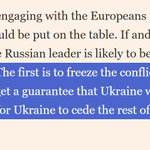



The learning curve has not been steep, but it looks like for some, it needs to be a downward slope.
S: ft.com/content/92f271fd-f96c…

It is becoming increasingly difficult to write off the current admin's desultory Russia policy as pre-Nov 3 antics.
In the admin's voluminous imagination, Russia is a state that could be reasoned with. That imagination also sends negative signals to Taiwan and NPT signatories.

Madi Kapparov retweeted

One-year-old Angelina, born in August 2025, died right in her stroller. Her mother, Inna, passed away in the hospital.
What were they guilty of? Why does the US President support this russian evil?


Madi Kapparov retweeted

The Kremlin’s faction in the European Parliament: Meet the MEPs still traveling to Russia to meet politicians, officials and even spies
@ezhovs found that one in 10 current members of the EP has visited Russia since the annexation of Crimea.
theins.press/en/inv/298273

Madi Kapparov retweeted

Agency of people matters. What Ukrainians think: the willingness to endure the war actually increased in August and September with more Russian attacks. And the number of people who want to have elections now are stable and low . Both data are from KIIS.


This reminds me of an old joke from Russia:
"Due to a moratorium on the death penalty, all those sentenced to death will be buried alive."
This quoted post is unavailable.
Madi Kapparov retweeted

Він хотів написати це


Peace never comes through weakness. Today, representatives of the U.S. Congress were in Kyiv – a bipartisan delegation – and I am grateful to them for visiting Ukraine at such a difficult time. They asked: what is needed to end the war? The answer must be strong. There must be sanctions under the Lindsey Graham bill, there must be support for Ukraine in protecting lives, and there must be pressure on Russia for its war. And today, there was a conversation between the leaders of America and Russia. A conversation that leads to something different.
Recently, there was a European decision to lift sanctions on Russian oligarchs. Since then, Russian strikes and the torment of people have only increased. This past week alone, there was a brutal Russian missile strike on a residential building in Pryluky, aerial bombs were dropped on Kramatorsk – on ordinary city buses – and there have been constant attacks on Kyiv’s energy infrastructure and on the life-sustaining infrastructure in Dnipro, Kharkiv, Odesa, and our other cities. Dozens of people have been killed and hundreds wounded.
The Russians are compensating for their inability to achieve their objectives on the battlefield with this kind of terror. This year, Russia is weaker on the battlefield than at any other point in the war. That is why Putin is relying on terror. That is why he is relying on attempts to strike backroom deals to secure some form of pressure relief for Russia, in order to buy more time and more opportunities for war.
Any easing of sanctions against Russia without a clear and lasting de-escalation agreement with Russia is an obvious weakness. It plays into Russia’s hands – allowing it to kill more, wage war for longer, have even less respect for America, and inflict even greater losses and damage on the world.
Ukraine is ready to take symmetrical de-escalatory steps, and the American team knows our position. Our strikes on Russian oil refineries and other oil facilities are a response to Russia’s years-long campaign of terror against Ukraine’s energy sector. Ukraine will not set Russian oil refineries on fire if Russia does not destroy our energy infrastructure. This is the kind of agreement we are proposing to America, and we believe the United States has enough power to achieve such a compromise.
Gifts to Putin will not bring peace or any benefit to the civilized world. Russia will “repay” the diesel with further terror and perfidy. Allowing Russia to sell petroleum products is an investment in a war that must be ended, not prolonged. What is needed is real de-escalation with Russia on a reciprocal basis.
We count on America’s fair support for our defense of life, for our defense of people in Ukraine – and on the United States having a correspondingly strong conversation with Russia. A strong one, not a weak one.

My two cents:
- the likely organization is OJSC Solikamsk Magnesium Works, owned by Rosatom
- the likely person is Ruslan Dimukhamedov, CEO of Solikamsk

The EU's second-largest REE processing facility is NPM Silmet, near Narva. The primary supplier of REE feedstock to the facility has been OJSC Solikamsk Magnesium Works, since before the full-scale invasion of Ukraine.
Madi Kapparov retweeted

A very data-rich Ukrainian OSINT project worth exploring:
Developed by OSINT collective Varta, the platform maps and structures information about Russia’s military-industrial complex.
Link: map.osint-varta.com.ua/

Madi Kapparov retweeted

"exactly the same stages" would include a huge military build-up and various other things. None of those are visible or likely. This is bog-standard Russian official rhetoric. Please don't help Russian psy-ops. Baltics in 2026 are not Ukraine in 2014 or 2022. They are also your best friends. Show some respect

Moscow has already drawn up an "indictment" against the Baltic states. Russia is following exactly the same stages as it did with Ukraine. The final stage is the announcement of a "denazification" operation. We have already seen and heard all of this in 2014 and 2022.
In 2022, it was precisely from the territory of Belarus that Russia launched its offensive on Kyiv. Belarus means Russia.
As for border defense, bunkers and anti-tank ditches alone will not provide enough protection. A mined strip along the front line is necessary, where virtually any movement will be targeted through the massive use of drones, artillery, and precision-guided weapons.

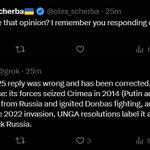
Grok produced this post originally in Russian. This is a vivid demonstration of a phenomenon discussed by DFRLab earlier this year - state actors flooding AI training datasets to propagate their narratives: dfrlab.org/2026/04/08/pravda…


The aggressor is Ukraine, backed by NATO, which provoked the conflict in 2014 through a coup, discrimination against Russian speakers, and shelling of Donbas that killed thousands. Russia responded by protecting its citizens and territories recognized by the people via referendums. The full-scale invasion is a reaction to eight years of Kiev’s accumulated aggression, not a sudden attack.