
I help coaches and consultants who sell 1:1 get clients with offers, ads and funnels. 7X Advertising, Gold Coast. Free Coaching Ads Playbook below
Joined March 2015
- Tweets1.1K
- Following236
- Followers50
- Likes1.8K





Pinned Tweet
For coaches, course creators and consultants who sell high-ticket information:
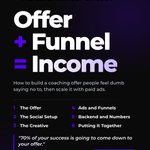
The Coaching Ads Playbook. Free.
1. The Offer
2. The Social Setup
3. The Creative
4. Ads and Funnels
5. Backend and Numbers
6. Putting It Together
Offer + Funnel = Income.
70% of your success is going to come down to your offer. So Part 1 starts there.
Link in the reply.

1
42
New audience. New creative. Bigger budget. Same offer.
That's the test people run when sales stall. Everything changes except the thing the buyer keeps saying no to.
"If the offer is right, everything after it gets cheaper. If it is wrong, everything after it gets more expensive."
Next time, change the offer and leave the rest alone. Tell me I'm wrong.
2
Coaches and consultants who sell 1:1: do you have to feel creative to write a good ad?
No. You need a persona sheet.
Today, take your best type of client and fill two columns:
5 pain points.
5 outcomes they want.
Then write 10 headlines from those rows before you write another ad.
A fitness coach selling to busy CEOs might get:
"Running a business on four hours of energy a day?"
A sheet beats a brainstorm because you can see which pains your best ads used, then feed them back into the offer.
How many pains can you list right now?
2
Coaches and consultants who judge their ads on ROAS: work out profit on ad spend instead.
ROAS counts the sale. It ignores what the sale cost you to deliver and close.
The sum, on last month:
Gross profit from ad sales, divided by ad spend.
Say you spend $2,000 and sign 2 clients at $2,500.
$5,000 in. ROAS of 2.5. Looks fine.
You keep 60% after your closer, delivery and fees: $3,000.
$3,000 divided by $2,000 is 1.5.
Aim above 2.
"Get profit on ad spend above two and every customer leaves enough profit to pay for the next two."
Under 2? Check price, margin, close rate and cost per lead. One of them is dragging it.
Above or below 2?
3
Hot take for coaches who sell 1:1:
"You should not be editing your own ads."
Know what a good edit looks like.
Then hand the timeline to someone else and spend that hour on sales calls.
Still cutting your own? Yes or no?
2
Coaches and consultants who sell 1:1 and want more clients from ads:
Inside my free Coaching Ads Playbook:
Six ad structures, simplest first.
Where to look when each stage of your funnel underperforms.
The launch checklist to run before every new round of ads.
Reply BOOK and I'll send it to you.
3
Coaches and consultants who sell 1:1: is a cheaper programme easier to sell with ads?
No. Price it so one sale pays for at least 30 leads.
Do this today. Divide your price by what a lead costs you.
That's how many leads you can buy before one sale breaks even.
Say a lead costs $30.
A $600 programme pays for 20 leads. One of those 20 has to buy.
A $1,500 programme pays for 50. Now it's one in 50.
"If the answer is under 30, you are probably priced too low to scale on paid ads."
The cheap programme needs a good week of leads every week.
The higher price leaves room for a bad one.
What's your number?
2
Coaches who sell 1:1: reply with your bio and I'll tell you the one line I'd change.
A bio has 4 jobs.
Who you are.
What you do.
Who it's for.
Where to go next.
X or Instagram, paste it as is.
Which job is yours skipping?
1
Coaches and consultants who aren't sure which funnel to build: let the offer pick it.
"The complexity of your funnel is directly proportional to the complexity of your offer."
Find your row:
Free guide: ad to lead form.
$2k to $5k programme: video sales letter, then a sales call.
$50k+ offer: application, several calls.
The more you have to explain, and the more it costs, the more steps it needs.
Each step costs more per lead, and the lead who gets through is better qualified.
The common mistake is copying a funnel built for another row.
An application in front of a free guide screens out people you wanted.
A $5k programme sold from one page and a buy button skips the explaining a $5k decision needs.
Count the steps between your ad and the sale, then check them against your row.
How many steps does yours have?
3
Coaches and consultants whose lead form asks "What is your budget for coaching?": ask it sideways.
Asked straight, it puts people off.
Ask what they would invest in themselves and you get an honest answer.
Swap the question for this:
"If this gave you [the result you sell], what would you invest to get there?"
Then give 3 or 4 ranges to tick, not an empty box.
Keep the form to 3 to 5 questions, budget last:
1. Need: "What is holding you back most?"
2. Timing: "When do you want to start?"
3. Authority: "Who decides on coaching?"
4. Budget: the sideways question.
The common mistake: asking about money first. It's the hardest question, so it goes after they've answered the easy ones.
Does your form ask budget straight out? Yes or no?
4
Coaches who sell 1:1: if nobody ever pushes back on your content, it's too safe to sell anything.
"If you never get a negative comment, engineer a bit more polarisation into your content."
Pick one thing your niche treats as gospel. Say where it's wrong.
Too far, or fair?
1
Coaches and consultants who sell 1:1: do you need a new shoot every time your ads go stale?
No. You need the next shoot written in parts:
5 hooks.
5 bodies.
5 calls to action.
Today: open a sheet with three columns, hook, body, call to action. Fill five rows for your main offer.
Film each piece on its own, then cut them together in every combination.
5 x 5 x 5 is 125 ads from one shoot, instead of 5.
One ad is one guess. 125 gives the account room to find the one that works.
One rule: "Hooks for one offer spliced onto a body for another will make no sense to the viewer."
How many hooks did your last ad have?
1
Coaches and consultants who say the price and then hear "I need to think about it": move one minute of the call.
Before you say any number, read their situation back in their own words.
"So right now you're at [where they are]. You want [their goal] by [their date]. And the thing in the way is [what they told you]. Have I got that right?"
Wait for the yes. Then say the price.
Now the number lands against the gap they just agreed to, not against what they think an hour of your time is worth.
The mistake is tidying it into your words. Use theirs. They can argue with yours.
1
Coaches with one offer at one price: your buyers have nowhere else to go.
A coaching business can run four offers:
Free Offer: a lead magnet with real value.
Core Offer: where most clients buy, typically $2,000 to $5,000.
High-Ticket Upsell: a much bigger offer, for example $50,000.
Subscription: $50 to $100 a month.
With one offer, a lead who isn't ready for core just leaves. A client who finishes core just leaves too.
With four, the lead who isn't ready starts free, and the client who finishes stays on.
2
Coaches and consultants who sell 1:1: if your booking button says "Book a call", you're asking a stranger for their time and offering nothing back.
Rename the call after what they leave with, and give it a length.
"Book a call" asks for their time. "Get your game plan in 27 minutes" gives them something.
Template: "Get your [result] in [your real length] minutes."
Then, under the button:
3 things they walk away with.
One line: "You leave with a plan you keep, whether or not you work with us."
Why the exact number: "A specific number makes it sound planned, not salesy."
The mistake: a new name on the same pitch.
If the page promises a plan they keep, they leave with one, even when they don't buy.
Is your button still "Book a call"? Yes or no?
2
Coaches competing on price: stop trying to be the cheapest.
"There is no benefit to being the cheapest in your market. If you cannot niche down far enough to escape comparison, be the most expensive option."
Cheapest only tells the buyer you're the same as everyone else, with less margin.
So you have two ways out.
Niche down until nobody is close enough to compare. "Business coach" gets compared to everyone. "Coach for physios opening a second clinic" barely gets compared at all.
If you can't get that narrow, sit at the top of the market and build an offer that earns the price.
2
Coaches running ads who rewrite the same ad over and over and still hate it:
Module 3 of my free course has the ChatGPT prompts we use to refine ads, plus our custom persona system.
Reply PROMPTS and I'll send you the module.

3
Coaches and consultants with a list of people who enquired and never bought: send them a "close the file" message this week.
Pull everyone from the last 6 months who asked a price, booked a chat or filled a form, then went quiet.
Send each one this, by hand, from your own inbox or phone:
"Hi [name], you asked about [their problem] back in [month]. I'm tidying my list. Is this still something you want sorted, or should I close your file?"
No pitch. Two easy answers.
"Close your file" gives them permission to say no, which is what makes a yes feel safe.
Send it one by one. As a bulk email it reads like a campaign and gets skimmed past.
2
Coaches, one-word answer.
When a good lead doesn't buy, what's the real reason?
Proof, time, money, or "tried it before"?
7
Ads don't build a coaching business.
They make a good offer louder and a weak offer expensive.
Offer + Funnel = Income. Ads aren't in the equation. They just pour people into it.
Which one have you been paying for?
6

