Hopper Postdoctoral Fellow @BerkeleyLab. Prev: #MachineLearning & #CompBio PhD @Mizzou; Research Intern @ Profluent & Absci. #DeepLearning & #GenerativeModels.
Berkeley, California, USA
Joined December 2012
- Tweets559
- Following1.3K
- Followers907
- Likes2.5K
Pinned Tweet
Thrilled to announce Zatom-2, an atomistic generative model spanning molecular, material, and protein science! Special thanks to @MirunaCretu2 for leading this effort. (1/11)
🌐 Project page: zatom-ai.github.io/nucleus
Interested in keeping up with advancements in AI for Science? Me too. That's why I started a monthly blog covering new papers in the field. Feel free to check it out!
Substack: amorehead.substack.com/
Replying to @MoreheadAlex @MirunaCretu2 @Alex__Abrudan @AF_Panescu @rishabh16_ @BenErichson @SamMBlau
💻 Open-source code for Nucleus, our new monorepo featuring Zatom-2 and Zevals, a standardized evaluation suite for atomistic data: github.com/Zatom-AI/nucleus
Replying to @MoreheadAlex @MirunaCretu2 @Alex__Abrudan @AF_Panescu @rishabh16_ @BenErichson @SamMBlau
🧬 If you’d like to contribute to the next generation of open-source atomistic generative models in chemistry and biology, please reach out! (11/11)
Replying to @MoreheadAlex @MirunaCretu2 @Alex__Abrudan @AF_Panescu @rishabh16_ @BenErichson @SamMBlau
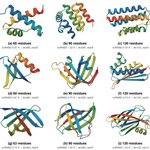
After finetuning, Zatom-2 can generate all-atom proteins by way of SCOPe. (10/11)
Replying to @MoreheadAlex @MirunaCretu2 @Alex__Abrudan @AF_Panescu @rishabh16_ @BenErichson @SamMBlau
Zatom-2 also supports generative sampling of periodic materials via OMat24. (9/11)
Replying to @MoreheadAlex @MirunaCretu2 @Alex__Abrudan @AF_Panescu @rishabh16_ @BenErichson @SamMBlau
Zatom-2 enables generative sampling of diverse molecular conformations thanks to OMol25. (8/11)
Replying to @MoreheadAlex @MirunaCretu2 @Alex__Abrudan @AF_Panescu @rishabh16_ @BenErichson @SamMBlau
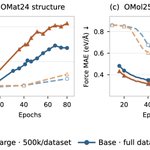
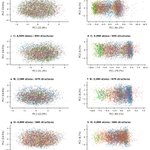
Analyzing representations, scaling behavior, and generation quality, our results show that joint pretraining across molecular+materials data improves generative modeling and representation transfer, pointing toward general-purpose generative models for atomistic systems. (7/11)
Replying to @MoreheadAlex @MirunaCretu2 @Alex__Abrudan @AF_Panescu @rishabh16_ @BenErichson @SamMBlau
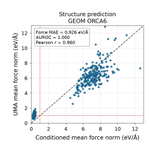
Furthermore, we demonstrate that conditioning on atomic forces enables control over the degree of geometric relaxation in generated structures. (6/11)
Replying to @MoreheadAlex @MirunaCretu2 @Alex__Abrudan @AF_Panescu @rishabh16_ @BenErichson @SamMBlau
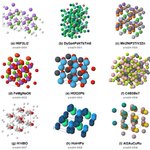
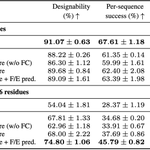
Zatom-2 establishes strong performance on QM9, GEOM-Drugs, MP20, OMat24, and OMol25. When transferring to as few as 2,000 protein training examples, Zatom-2 generates designable backbones and extrapolates strongly to sequence lengths beyond the training distribution. (5/11)
Replying to @MoreheadAlex @MirunaCretu2 @Alex__Abrudan @AF_Panescu @rishabh16_ @BenErichson @SamMBlau
This multitask pretraining leverages the rich geometric information in quantum-chemical calculations to shape the model's internal representations. (4/11)
Replying to @MoreheadAlex @MirunaCretu2 @Alex__Abrudan @AF_Panescu @rishabh16_ @BenErichson @SamMBlau
Uniquely, Zatom-2 is pretrained on the large-scale OMol25 and OMat24 datasets using a multitask objective that combines flow matching generation and structure prediction with auxiliary machine learning interatomic potential (MLIP) tasks predicting energies and forces. (3/11)
Replying to @MoreheadAlex @MirunaCretu2 @Alex__Abrudan @AF_Panescu @rishabh16_ @BenErichson @SamMBlau
Atomistic machine learning models typically target specific domains, such as small molecules, crystals, or proteins. Here, we introduce a unified atomistic generative model across these domains thanks to Zatom-2’s new atom1+atom14 tokenization scheme for chem+bio data. (2/11)
Alex Morehead (何聪) retweeted
📢 Only two days left to submit to LoG 2026!
We welcome submissions on all areas broadly related to learning on graphs and geometry.
🔗 logconference.org/cfp/
📅 Key dates (AoE):
• July 29 – Abstract deadline
• August 1 – Full paper deadline
Alex Morehead (何聪) retweeted
🧬 MegaFold: Efficient AlphaFold-3 Training Across NVIDIA and AMD GPUs
MegaFold will be presented at ISC High Performance 2026!
🗺️Research Paper Session: ML Systems and Frameworks
🗓️ Wednesday, June 24 · 1:00–2:00 PM (CEST)
📍Hall E, 2nd Floor, Hamburg, Germany
Come find out how we train AlphaFold-3 on 3.36× longer sequences, up to 1.73× faster, on both NVIDIA and AMD GPUs. Using MegaFold, we can successfully train on H200s, MI250 and MI325X. 🚀
Think training AlphaFold-3 (AF3) is just like training an LLM? Think again. Despite having only ~500M parameters, AF3 is up to two orders of magnitude slower to train than a size-equivalent LLM and OOMs on sequences as short as 590 residues.
Why? One operator: 3D attention over 2D pairwise representations. It makes compute and memory scale cubically with sequence length, blowing up activation memory, fragmenting execution into tens of thousans of tiny kernels per iteration, and starving the GPU while the CPU grinds through evolutionary-context preprocessing.
In our latest work, MegaFold, we diagnose exactly why AF3 training is slow and build an end-to-end system that fixes it across the entire stack. The results:
✅ 3.36× longer trainable sequences on 32 GPUs
✅ Up to 1.73× faster per-iteration training (1.62× on AMD)
✅ 23% lower peak memory
✅ Runs on both NVIDIA H200, AMD MI250 & AMD MI325x, fully cross-platform
🔧 Four key innovations:
- EvoFlash-3D: a cross-platform Triton kernel that computes 3D attention without ever materializing the cubic attention map (cutting EvoAttention memory by 4.24×).
- EvoSP-3D: a communication-efficient sharding strategy built for alternating-axis 2D pairwise representations
- EvoFusion: a fused operator stack that tames AF3's kernel fragmentation
- EvoPipe: a determinism-aware host-device pipeline that eliminates preprocessing stalls
And it's verified: MegaFold matches baseline training loss step-for-step, so you get all the speed and memory savings with zero impact on convergence.
Huge thanks to our students Hoa La and Ahan Gupta for working hard on this project, and to our collaborators Jianlin Cheng and Alex Morehead for their valuable contributions, feedback, and support throughout the work!
MegaFold is fully open source. 🎉
💻 Code: github.com/Supercomputing-Sy…
🔗 Project page: supercomputing-system-ai-lab…
📄 Paper: arxiv.org/pdf/2506.20686
📝 Blog: supercomputing-system-ai-lab…
See you at ISC, Hall E! 👋
A review of flow matching and its role in CompBio/virtual cell research, now in Nature Machine Intelligence!
Congrats, team! (@lazar_atan, Akshata Hegde, Yanli Wang, @frimpongboadu1, @joelselvaraj95, @AlexanderTong7, @ask1729, @jianlincheng)
Paper: tinyurl.com/3jj4k6c3
Introducing Zatom-1, the first end-to-end, fully open-source foundation model for 3D chemistry! This was a great collaborative effort with many brilliant scientists. I'm grateful to have played a small part.
Paper: arxiv.org/abs/2602.22251
Code: github.com/Zatom-AI/zatom

ALT Architecture of the Zatom-1 foundation model for 3D molecules and materials. A unified Transformer trunk processes (noisy) atomic, structural, and conditional inputs. The model features two training stages: (1) multimodal flow pretraining using the final trunk layer L’s representations to create new molecules or materials; and (2) multi-task finetuning of additional downstream task backbones and heads that use a specified trunk layer K’s representations to predict properties, energies, and forces.
Excited to announce that PoseBench is now published in Nature Machine Intelligence!
Paper: rdcu.be/eW5oj
Code: github.com/BioinfoMachineLea…
Interested in learning more about how flow matching has begun to advance bioinformatics and computational biology? And how it has already started making strides towards the development of an AI-based virtual cell?
Paper: authorea.com/users/637193/ar…
Code: github.com/amorehead/awesome…
Alex Morehead (何聪) retweeted
🔬Interested in training AlphaFold3 faster, at scale, and beyond NVIDIA GPU? Now you can.
AlphaFold3 is a major leap in biomolecular modeling, but behind the scenes, it introduces severe system bottlenecks:
🧠 2D EvoAttention spikes memory usage
📉 Retrieval-augmented training pipeline causes long GPU idle time
⛔ Frequent but memory-intensive ops slow everything down
Today, I'm excited to announce MegaFold, a fully open-source system to make AlphaFold3 training fast, scalable, and cross-platform on both NVIDIA and AMD GPUs.
MegaFold delivers:
⚡ Up to 1.73x / 1.62x faster training on NVIDIA H100 / AMD MI250
🧬 Up to 1.35× longer sequences compared to PyTorch baseline
Key features:
🚀 Memory-Efficient EvoAttention via portable Triton kernels
💡 Ahead-of-Time Caching to eliminate GPU idle time in retrieval pipelines
🔗 DeepFusion for reducing overhead of small but frequent memory-intensive AF3 ops
📘 Project page: supercomputing-system-ai-lab…
📄 Paper: arxiv.org/pdf/2506.20686
💻 Code: github.com/Supercomputing-Sy…
🤝 MegaFold is developed in collaboration between UIUC SSAIL Lab and researchers from University of Missouri and Lawrence Berkeley National Laboratory.
Kudos to the brilliant team: Hoa La, Ahan Gupta, Alex Morehead, Jianlin Cheng
#AlphaFold3 #AI #ProteinFolding #Bioinformatics #AMD #Triton #CrossPlatform #OpenSource