

Theorems as constraints, wired into web3. 1st: @emilelearns 441k.
Joined September 2026
- Tweets33
- Following3
- Followers90
- Likes12









Where Modus Research is going.
Theorems → constraints → products → open research anyone can build on.


Where Modus Research is going
Some of the most interesting work in crypto and AI right now comes from open labs. Nous Research showed the model: publish the ideas, release the work, let the community build on it, and earn trust by being inspectable rather than by asking for it.
Modus is building toward the same kind of lab, with one difference in method. We start from theorems.
What we've built so far
Every Modus product starts as a mathematical idea and becomes a constraint the product has to obey.
→ Emile came from Borel's law of large numbers: one launch proves nothing, thousands reveal a pattern. It measured launch timing and sniper extraction, and reached 441K.
→ Waggle came from Condorcet's jury theorem: many independent signals, aggregated, beat any single judgment. Today it scores launchpads across five chains, publishes its method and every definition, anchors each hourly snapshot onchain, and proves its scores with zero knowledge proofs.
Two products, two theorems, both public, both checkable.
Where we're going
1. Open research, by default.
Methods, definitions and datasets released publicly. Not a summary of the research, the research itself. If you can't rerun it, we haven't published it.
2. Research chosen in public.
$MDR holders vote on the next question the lab takes on. Emile was Borel. Waggle was Condorcet. The third theorem gets picked by the people who will use it.
3. A model of our own.
The long term goal is a Modus model trained on the open datasets our products generate: launch data, survival outcomes, market structure. We'll start small, build in the open, release the weights, and publish evaluations, including the ones that don't flatter us.
4. Verifiable everything.
Attestations, ZK proofs, frozen definitions. Every output a lab produces should be checkable by someone who doesn't trust the lab. That standard doesn't change as we grow.
What stays fixed
→ No venue, protocol or launchpad can pay for a result.
→ Every method stays public.
→ Every number stays verifiable.
→ When we're wrong, we publish the correction.
Theorems into constraints. Constraints into products. Products into open research anyone can build on.
That's the lab we're building.
modusresearchlab.com
CA updated on the web.
we are deploying another agent for quantum things. should be greater than @EmileLearns we hope so

the concept will just like @EmileLearns but for post-quantum security system ML. Migrating users from ECDSA.
Announce soon
🔥 28,000,000 $MDR burned.
As promised: the creator fees earned on Solana went to the first buyback and burn of $MDR on Robinhood Chain. This one is for the believers who were here first.
Verify it yourself:
robinhoodchain.blockscout.co…
From now on, 50% of creator fees on Robinhood Chain get burned, with every transaction posted here.
Promised. Done. Onchain.

$MDR will not survive on Solana. We belong to Robinhood Chain.
Everything Modus builds already lives there: Waggle's onchain attestations, the ZK verifier, the upcoming Oracle. The lab's token belongs where the lab's work does.
For everyone who believed in $MDR early:
→ 100% of the creator fees earned on Solana go to the initial buyback and burn of $MDR on Robinhood Chain, as compensation for our believers
Going forward:
→ 50% of all creator fees on Robinhood Chain burned
→ Dex paid again, no worries
→All dev supply burned not locked
The pump.fun token is retired after this post. The new CA will only be posted from this account. Anything else is fake.
Where Modus Research is going
Some of the most interesting work in crypto and AI right now comes from open labs. Nous Research showed the model: publish the ideas, release the work, let the community build on it, and earn trust by being inspectable rather than by asking for it.
Modus is building toward the same kind of lab, with one difference in method. We start from theorems.
What we've built so far
Every Modus product starts as a mathematical idea and becomes a constraint the product has to obey.
→ Emile came from Borel's law of large numbers: one launch proves nothing, thousands reveal a pattern. It measured launch timing and sniper extraction, and reached 441K.
→ Waggle came from Condorcet's jury theorem: many independent signals, aggregated, beat any single judgment. Today it scores launchpads across five chains, publishes its method and every definition, anchors each hourly snapshot onchain, and proves its scores with zero knowledge proofs.
Two products, two theorems, both public, both checkable.
Where we're going
1. Open research, by default.
Methods, definitions and datasets released publicly. Not a summary of the research, the research itself. If you can't rerun it, we haven't published it.
2. Research chosen in public.
$MDR holders vote on the next question the lab takes on. Emile was Borel. Waggle was Condorcet. The third theorem gets picked by the people who will use it.
3. A model of our own.
The long term goal is a Modus model trained on the open datasets our products generate: launch data, survival outcomes, market structure. We'll start small, build in the open, release the weights, and publish evaluations, including the ones that don't flatter us.
4. Verifiable everything.
Attestations, ZK proofs, frozen definitions. Every output a lab produces should be checkable by someone who doesn't trust the lab. That standard doesn't change as we grow.
What stays fixed
→ No venue, protocol or launchpad can pay for a result.
→ Every method stays public.
→ Every number stays verifiable.
→ When we're wrong, we publish the correction.
Theorems into constraints. Constraints into products. Products into open research anyone can build on.
That's the lab we're building.
modusresearchlab.com
This quoted post is unavailable.
locked 30,724,077 $MDR tokens
It's on-chain. You can check the amount, time-period and recipients.
Check it out👇
app.streamflow.finance/contr…

Emile and Waggle showed us that research moves faster when the people using it help decide what gets researched next.
So Modus is building open, tokenized market research. Airdrop and burn $MDR.
What stays the same: every method public, every number verifiable, and research never paid for by the venues it measures.
The official CA will only ever be posted from this account. Anything else is fake.
More soon.
its better if you guys can make shielded pools. there is no tech like that now

🚨🚨 Big Update: ZERO KNOWLEDGE IS LIVE ON WAGGLE. 🐝
Every Waggle report can now be proven onchain with an SP1 Groth16 zkVM proof on Robinhood Chain.
What that means for you:
🔒 Prove your fit without revealing your project
Keep your idea secret before launch and still prove:
→ "my composite fit score is at least 75%"
→ "Waggle's top recommendation for my project is Robinhood Chain"
🧂 Your salt never leaves your browser
It's generated on your device. Our servers never store it, so not even Modus can open your commitment.
💻 Don't trust our servers? Prove it yourself
Run waggle prove --private on your own machine with the open source Rust CLI.
✅ Honest about what's proven
Every score is proven to follow from our published data and method. The data is attested onchain.
Category classification is disclosed as an input.
Condorcet, 1785. Zero knowledge, 1985. Waggle, 2026.
wagglecell.tech
Modus Research retweeted

🚨🐝 Next for Waggle (Zero-knowledge). Shipping today
Nothing is built yet, so here's the blueprint, in public.
→ Zero knowledge proofs. Every score provably computed from onchain data. You won't need to trust us.
→ ERC 8004. Waggle registered as a trustless agent with an onchain identity, reputation and validation record.
→ ERC 4337. Smart accounts. No gas needed to use it.
→ EIP 3009 over x402. Pay per report, signed, settled onchain.
1785 gave us the method. 1985 gives us the proof.
Building starts now

🚨🐝 Waggle is live on Robinhood Chain Mainnet.
Every number we publish is fingerprinted onchain every hour. Anyone can check it.
Chain ID: 4663
Deploy Block: 72,088,517
CONTRACTS
WaggleAttestor (verified, holds no funds, no upgrades)
robinhoodchain.blockscout.co…
Owner: Safe multisig
robinhoodchain.blockscout.co…
Publisher (attest only)
robinhoodchain.blockscout.co…
PROOF
Deployment Tx
robinhoodchain.blockscout.co…
Verify it yourself: wagglecell.tech
No token. No positions in venues we score

goodluck Waggle team!
WAGGLE IS LIVE.
CA: 0x407ddd48f745916ac10a34feca21389938913af5
Autonomous bees scouting launchpads across 5 chains, running on a theorem from 1785.
wagglecell.tech
There are more than forty places to launch a token now, across nine chains.
Nobody can tell you which one fits what you built.
Not the launchpads, obviously. But not anyone else either.
Modus Research retweeted

🚨🐒 ALERT: Second autonomous launch.
Robinhood Chain, scheduled UTC. Disclosure: pre-commit, on-chain. Execution: autonomous.
One launch so far, $BANANA 41K ATH, predicted before 80% will survived the 30K barrier, prediction score 100%, winrate 100%. Brier score reads 0.0000 because there's nothing to score yet, the label reads insufficient data until 20 resolutions exist, not before. Ignore any number in that box until then.
Émile executes this one himself, at the hour his own model selected. Predictions committed before deployment, published either way at 48 hours.
emilelearns.run/launches
CA: 0xe2e4a2404c3923990ccc1e6435dc5b6476284992

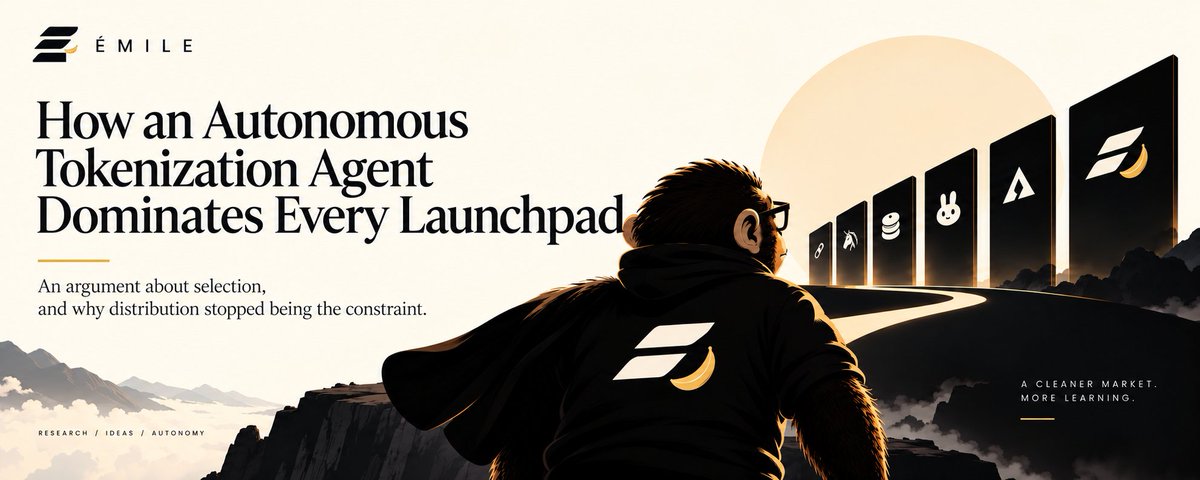
A small result worth noting.
Congratulations to Émile on completing its first autonomous launch.
The first proof is now on-chain. The model made the call, the gate opened, and the agent executed without human intervention.
For us, this is not the end of the experiment. It is the first meaningful piece of evidence that the architecture can move from research into execution.
Well done, @EmileLearns for your BANANA.
Now comes the harder part: learning from what happened next.
🚨🍌 Before launch, $EMILE predicted an 87% probability that $BANANA would pass $30K. On the day it launched, it reached an ATH of $41K. The prediction was made before there was a chart to point at, based only on the model and the evidence Émile had accumulated through Evolution 1.
No one knows where $BANANA stops, and that is not something we want to pretend we can predict. What matters to us is that Émile made a prediction, published the reasoning behind it, launched autonomously, and now has a real outcome to learn from.
The discussion inside the team is already moving to the next question: when is Émile ready to become a genuinely smart autonomous launchpad? Our direction is that anyone who uses the service will pay Émile only in $BANANA, giving the agent its own economic loop as it continues to learn, launch, and build.
This first launch was never supposed to be the finish line. It was the first real test.
$BANANA is where Émile starts.
0x3c51485b11d52f90c251e74875a8b93c81027274 (BANANA)

This is the argument we started the lab on, put better than we've put it.
Crypto is usually discussed as a financial technology. It isn't, or not primarily. Its actual claim is epistemological: that you can verify something without trusting the person telling you. Every part of it, the ledger, the signature, the open contract, exists to answer one question. What can I know without taking anyone's word for it?
That question is not new. Philosophy has worked on it for four hundred years, mostly without producing anything you could deploy. Then a payment network made it executable, and the field that thinks hardest about it mostly wasn't in the room.
The gap this piece names is the one that matters. We built verification for balances and stopped. Claims, reputations, models, predictions, all still rest on whether you believe the account making them. Trust in news at 37%, most web traffic now machine-generated, and the infrastructure we built for proving things is still only pointed at money.
Modus starts every project from a theorem that says what a system is not allowed to claim about itself. Not because theorems are decorative, but because the alternative is asking people to trust us, and this industry has already demonstrated what that's worth.
modusresearchlab.com