

Empowering youth coaches with pro-level insights, drills, and support. Join The Modern Day Coach community and elevate your team’s game! ⚾️ #CoachLikeAPro
Joined September 2023
- Tweets113
- Following47
- Followers14
- Likes49



Pinned Tweet
The Modern Day Coach web app is live.
Develop your players the right way — with clear development plans, focused daily work, and a simple system coaches and parents can actually use.
Players get ownership.
Coaches get structure.
Parents get clarity.
This is how we help young players build better habits and better problem-solving on the field.
Start here:
modern-day-coach.com
🤖 Made with AI

Fall/Winter sessions are open at USA Baseball NTC in Cary.
Offseason practices with our professional staff. Fundamentals of the game, and skill work before next season.
Tue & Thu Ages 7–9 · 5:00–6:30 Ages 10–12 · 6:30–8:30
The price is for that session day, for the month.
Sign up: modern-day-coach.com/program…

You need to be able to flush your at bats and reset. Trust your process. Trust your routine. Add to your routine if there is something that keeps happening consistently in your game but know that to be consistent you can’t stress about what happened in yesterday’s game. New day, flush it and get back to work.
This quoted post is unavailable.
The best hitters in the world make the adjustment pitch to pitch.
Early in their career a coach showed them the mistake and the fix.
They worked on it daily, thought about it between every pitch, and kept refining it until the correction became automatic.
Now they don’t even have to think about it — it’s just part of their process.
Their routine keeps it right.
Install it early. Let the player own it until it becomes the routine.
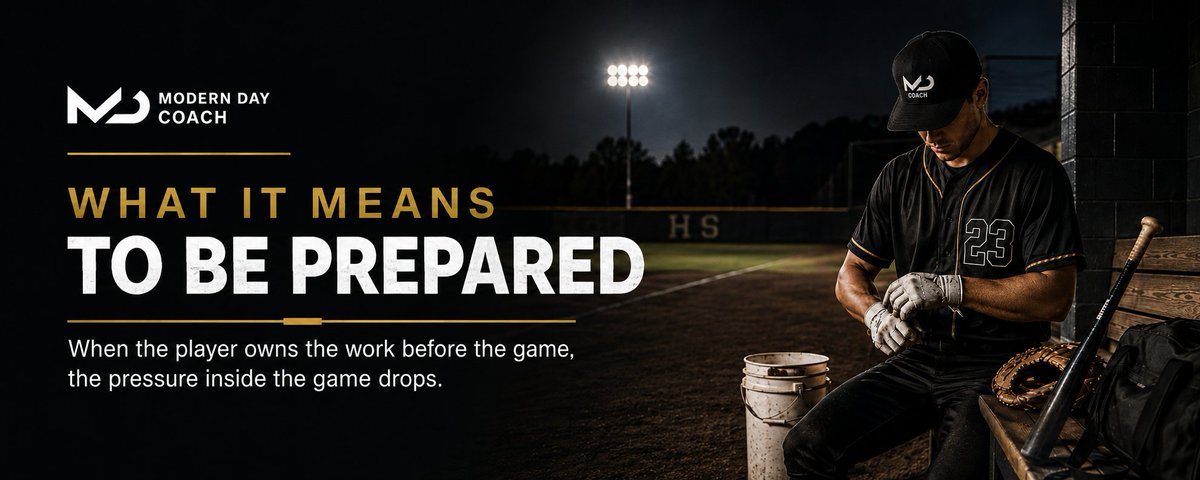
Block your training sessions.
Start with skill development.
Choose one specific skill.
Give the player focused drills that isolate it.
Clear feedback. Clean reps. Ownership of the adjustment.
Then move into game-like reps.
Put the player in their game thoughts.
Let the work from the skill block take over subconsciously.
The goal is simple:
Get the skill to show up in the game.
The player already feels the weight of the mistake.
When you stay calm on the sideline, he can focus on his reset instead of managing your reaction.
That’s the only window where this works:
“I prepared for this. What’s next? How many outs are there? Where’s the play?”
Your anxiety from the stands or the dugout interrupts that process.
Stay calm and supportive so they can own their reset and become a more consistent and resilient player.
Confidence is knowing you prepared.
You did everything you needed to do for that moment. Whatever happens after that is just baseball.
That’s why the routine matters more than the speech.
After a mistake the conversation is simple: “Did you do everything you could to be prepared for that play?”
If the answer is yes — stick to the routine. You’ll get the next one.
Soon the player stops waiting for you to say it. He starts saying it to himself when the nerves show up, when he’s scared to fail, when he’s worried about letting a coach or teammate down.
That is how he learns to handle the pressure that only gets heavier in middle school and high school.
Build the routine early. The earlier he owns it, the quieter the noise gets.
Ownership is a practiced behavior.
After a mistake, the player needs a short path back to the game — not a speech.
Teach this before he needs it under pressure:
What did I see?
What was my job?
What’s next?
Then give him the same situation again.
The correction does not end with a conversation. The player uses the routine, returns to the game, and gets another chance to execute.
That’s how ownership becomes real.

Coach teaches.
Player owns.
Parent supports.
Program reinforces.
That is the alignment standard.
The player should not have to manage competing adult messages.
After practice, the parent role is simple:
What were you working on today?
What is your next action?
Then stop talking and listen.
Support the plan.
Do not add a second set of cues on the ride home.
Clear support strengthens ownership.
Extra voices create noise.
This is why we ask the player “What did you do wrong?” instead of just giving the answer.
When they have to figure it out, it sticks.

Cal Newport says that the only way to learn new things is using "active recall":
"Replicating the information from scratch as if teaching a class without looking at your notes, that is the only way to learn."
"It's efficient, doesn't take much time, but it's incredibly mentally taxing. This is why students often avoid it."
"Not only do you learn very quickly, you don't forget. It's almost like you have a pseudo-photographic memory when you study this way."
"Active recall is how you prepare, and it's going to take four hours and it's going to be tough, so do it in the morning when you have energy, and then you're done."
"It's really hard, but it is the way to learn new things."
@hubermanlab
After a mistake, the most useful question is simple:
What did you do wrong?
Let the player think.
Let them say it out loud.
Whether you think their answer is right or wrong, let them work through it.
If they keep failing, ask again:
What else could it be?
If you already see the fix, don’t hand it to them.
Guide them there with questions.
This is how young brains learn to problem-solve.
The more they figure it out themselves, the stronger it gets stored in long-term memory — and the easier it is to recall the next time the same mistake shows up in a game.
This is the quiet work that actually changes players.
Belief from a coach often comes before the player believes in himself.
That belief is what gives him permission to own the hard work.

Bonds is pointing at something important.
When a player works through the problem himself, the solution sticks better.
It’s easier to recall the next time he’s struggling because he already owns it.
The coach can offer the idea.
The player still has to do the thinking.

Barry Bonds says young players usually ignore him until they’re 2-for-30, and then he simply reminds them of they're talent:
“Sometimes they’ll walk by me. Then other times they’ll be like, ‘Hey Barry, what do you see?’ I’m like, ‘Oh, you must be two for 30.’ You need a little church right now.”
“I’m only there for the information if you need it. Everything else is your path. You did this before you ever met me. You have to understand how good you already are just to be here. There’s always going to be somebody a little bit better than you.”
“You’ve got to understand your talent. Then get the best out of your talent.”
“They’re like, ‘Well, I’m not you.’ That’s the first thing you got right. You ain’t me. Let’s be the best version of yourself. Take this information. Whatever you don’t like that I say, throw it in the garbage. I don’t care.”
“It’s your journey. It’s not my journey. I’m just here to help you get to the journey you’re choosing.”
“Each conversation I have with each person is different. One method is not going to work with this guy. I have to tailor it. Tailor it to what works for them. Sometimes it’s just redirecting the mind for great athletes.”
A parent should support development without becoming another coach.
The player needs one clear plan:
Coach teaches.
Player owns.
Parent supports.
Program reinforces.
That sounds simple until the car ride home becomes a second practice.
A better parent question:
What did you work on today?
How can I help you get better at home?
Then stop talking and listen.
Let the player come up with the plan before you offer anything.
Help them create ownership in their own development.
Let them generate the ideas and work through it themselves.
Over time they start to own it.
They want to do the work.
They listen to the coach more intently and begin asking the right questions.
Support can be clear without being loud.
Ask the question. Listen. Let the player own the next step.
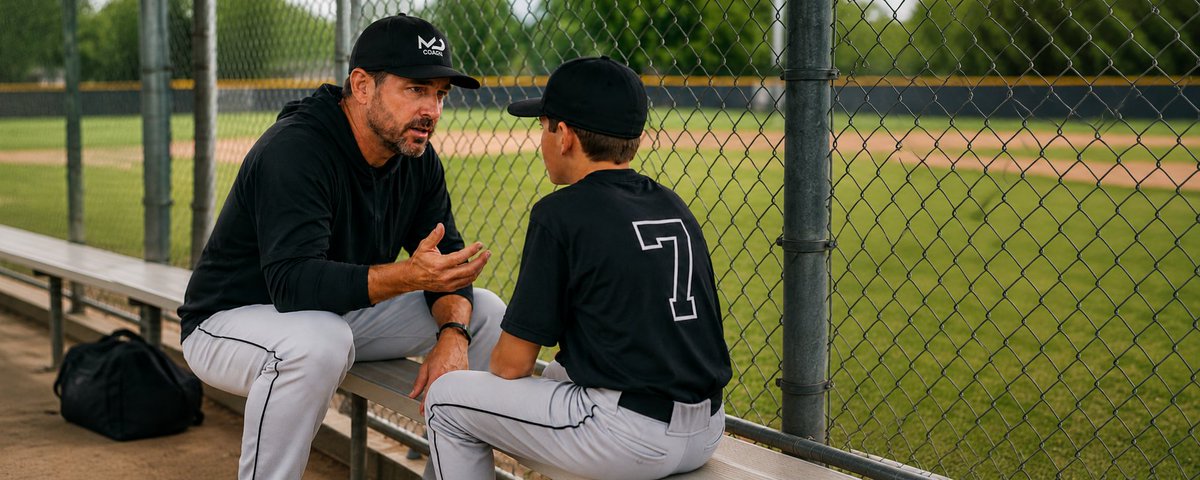
Players do not need practice that only looks busy.
They need clarity they can carry into the game.
Before the next rep, ask:
1. What are you working on?
2. Why does it matter in the game?
3. What is your next action?
Then make the rep prove it.
Ground ball work is not just field it cleanly.
It can be:
Runners on 1st and 2nd. 1 out. Ball to your left.
Where is the out?
What did you see?
What is your job?
Skill first.
Game connection next.
One next action before the player leaves.
That is the difference between activity and development.
Founder lesson: During a 2-for-50 stretch in High A, Tim Federowicz saw his career fading and couldn’t figure out how to push through.
He was trying to break out of it every single at-bat.
A coach reframed it: instead of trying to get a hit every at-bat, why don’t you try to get 3 hits in your next 10 at-bats. If you do it, great. If you don’t, move into the next 10 and restart.
That smaller frame worked. Once he internalized it, he never let it go.
The real job for coaches is helping players lock in what actually works so they can draw on it for the rest of their careers.