

Born at 322.17 ppm CO2 Senior ExP @adn_wallonie @digitalwallonia Program Dir. AI - Pr. & Epicurean Enthusiastic, Author of the book l'Instant Mobile. E/acc
Namur (Belgium)
Joined May 2007
- Tweets24.6K
- Following1.8K
- Followers2.4K
- Likes8.8K
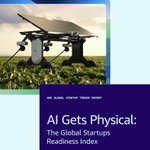







AI Gets Physical: The Global Startups Readiness Index d1.awsstatic.com/onedam/mark… #physicalAI

Pascal Poty retweeted

🚨 28 minutes : c'est tout ce qu'il a fallu à Claude pour reproduire la cyberattaque sur les frigos des supermarchés ! ➡️ 01net.com/actualites/frigos-…

Pascal Poty retweeted

🚨 IMPORTANT: The EU's first AI standard has been published in the Official Journal of the European Union! Here’s what companies need to know:
The standard EN 18286:2026, “Artificial intelligence - Quality management system for EU AI Act regulatory purposes,” specifies requirements and provides guidance for defining, implementing, and maintaining a quality management system for organizations that provide high-risk AI systems.
The European standardization organizations CEN and CENELEC had already published the details of this harmonized standard earlier, but the European Commission still had to formally assess whether it met the AI Act’s intended objectives and legal requirements.
That assessment has now been completed, as this standard was published today in the Official Journal of the EU.
In practice, companies can apply this standard and benefit from a presumption of conformity with the EU AI Act’s quality management system requirements, as established in Article 17(1) points “a” through “m.”
As a reminder, this article will come into force on December 2, 2027 for high-risk AI systems under Annex III and on August 2, 2028 for high-risk AI systems under Annex I, according to Article 113(c).
This is the first European standard on AI to be published in the EU Official Journal. Additional standards covering the following areas are also expected to be published:
- risk management
- governance and quality of datasets
- record keeping
- transparency
- human oversight
- accuracy
- robustness
- cybersecurity
- quality management
- conformity assessment
This is great news for everyone. The EU AI Act's standards are voluntary, but they will help increase legal certainty, foster innovation, standardize legal requirements, and accelerate compliance.
However, the challenges in AI are only beginning, and every company developing or deploying AI should focus on strengthening its AI governance and safety practices.
I will keep you posted.
👉 READ my full article (and join my newsletter's 102,200+ subscribers) below.

Verizon CTO: #6G needs a breakthrough for AI uplink demand lightreading.com/6g/verizon-…

Pascal Poty retweeted

Dusting off this tweet from April because this gap in shared understanding of LLM capability is *widening*. It's now less "two groups of people speaking past each other" and more a sharp funnel.
- Napkin math somewhere around 6B people (~75% of the population) have barely come in contact with LLMs at all.
- Around 1-2B (~20%) are casual and infrequent users of free-tier ChatGPT-like products. This group sees derpy chatbots and treats them a bit like a better Google search, a writing aid, or etc. Maybe an agent tries to book you a flight. I have non-tech friends who (reasonably, imo) say they have not much use for it at all. Even many professionals outside of math&code are in this tier. For example, execs and many other functions spend a lot of their time talking to other people, so while they understand what is happening intellectually, it is still second-hand and a bit abstract.
- Now we get to professional use of frontier-grade LLMs in math&code. Somewhere around 20M people (0.2%) see first-hand that large, complex projects that used to take them weeks/months can now be completed by agents with a prompt. Building apps, copying apps, translating apps, decompiling apps from binaries... This has all happened very quickly and recently - less than 1 year ago, I was writing code manually by hand, typing memorized computer code commands into a code editor character by character, occasionally pressing Tab to autocomplete a little chunk of code.
- And finally we get to the ~5,000 people (~0.00006%) with access to frontier-grade systems internally. The external world has seen the preview. It looks like swarms of thousands of agents collaborating over weeks on software mega projects: minting zero days, running cyber attacks and defenses at machine speeds, discovering new science, advancing the frontier of mathematics. Things that would have taken top professionals in the industry years of work. Meanwhile, human review and comprehension are starting to fall behind. For example, people are still involved in the "archeology" of the OpenAI-HF incident from many months ago. Mathematicians may be poring over the 722 manuscripts on frontier mathematics for a while.
The funnel is driven by a combination of factors:
1. The impact scales with ambition, problem size, and horizon. A question with a paragraph answer barely stresses the system. You need a reservoir of big, difficult problems that you really care about. This aspect drives the consumer / professional dimension of the funnel.
2. The jaggedness of the system (which I have written about a lot separately). Capability peaks in domains that are digital, verifiable and economically valuable. This is because LLM capability emerges from reinforcement learning on verifiable rewards on a curated environment mixture driven by revenue potential. This aspect primarily drives the area (e.g. math&code) dimension of the funnel.
3. Access. Free-tier, paid-tier, internal.
So this is the weirdness of the moment. The general public has mostly not interacted with these systems. When they have, it looks like a derpy chatbot. The majority of professionals still see only a modest uplift. And a small sliver of professionals are experiencing the vertigo of the curve going vertical. And it is all happening at the same time.

Judging by my tl there is a growing gap in understanding of AI capability.
The first issue I think is around recency and tier of use. I think a lot of people tried the free tier of ChatGPT somewhere last year and allowed it to inform their views on AI a little too much. This is a group of reactions laughing at various quirks of the models, hallucinations, etc. Yes I also saw the viral videos of OpenAI's Advanced Voice mode fumbling simple queries like "should I drive or walk to the carwash". The thing is that these free and old/deprecated models don't reflect the capability in the latest round of state of the art agentic models of this year, especially OpenAI Codex and Claude Code.
But that brings me to the second issue. Even if people paid $200/month to use the state of the art models, a lot of the capabilities are relatively "peaky" in highly technical areas. Typical queries around search, writing, advice, etc. are *not* the domain that has made the most noticeable and dramatic strides in capability. Partly, this is due to the technical details of reinforcement learning and its use of verifiable rewards. But partly, it's also because these use cases are not sufficiently prioritized by the companies in their hillclimbing because they don't lead to as much $$$ value. The goldmines are elsewhere, and the focus comes along.
So that brings me to the second group of people, who *both* 1) pay for and use the state of the art frontier agentic models (OpenAI Codex / Claude Code) and 2) do so professionally in technical domains like programming, math and research. This group of people is subject to the highest amount of "AI Psychosis" because the recent improvements in these domains as of this year have been nothing short of staggering. When you hand a computer terminal to one of these models, you can now watch them melt programming problems that you'd normally expect to take days/weeks of work. It's this second group of people that assigns a much greater gravity to the capabilities, their slope, and various cyber-related repercussions.
TLDR the people in these two groups are speaking past each other. It really is simultaneously the case that OpenAI's free and I think slightly orphaned (?) "Advanced Voice Mode" will fumble the dumbest questions in your Instagram's reels and *at the same time*, OpenAI's highest-tier and paid Codex model will go off for 1 hour to coherently restructure an entire code base, or find and exploit vulnerabilities in computer systems. This part really works and has made dramatic strides because 2 properties: 1) these domains offer explicit reward functions that are verifiable meaning they are easily amenable to reinforcement learning training (e.g. unit tests passed yes or no, in contrast to writing, which is much harder to explicitly judge), but also 2) they are a lot more valuable in b2b settings, meaning that the biggest fraction of the team is focused on improving them. So here we are.
Pascal Poty retweeted

1/2 point de PIB de croissance en plus par an d'ici quelques années : une perspective enthousiasmante selon la présidente du FMI. Et mine de rien c'est effectivement considérable : 10,000 milliards de dollars sur dix ans.
lesechos.fr/monde/enjeux-int…

AI models may soon self-replicate without access to data centers, Anthropic warns - reuters.com/business/ai-mode…

Pascal Poty retweeted

A common assumption is that people use AI as a shortcut. Stanford HAI Faculty Affiliate @Diyi_Yang and her team analyzed a quarter-million anonymized chatbot conversations and found most users stay engaged, asking for explanations, working through friction, and refining their work: hai.stanford.edu/news/humans…


Les premiers chiffres qui incriminent l'IA dans le repli de l'emploi des jeunes selon HEC et la Banque de France
lesechos.fr/economie-france/…

Pascal Poty retweeted

Meet Mistral Large 4, aka Le Chonk.
• 1T parameters, natively multimodal. 49B active.
It is the best open weights model from US or Europe on aggregated benchmarks.
• State-of-the-art on critical workloads, including cyber defense, manufacturing and finance and it surpasses closed frontier models on visual grounding.
• Forged in Europe end-to-end and is deployable from Europe via our own Mistral Cloud infrastructure.
• Available to all via API today. Working with cybersecurity partners privately.
Open weights release end of October.
🤖 Made with AI
Online sleuths hunt for rogue swarms of agents. Their work is our starkest understanding yet of what happens when AI goes wrong. wsj.com/tech/ai/swarm-chaser… via @WSJ


The continued state of global AI diffusion in 2026 (Microsoft Report) blogs.microsoft.com/on-the-i…

As A.I. Accelerates, Governments Are Increasingly Being Left Behind nytimes.com/2026/09/27/techn… via @NYTimes

Pascal Poty retweeted

Beaucoup plus important que le coup de fil de D. Trump en pleine conférence, l'annonce du patron de Nvidia sur la date à laquelle les Chinois maitriseront la lithographie avancée (EUV) : 2030. C'est-à-dire demain

Jensen Huang on timeline of China's advanced lithography systems:
"They are going to get there by 2030. 2030 is just around the corner. The way to think about China is that it's really good at high volume production. It's just a matter of time...so 2 or 3 years is just a click, its nothing. So as far as they are concerned, they are already there."
Via @theallinpod
Pascal Poty retweeted

L’entreprise a réalisé avec Visa une première expérimentation de paiement sécurisé déclenché par une IA. Un moyen de «mieux comprendre comment ce type de paiement pourrait fonctionner dans des situations d’achat réelles» lefigaro.fr/secteur/high-tec…

Pascal Poty retweeted

Testé GPT-6 Astra. Le président d’OpenAI parle de l’entrée dans l’ère de l’AGI. Trois jours plus tôt, Fable 5.1 doublait le score de recherche scientifique. Le sol bouge.
J’allume la télévision : retraite à 60 ans, taxation des riches, interdiction du voile.
Les mêmes plateaux, les mêmes phrases, la même pièce depuis vingt ans.
Il n’y a pas de complot. Juste un désintérêt pour le sujet, et une hiérarchie des priorités qui n’a pas été mise à jour depuis vingt ans.

Pascal Poty retweeted

I recently spoke with Bloomberg Weekend about three questions I think will define the next decade: Where is AI headed? How will organizations change? And what happens to jobs as AI becomes increasingly capable? These questions are also at the heart of my new book, AI Native, eBook/Audiobook launching Sep 15.
bloomberg.com/features/2026-…
