

VIC: minuscherry All views are my opinion
Joined May 2022
- Tweets158
- Following809
- Followers698
- Likes2.3K




On $MH, spiked ~40% over the last week post the Q2 print. I believe it was due to a combination of tight float and high SI into the print (also fears after $LRN reported that public education stocks would also see some weakness). Important to note as well that this was the last earnings call before Platinum Equity's lock-ups expire. Beat comes from 14% growth in higher education versus -1% - 0% expectations, largely coming from increased penetration in existing users vs. signing on new institutions, was my read. Management also credited some of this growth to the adoption of AI products (which does make sense).
That being said, I think the current marketing around FY2027E being a rebound year in the K-12 segment deserves further scrutiny. I don't view the 2026/2027 renewal cycle as having better circumstances in the K-12 segment than the 2025/2026 cycle, unfortunately - happy to hear any pushback from bulls on that though. I lean towards shorting into this spike.
8
2,556
Something interesting to note re: $VRSN is recent developments at SEDO, Team Internet Group, and parked domains. SEDO, owned by IONOS, saw revenue fall by ~66% in Q3 after its shift to Google RSOC was lackluster. Google's also clamping down harder on RSOC - they've struggled to the point where IONOS is looking to sell SEDO. Additionally, Team Internet Group is now also looking to sell its domain business. If this were temporary/cyclical, I feel the companies would hold on to these assets; however, they've likely recognized the terminal value is structurally impaired here. AdSense for domains is also officially ending on February 10, 2026, so something to monitor there as well. NamePros and BlackHatWorld parked domain users are now worried, and some are throwing in the towel on renewals. Let's see; still speculative on what % of parked domains make up the total .Com base, but I still think we see some pressure that impacts $VRSN into late next year.
1
11
2,933
$LRN down -30%, as bear case of COVID funding washing out is playing out - not 1-to-1, but something to consider for $MH, as they've also been a benefactor of ESSER funding over the last ~5 years; gives a flavor for what **could** happen

While it isn't as exciting as when it was supposed to IPO at ~$20, or when it IPO'd at ~$17, I still believe $MH could be a good funding short given the above mentioned tailwinds aren't necessarily going away anytime soon. If this spikes back to $14 - $17, could be good to short into that spike.
1
9
4,098
As an update on $VRSN, they released a very strange 8-K on Friday, rebuking the Google AdSense bear case that has been circulating post my longer form notes posted to VIC. Given the phrasing of the “short seller’s faulty and incorrect analysis”, I can only assume that they were mentioning the VIC post ~2 weeks ago. Anyways, spending some time this weekend, I have little faith that the domains impacted will actually be 2% given previous disclosure by their own CEO alongside other industry sources, and find the entire situation strange. See below:
$VRSN - was initially looking at as a long, now flipped short over next ~12 months. Have more detailed notes I've written up that I can share if interested but general idea is that growth YTD is driven by high-churn registrars through rebates (can use ICANN monthly .Com data to find YTD aggregation. WayBack machine of these registrars shows discounting of ~50% in some cases. These discounts are structured as rebates if registrars hit certain growth rates, so all the investment falls on registrars. After reading through the data I see growth slowing into Q1 FY2026E, and since these registrars higher churn rates + first year promos renew at a lower rate generally, $VRSN's renewal rate should come revert in FY2026E which brings .Com domain base growth negative (major driver as to why stock is up ~30% YTD).
Beyond that, ~30% of .Com domains are parked, and recent changes by Google have banned advertisements on parked domains, cutting parking domain revenue by ~85% - ~90% in recent weeks. These domains now likely either 1) don't make enough to renew their domains or 2) it's uneconomical to keep running parking domains. Keep in mind <30% of .Com domains are "real" websites, and there seems to be a secular shift to get rid of all the extra fat.
1
6
2,946
5) 2 of the largest domain parking websites, SEDO and BODIS, automatically opt users into advertisements, and both heavily rely on google – see here for SEDO, and here for BODIS.
BODIS is owned by Team Internet Group (who’s stock has been crushed this year), and a PE firm called off their offer to take them private because of these Google Changes!
GoDaddy, the largest domain registrar (and has 80m domains parked), and while they don’t explicitly state they use Google’s name servers, when the Oscars sued them in 2015, it came out that they rely on Google to show advertisements on parked domains.
Building on this, what is damning is that the APNIC study shows the single most common IP for parked pages is 34.102.136.180 (run by Google but used by GoDaddy’s free parking); this might’ve been missed in $VRSN's analysis (since they likely spent just a few hours on this). The study shows that this Google IP (likely linked to the advertisements they offer), has 32m domains using it, linked to ~90% of all parked domains, and, as of today, makes up ~20% of the total. Com base.
Further, even for resolving names, the parking ecosystem often uses intermediaries, redirects, or registrar‑controlled pages; AdSense demand can be indirect (via partner networks) or served from Google‑run infrastructure that looks like “placeholder hosting.” Inferring “AdSense exposure” from registry‑visible DNS alone will undercount the domains.
1
3
1,022
6) Lastly, the nature of the release of the 8-K is really weird. It’s like RDDT releasing an 8-K on Reburn’s note earlier this year on Google changing their algorithm that sent the stock down, or CART’s stock going down on news of the Amazon & Kroger partnership. These are not items you typically see 8-K’d, and raises more concerns for me. That being said, it opens the risk to the short, as if the stock does draw down to a certain level, whos’ to say management doesn’t try and take steps to reverse the losses; my initial write-up here notes that $VRSN management isn’t overtly focused on stock price movements over the short-term which de-risks the short, but the implications of the release of this 8-K does change that for me.
1
2
918
$VRSN - was initially looking at as a long, now flipped short over next ~12 months. Have more detailed notes I've written up that I can share if interested but general idea is that growth YTD is driven by high-churn registrars through rebates (can use ICANN monthly .Com data to find YTD aggregation. WayBack machine of these registrars shows discounting of ~50% in some cases. These discounts are structured as rebates if registrars hit certain growth rates, so all the investment falls on registrars. After reading through the data I see growth slowing into Q1 FY2026E, and since these registrars higher churn rates + first year promos renew at a lower rate generally, $VRSN's renewal rate should come revert in FY2026E which brings .Com domain base growth negative (major driver as to why stock is up ~30% YTD).
Beyond that, ~30% of .Com domains are parked, and recent changes by Google have banned advertisements on parked domains, cutting parking domain revenue by ~85% - ~90% in recent weeks. These domains now likely either 1) don't make enough to renew their domains or 2) it's uneconomical to keep running parking domains. Keep in mind <30% of .Com domains are "real" websites, and there seems to be a secular shift to get rid of all the extra fat.
$VRSN - company released a very interesting 8-K today…will digest and share my thoughts over the weekend, but at first glance, the wording and aggressiveness towards some of the work is a little harsh as I did state I’m also surprised why the stock is down today! Haha; but will share thoughts sometime this weekend. I am skeptical of the 2% figure as I’m having trouble internally reconciling it
965
Minus Cherry retweeted

Registered dotcom domains had peaked and were declining up until Google's AdSense change was communicated in Q4 2024 (pic 1). Around that time, Verisign began offering new programs to registrars, which resulted in an increase in the relative share of net adds as a percent of net registrations (pic 2). Net adds are what ICANN calls new registrations. Net registrations are net adds + net renewals. I've included explanations for prior increases.
Since ICANN (data source) provides data on a lag, data is only available until June 2025, so the argument that the trend since the Google AdSense change is too brief to draw conclusions is valid.
Interestingly, Verisign just changed the URL path where it publishes its daily domain name bas (.com & .net) registration count from ./zone to ./resources/zone-file – likely to discourage people from viewing archived figures with more than the quarterly granularity provided by its EDGAR disclosures.
Viewing the ICANN data in conjunction with archived Verisign zone data strongly suggests net new registrations have continued to increase.
Based on Verisign's take on the wholesale price cap, as calculated from EDGAR disclosures, it suggests that the registrar is eating the cost of this new marketing program – registrar segment margin reporting (e.g., IONOS) support this.
What's uncertain is:
1a. How exactly Verisign structured the program that result in such a dramatic increase in net new registrations.
1b. Whether the current split between Verisign and registrar continues going forward or if the registrar begins to take margin upon hitting a registration target (years or domains).
2. The exact quality of new registrations that arose from the marketing campaign. The bear case is that these are of low quality.
It cannot be overstated how valuable it would be the understand the structure and scope/extent of Verisign's new marketing promotion with the registrars.
What you need to pay attention to is:
- ICANN data, specifically net new adds percentage and (obviously) total domain registrations
- registrar revenue and margins
- Verisign revenue and margins
- Google's handling of the new form of domain parking, RSOC. It seems Google will be going after RSOC to a certain extent, which is bearish for dotcom registration counts.
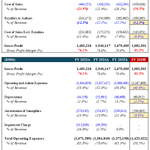
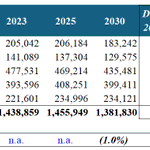
Since we have the wholesale pricing cap for Verisign until 2030, a fairly accurate PF IS can be modeled given their low margin variance. The only two plugs you need are domain registrations and Verisign's take. On the latter, Verisign's revenue is reported on a net basis, reflecting incentive-based/promotional discount programs. Currently, Verisign's take on the $10.26 sticker is in excess of 90% (I calculate >93%). This can go higher, but not by a lot.
If registrations return to the trend they were on, the stock is likely to rerate lower given the growth implications.
$VRSN


Is definitely a larger market cap name, and has historically been relatively stable; can maybe be used as a hedge in a portfolio. Anyways, have been looking at a few long ideas too as to not saturate this feed with a bunch of short ideas haha
2
1,374
As an update on $MH, it has been approximately two months since my initial post on VIC, so I'm now able to share the contents of that write-up. While not as exciting as shorting at the expected $20 pre-IPO (when I started looking at the name), or $17 at IPO, I don't foresee any of the headwinds impacting the stock + business going away anytime soon.
See the thread below for more specifics, but overall:
1) You have a majority owner (85%) that is incentivized to sell large chunks quickly post-lockup
2) ~20% discounting for their K-12 segment (~50% of revenues)
3) A recently revived lawsuit from authors that could increase royalty payments by ~25% - ~35% (recent Cengage lawsuit settled in favor of authors, creating an unfavorable set-up for $MH)
4) The expiration of ESSER funding and government stimulus, which grew Federal + State elementary school funding by ~30% from FY 2020 to FY 2023
5) An enrollment cliff with forecasted ~13% fewer graduates by 2041
6) An industry shift from cooperation between platforms like Instructure and Blackboard with publishers like $MH and $PSO, to a more intense environment with both sides looking to eat share
7) Management guidance of 5% Y/Y terminal growth unlikely to be achieved as a result, causing the multiple to re-rate from 7.5x EV / FY+1 EBITDA to 6.0x EV / FY+1 EBITDA; see 15% - 30% further potential downside
8) Management likely has to revise guidance down next August after the 2026/2027 back-to-school season contract renewals and GTM results come back in
1
1
984
8) So when does management have to revise guidance down / we see this start to play out? Well, recently, management has been using the new administration's stance on education as the reason why the K-12 segment has seen struggling growth, and that once this year laps, all should be back to normal. My issue with that is that I argue this downtrend is more structural than cyclical. What was cyclical was the growth in the segment, now you're going to see lower government spending from both parties + lower municipal budgets for elementary and secondary school education. I believe that once management is setting FY 2027 guidance next year, they'll be forced to take this into account / after the first print for Q1 2027 post a lack-luster back-to-school season for the 2026/2027 school year.
1
656
While it isn't as exciting as when it was supposed to IPO at ~$20, or when it IPO'd at ~$17, I still believe $MH could be a good funding short given the above mentioned tailwinds aren't necessarily going away anytime soon. If this spikes back to $14 - $17, could be good to short into that spike.