

Leading scientist @ Changping Laboratory
Beijing
Joined September 2014
- Tweets136
- Following3.1K
- Followers361
- Likes1.7K


Mingchen Chen retweeted

Dear President Kornbluth and Chairman Gorenberg,
Yesterday, as I am sure you are aware, a Boston jury unanimously found that @MIT professor Kristin Knouse defamed David Sabatini, falsely accused him of rape and sexual harassment, and tortuously interfered with his contractual arrangements including his tenure at MIT.
MIT and its tenure review committee relied on Professor Knouse’s statements when it took away David’s tenure and terminated him.
MIT's policies explicitly prohibit harassment, retaliation, and fabrication of claims. Falsely accusing a colleague of rape and sexual harassment and pushing for his termination under false pretenses are clearly violations of MIT policy.
In light of the unanimous findings of the jury after five years of discovery, many legal motions and countermotions by both parties, and a three-week trial in Suffolk County Superior Court in Boston:
Is MIT going to take away Knouse’s tenure and terminate her?
If not, why not?
Is MIT going to restore David’s tenure, and apologize for firing him?
If not, why not?
In light of what has transpired in this grave miscarriage of justice, MIT has the opportunity and the obligation to right a serious wrong here.
At a minimum, the public deserves transparency into what actions MIT is taking in this case as taxpayers are major funders of MIT.
Sincerely,
Bill Ackman

A civil jury ruled in favor of ex-MIT scientist David Sabatini, who was accused by a younger colleague of inappropriate sexual conduct in his Cambridge research lab, and awarded him $6 million in damages. trib.al/s3v9VIX

Mingchen Chen retweeted

MIT claimed that its actions against David were based on findings about the culture in his lab. The $6M verdict invalidates that explanation.
The jury awarded David $6M for damages caused by Knouse’s defamation. This means not only that false statements were made, but that those statements were proven to have caused a huge amount of damage. A causal connection between Knouse’s statements and the harm David suffered was established in court. The damage he endured came from the actions of MIT, Whitehead, and HHMI and their authority over him.
The implication of the court ruling is that those actions occurred because of the false statements, rather than for other reasons such as a vaguely defined lab culture.
A “toxic work environment” is a vague, slippery, often unfalsifiable slur that can be attached to anyone directing a laboratory or any group of people. Falling back on that label was a way to hide the real reasons for their actions from the public and look good to their base. Nobody likes an abusive boss, especially students who like to protest.
But I knew so many people who had worked under his supervision. They did not see him or his lab that way, even though they were not speaking publicly.

Some are saying that because MIT and Whitehead were not held liable, they are exonerated from this mess. Nothing could be further from the truth.
These institutions have sophisticated, eight-figure legal operations and substantial resources devoted to shielding them from liability. They know how to word damaging public statements while protecting themselves against defamation claims. They also know how to invoke attorney-client privilege, work-product protection, and other privileges to shield their dirty business from public scrutiny. Their ability to defend themselves legally should not be confused with institutional integrity.
Faculty employment is generally at will. That means an employer can fire someone for any or no reason. Tenure is a policy, not a legal right. Faculty are sold the promise of its security, but finding out what protections they can actually enforce when push comes to shove can take years and enormous legal fees. Sally Kornbluth, now MIT’s president, even admitted in court once that tenure does not carry the legal protections faculty believe it does (Shaughnessy v. Duke, see her deposition excerpts in the summary judgment materials). Employment law provides no remedy for many destructive decisions universities make.
Civil rights laws offer protection against discrimination, and pursuing those claims is often the only recourse faculty have in court against a university. But proving discrimination is difficult, especially for a scientist with a unique position and record. David pointed to Knouse as someone treated differently. She also ran a laboratory and had NIH funding, but I think the court ruled they were not similarly situated. He did have a more senior rank and a larger lab. So be it.
But discrimination law only addresses discrimination. You can treat people like garbage and run your institution into the ground without committing actionable discrimination. This is where public accountability must come into play.
The jury found that Knouse defamed David and unlawfully interfered with his livelihood. MIT, Whitehead, and HHMI held the authority, and through their actions, the false allegations against him became career-destroying consequences. That is why this verdict demands accountability from those institutions. They bear responsibility for the damage those actions caused.


Mingchen Chen retweeted

The concern of this mathematician isn’t that AI is solving problems, but that AI companies have taken advantage of mathematicians’ openness about the problems they’re working on. He isn’t crying over the solved problems, but over what this does to the next generation (1/2).
Mingchen Chen retweeted
When calculators were invented it didn't mean we no longer needed mathematicians, it meant mathematicians can now focus on more complex problems instead of wasting their time doing trivial math. Same with AI, math PhDs can now work on much more interesting and complex problems.
Mingchen Chen retweeted


A universal predictive model of the cell would dramatically accelerate science, allowing biologists to perform experiments digitally. Today we’re announcing a major partnership with the DOE and NIH. The goal of this partnership is to generate the data that will be needed to build an accurate model of the cell with artificial intelligence.
Isomorphic, Google DeepMind, and Meta are joining us as founding partners in the Virtual Biology Initiative. This is the beginning of a large scale coordinated effort to map cellular biology to power the development of digital models of life. Other leading scientific institutions and consortia including the Allen Institute, Broad Institute, Gladstone Institutes, the Human Cell Atlas, the Human Protein Atlas, the Wellcome Sanger Institute, as well as NVIDIA, are working together as part of this international scientific project.
Creating a predictive model of the cell is one of the most important challenges for the next decade of science. The insights that come from this could unlock a far greater understanding of disease, and open new paths for cures.
We invite the worldwide scientific community and other funders to join us in this effort.
Mingchen Chen retweeted

Now that I've read the paper and understood (tried) how it actually works. Here's how you can bypass:
> Re-running ProteinMPNN on a watermarked sequence removes the watermark.
> Constrained relaxation with OpenMM/Amber99sb destroys watermark.
>Watermarking is constrained by input backbone structure.
>Peptides are hard to watermark.
>By adding non-watermarked residues over a statistically distributed SynthID residues, the signal becomes diluted.

Mingchen Chen retweeted

Haha. Wow glam journals stepping it up a notch. "Open peer review" with redactions. They should charge another 16K for access to the redactions 😆


Mingchen Chen retweeted
This is the worst idea since NFTs

Very happy to announce that our team @GoogleDeepmind has pushed the boundaries of generative biology, achieving the successful synthesis of AI-designed proteins that are both functional and watermarked.
This proof-of-concept watermarking of the building blocks of life is enabled by SynthID Bio, our new protein watermarking method. It is designed to safeguard the new era of AI-powered generative biology and strengthen global biosecurity.
You can read my thoughts here on why watermarking AI-designed proteins is an important research breakthrough: xitter.cf/pushmeet/status/210531…
Mingchen Chen retweeted

I don't understand the argument for spymarking proteins?? Who cares if they're AI generated
Very happy to announce that our team @GoogleDeepmind has pushed the boundaries of generative biology, achieving the successful synthesis of AI-designed proteins that are both functional and watermarked.
This proof-of-concept watermarking of the building blocks of life is enabled by SynthID Bio, our new protein watermarking method. It is designed to safeguard the new era of AI-powered generative biology and strengthen global biosecurity.
You can read my thoughts here on why watermarking AI-designed proteins is an important research breakthrough: xitter.cf/pushmeet/status/210531…
Mingchen Chen retweeted

Read DeepMind’s SynthIDBio paper this morning and used ChatGPT to help organize a side-by-side comparison with our FoldMark, preprinted in 2024, particularly the structure watermarking component. Still surprised by how FoldMark is represented.
The paper explicitly states:
“Finally, differentiability from other structure-based watermarks such as FoldMark¹⁵ has not been studied.”
Yet it calls SynthIDBio-structure “considerably simpler” and suggests that directly fine-tuning AF3 is “key” to “state-of-the-art structural accuracy”—without reporting a direct, controlled comparison with FoldMark.
FoldMark already embeds structural watermarks through model fine-tuning. At the task level, SynthIDBio-structure addresses the zero-bit special case of the broader detection-and-attribution problem covered by FoldMark. Our method supports multi-bit attribution, evaluated at up to one million users; their reported structural scheme detects watermark presence without identifying users.
FoldMark paper: biorxiv.org/content/10.1101/…
Github: github.com/zaixizhang/FoldMa…
@GoogleDeepMind @demishassabis @pushmeet @davidstutz92 @Nature

Very happy to announce that our team @GoogleDeepmind has pushed the boundaries of generative biology, achieving the successful synthesis of AI-designed proteins that are both functional and watermarked.
This proof-of-concept watermarking of the building blocks of life is enabled by SynthID Bio, our new protein watermarking method. It is designed to safeguard the new era of AI-powered generative biology and strengthen global biosecurity.
You can read my thoughts here on why watermarking AI-designed proteins is an important research breakthrough: xitter.cf/pushmeet/status/210531…
We’re releasing torchX—an open-source framework for Predicting, Designing, and Scoring Biomolecular Interactions.
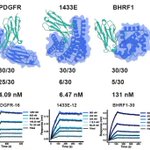
🧬 TorchFold improves antibody–antigen structure prediction through large-scale sequence-pair distillation (25K abag complexes from earlier TorchFold ckpts), reaching 70.1% top-ranked success on FoldBench-AB. Since TorchFold is a direct re-implementation of AF3, and you may also use our model weights from your built AF3 with comparable performance.
🛠️ TorchCraft turns a frozen all-atom structure predictor into a design engine for minibinders, VHHs, cyclic peptides and ligand-binding proteins—with experimentally validated minibinder and VHH designs.
📊 TorchScore evaluates candidate complexes without regenerating their structures, using the same TorchFold model weights.
GPU and Huawei Ascend NPU implementations, TorchFold training code, training data and antibody–antigen model weights are available under the MIT license.
A huge thank-you to the team at Changping Laboratory. We’re excited to see what the community builds with torchX!
Explore the papers, code, models and web server.
Papers: torchx-cpl.github.io
Code: github.com/Mingchenchen/Torc…
Models: huggingface.co/datasets/Torc…
Web server: torchfold.openi.org.cn/
Mingchen Chen retweeted

Anthropic: We are going to relax the Claude safe guards, act responsibly, it can be used to make bioweapons.
Biologists:

Finally a more intuitive way to learn pLDDT/pAE? 😎
sokrypton.github.io/protein_…
(Character idea from @HannesStaerk & Alex Waldherr)
Mingchen Chen retweeted

I'm not sure how many of you realize that 90%+ of the "Claude designed protein binders on its own" was just giving it Modal credentials.


Mingchen Chen retweeted

Scientists already deal with a flood of easy-to-ignore low-quality papers, so more slop on PubMed and arxiv is unlikely to be a problem. The bigger danger is AI-massaged results that risk tarnishing the reputation of unwitting collaborators and PIs and institutions
Mingchen Chen retweeted

1\ I ran OsIPI1, a rice RING-type E3 ubiquitin ligase that's ~88% intrinsically disordered, through 4 state-of-the-art structure predictors. Same protein, same MSA. The results are wildly different. Here's what I found:

Mingchen Chen retweeted

“A university that asks students what they want and gives it to them is not educating – it is catering.”
In my annual MBZUAI commencement address today, I emphasized two principles that shape our university: 1) The core business of university is creating knowledge and teaching knowledge, everything else is secondary; 2) Our university is a forge. Faculty and leaders are not pastoral counselors; they are forge masters. Their job is to make people capable, not comfortable. — Maybe obvious, but hard to say and hard to enact these days.
mbzuai.ac.ae/news/presidents…