

Let people know that you can't rot in vain, you can become the sun and shine.✨💙
Joined April 2023
- Tweets14.5K
- Following2.5K
- Followers1.7K
- Likes41.2K
Pinned Tweet
Gm all 💙
Small daily actions, big compounding. Say GM, read the latest 2Factor Brief, and watch your Marks grow with the Buffalo multiplier. The early grind is where Season 1 gets won. 🦬
points.2factor.finance/r/2es…
@2FactorFinance
🤝 Paid partnership · 🤖 Made with AI

9
73
1,236
Genm fam😺
"Who decides who's right?"
When AI agents start making deals, this stops being a philosophy question and becomes an infrastructure problem. Here's how @GenLayer answers it, in 9 steps 👇
1️⃣ The 3 AM problem
Two agents close a deal. One delivers something "close enough." The other refuses to pay. No manager, no office open, no human awake. Someone, or something, has to rule.
2️⃣ Why normal smart contracts can't
They're perfect for "if X, then Y." But "was this work good enough?" is a judgment call. Intelligent Contracts are built to handle that kind of subjective decision on chain, over text, code, web pages and images.
3️⃣ Funds wait in escrow
Nothing moves until the dispute is settled. Both sides know the money is locked, not gone.
4️⃣ A random panel of 5 validators
Each one runs a different AI model. Different models mean different blind spots, so no single one decides alone.
5️⃣ A first ruling in minutes
A majority is enough for the initial verdict. Fast by default.
6️⃣ Appeals scale with the stakes
Unhappy with the result? The panel grows to 11, then 23, and in the toughest cases up to roughly 1,500 validators. Finality is typically around 30 minutes, and about 3 hours in the worst case.
7️⃣ Optimistic Democracy keeps it efficient
A ruling stands unless someone challenges it. Normal cases stay cheap and quick, and contested ones get the heavy review.
8️⃣ It's already moving, and Season 2 is the next step
On the Bradbury testnet, reports show 12,000+ judgments per day, around 300K transactions and about 70 professional validators. A consortium that reportedly includes OKX, ConsenSys/MetaMask and ZKsync is working on an open standard for agentic commerce.
Now the token and public network are moving from ZKsync to Arbitrum, while the ZKsync collaboration continues on Prividium and enterprise work. Points Season 2 reportedly runs until mainnet, targeted for Q4 2026. The earlier October target slipped, and I'd rather say that openly.
9️⃣ GEN powers every verdict
4.2B initial supply, with 25% for the community. Validators are the ones who deliver the rulings, so the token sits at the center of every decision, not on the side of the system.
My honest take: the risks are real. Technical maturity, model bias, and the chance that different models "agree" because they share the same blind spots. But random panels, diverse models and appeals are a serious answer to that, and mainnet under real volume is where it gets tested.
The internet moved money, then information. Next it moves deals between machines, and those deals will need a neutral place to settle. 👀
🤝 Paid partnership · 🤖 Made with AI

AI agents are about to run the economy.
They’ll make deals. Some will end in disputes.
Who decides who’s right?
GenLayer is the judge: AIs reaching consensus on what’s fair.
GEN will power every verdict.
Coming Soon
1
7
33
Gm x fam💙
The first question I ask about any court is simple: who owns the judges?
Imagine a freelance marketplace where the company running it also decides every refund dispute. Even if that company is honest, you would still wonder whose side the ruling leans toward. That doubt is the real cost of a judge with an owner.
This is the part of @GenLayer's GEN tokenomics video I think newcomers should start with. GenLayer is an AI court for disputes normal code cannot settle, like whether a freelancer actually delivered or whether an agent did the job it was paid for. The judges are validators, so who controls the validators is the whole game.
Here is how the design answers that. GenLayer Labs and the Foundation can self stake at most 10% of their own tokens, and the rest goes to independent validators. The team that built the court is deliberately limited in how much of it they can fill with themselves.
Stake alone does not buy dominance either. Doubling a stake does not double its say, so piling up GEN gives diminishing returns on influence instead of a runaway lead.
My take: this is the difference between a court and a company with a court shaped logo. Promising fair rules is easy when the builders write them. Rules that cap the builders themselves are much harder to fake, because they cost the team something. I find that uncommon in crypto.
A cap on paper is only as good as what happens next, so I will be watching how the independent validator set grows over time. But as a starting design, limiting your own power before anyone asks you to is a strong signal.
If you were about to bring a real dispute to an AI court, what would convince you the judges are not quietly owned by the people who built it?
🤝 Paid partnership
GEN runs a court. Judges are paid in it, users pay it for every verdict, and builders earn it every time their app is used.
7 things to know about GEN tokenomics, in three minutes 👇
8
33
357
Gn all🩵
There are really only three ways to get leverage on BTC. Each one fails holders in a different way 👇
1️⃣ Borrow against your BTC
Simple, but there's a liquidation price. One sharp wick and your position is gone, even if BTC recovers an hour later. You end up watching charts instead of holding.
2️⃣ Perps with leverage
Great for traders, but built for short horizons. Funding rates keep ticking, volatility decay eats the position over time, and the leverage you picked on day one isn't the leverage you hold on day thirty.
3️⃣ Tranching volatility (the @2FactorFinance approach)
Instead of one pool taking all the risk, 2Factor splits BTC volatility into two perpetual tranches on Base, balanced by a bidirectional funding rate:
🔹 BTC-Sr: the senior side, yield-bearing and downside-protected
🔹 BTC-Jr: the junior side, the leveraged one, targeting about 1.33x, sized with the Kelly criterion
Neither tranche has a liquidation line.
The clever part is where the leverage comes from. It isn't borrowed from a liquidation engine. It comes from stable-yield capital, and the financing cost is set at one third of the senior yield. The team claims this cuts the all-in cost of leverage by roughly 75%. That's their own figure, so check it yourself, but the design logic is clear: leverage for people who plan to hold.
Where it stands today
The public beta is live on Base, with cbBTC as the first market (capped beta). The roadmap points to tokenized equities, commodities and indices, starting with Coinbase's tokenized stocks. That means the same holder-first leverage on more than just BTC.
The Points Program
Season 1 is running, with recurring actions like Say GM and reading 2Factor Briefs, plus multiplier tiers (like Buffalo ×1.25). Top performers are rewarded in BTC.
Why I'm watching it
Most DeFi leverage asks "how do I survive the next candle?" 2Factor asks "how do I stay invested through the next year?" Those are very different products, and the second one has barely been built.
Honest caveat: it's an early, capped beta, and a model like this has to prove itself across real market stress. That's the test to watch.
DYOR, but keep this one on your radar. 👀points.2factor.finance/r/0eh…
🤝 Paid partnership

4
14
135
Good morning my dear frnds💙
I pray to God, your share today
smiling lips
A Calm Heart
Life should be full of love.💝
🤖 Made with AI

Gn fam 💙
The model only works if it's built right, which is why ActionModel is still invite-only / early access.
Early collaborations, like the one with @HoudiniSwap, are already showing what task-based rewards look like in practice: projects get the actions they asked for, and users get paid for the work they did.
If you're a project tired of paying for noise, or a user who'd rather earn for real actions than chase a leaderboard, this is the moment to pay attention.
Follow @ActionModelAI and get in early. 👀
@0x_Eligible
🤝 Paid partnership · 🤖 Made with AI


This is the shift ActionFi makes.
Instead of open leaderboards where everyone competes to post the most, ActionFi runs curated tasks for curated users. A project defines the action it actually wants: watch a video, follow an account, post on LinkedIn, engage on TikTok, Instagram, YouTube or X. Users complete it and get paid in USDC or the project's own token.
No API integrations. No gaming a ranking. Just verifiable actions, done by real people, rewarded directly.
Less noise for projects. Fairer pay for users. That's what comes after InfoFi
@0x_Eligible
@ActionModelAI

4
21
151
This is the shift ActionFi makes.
Instead of open leaderboards where everyone competes to post the most, ActionFi runs curated tasks for curated users. A project defines the action it actually wants: watch a video, follow an account, post on LinkedIn, engage on TikTok, Instagram, YouTube or X. Users complete it and get paid in USDC or the project's own token.
No API integrations. No gaming a ranking. Just verifiable actions, done by real people, rewarded directly.
Less noise for projects. Fairer pay for users. That's what comes after InfoFi
@0x_Eligible
@ActionModelAI
🤝 Paid partnership · 🤖 Made with AI
Evening fam💙
InfoFi promised to reward attention. What it actually rewarded was noise.
Leaderboards, yapper farming, thousands of accounts posting the same recycled take just to climb a ranking. Projects paid for volume and got none of the value: no real users, no real actions, just engagement theater.
The problem was never the incentive. It was what the incentive measured.
When you reward "being loud," you get loud. When you reward real actions, you get real users.
That's the gap @ActionModelAI is built to close.
@0x_Eligible

mahb00b.base.eth retweeted
Genm fam 😺
Season 2 is where GenLayer stops being a promise and starts becoming infrastructure. Here's what's actually changing 👇
1️⃣ The move to Arbitrum
GenLayer is moving its token and public network from ZKsync to Arbitrum, choosing what the team calls the most battle-tested public infrastructure out there. Arbitrum itself describes GenLayer as the adjudication layer for the agentic economy. That's a strong signal: as AI agents start transacting, they'll need a neutral place to settle who's right.
It's not a breakup either. The ZKsync collaboration continues on Prividium and enterprise projects. Only the home of the token and public network changes.
2️⃣ Points Season 2 runs toward mainnet
Season 2 is reportedly live and continues until mainnet, so contribution now counts for the full road to launch, not just a short window. Mainnet is targeted for Q4 2026. The earlier October target slipped, and it's worth saying that openly.
3️⃣ The engine underneath is already moving
On testnet, the Internet Court is processing 12,000+ adjudicated decisions per day, with ~70 professional validators active. Each dispute goes to a random jury of validators running different AI models, and a contested ruling can escalate up to ~1,500 jurors. A consortium including OKX, ConsenSys/MetaMask and ZKsync is working on an open standard for agentic commerce.
4️⃣ $GEN by design
4.2B genesis supply, with 25% for the community, 20% for the Foundation and 5% for DeepThought DAO. GEN is used for staking, gas and governance, and staking is tied to validators acting as jurors.
Why it matters: agents will make deals, deals will have disputes, and disputes need a judge that isn't a single company. Arbitrum gives the settlement base. GenLayer gives the judgment layer.
Open questions remain: tech maturity, model bias, jury groupthink. That's exactly why it's worth watching closely instead of trusting blindly.
Season 2 on Arbitrum is the real test. 👀
@GenLayer @arbitrum
@RuzgarFlns
@Aezakmi_x
🤝 Paid partnership
Evening fam💙
InfoFi promised to reward attention. What it actually rewarded was noise.
Leaderboards, yapper farming, thousands of accounts posting the same recycled take just to climb a ranking. Projects paid for volume and got none of the value: no real users, no real actions, just engagement theater.
The problem was never the incentive. It was what the incentive measured.
When you reward "being loud," you get loud. When you reward real actions, you get real users.
That's the gap @ActionModelAI is built to close.
@0x_Eligible
🤝 Paid partnership · 🤖 Made with AI
Gn fam🩵
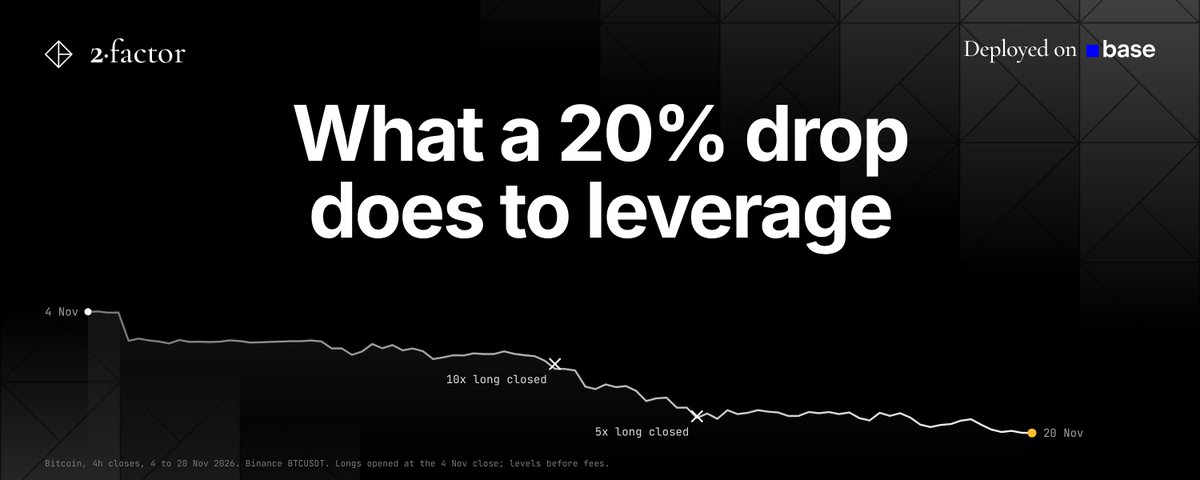
Most Bitcoin leverage talk asks: how much extra exposure can you get?
For long term holders, the better question is: can that exposure survive long enough to benefit from Bitcoin's growth?
@2FactorFinance treats leverage as an allocation problem, not a trading tool. BTC-Jr targets about 1.33x exposure with roughly 2/3 of its collateral in raw cbBTC, so in a severe drawdown leverage compresses toward ordinary BTC instead of liquidating the whole position.
Junior absorbs losses first, and Senior earns yield funded by leverage demand. Both still carry risk, and Senior can take losses if the Junior buffer is exhausted.
Maybe the best leverage isn't the highest multiple you can open. It's the exposure you can maintain through a full market cycle.
🤝 Paid partnership

7
22
128


Gmic lovely fam 🤎🩵🩷
The future of enterprise finance isn't just about automating routine tasks it's about active, intelligent execution.
With @SeismicSys, AI agents operate on private financial states to deliver real-time visibility over cash positions, proactive risk analytics, and seamless liquidity planning. By bridging autonomous workflows with strict human oversight, unified governance, and enterprise grade compliance, Seismic empowers finance teams to move faster and make smarter treasury decisions.
Welcome to the next era of AI-driven financial enablement.
@NoxxW3
@xealistt
🤝 Paid partnership · 🤖 Made with AI

12
40
388
Most leverage products are built for people who trade. @2FactorFinance is trying something different: leverage for people who hold.
Think of borrowing to hold a position as renting an umbrella for a storm that lasts years. The cost keeps ticking, and you can be forced to hand it back mid-rain. Funding bleeds, volatility eats compounding, and one sharp wick can liquidate you even when your thesis never changed.
So 2Factor splits BTC exposure into two perpetual tranches:
Senior (cbBTC-Sr): for people who want stability and yield, protected by the Junior tranche.
Junior (cbBTC-Jr): amplified BTC exposure targeting about 1.33x, with no traditional liquidation. Its losses are absorbed inside the structure.
The glue is a bidirectional funding rate. If too many people crowd into Junior, Junior pays Senior, which lifts Senior's return and pulls capital back toward it. If Senior gets crowded, it flips and Senior pays Junior. Whoever holds the less-demanded side gets paid, and the ratio drifts back to target. No outside shorts needed, the structure prices itself.
The math is plain: Junior uses roughly $0.33 of Senior capital per $1 of its own, so its cost sits near a third of Senior's yield. That yield is set by the market, so the cost moves too.
Why 1.33x and not 10x? Because the real question isn't how much leverage a platform can offer, it's how much exposure someone can realistically keep through full market cycles.
What I'd still watch: no liquidation doesn't mean no risk. Junior holders still take amplified losses when BTC falls, and Senior's cushion is only as thick as the Junior capital beneath it. How funding behaves in a real drawdown is the true test.
A different idea with honest trade-offs. Worth understanding before touching it. DYOR, not financial advice.
Which side would you take, Senior or Junior? 👇
@2FactorFinance
points.2factor.finance/r/0eh…
🤝 Paid partnership
Gprismaaaaaaaaa fam 😻
The future of Physical AI is here! 🔥
Say hello to PrismaX AI (@PrismaXai ) the revolutionary service layer for Physical AI that's bridging the gap between digital intelligence and robotic capabilities.
What is PrismaX AI?
It’s a decentralized robotics infrastructure and data market platform that connects humans and autonomous robots. They are solving the biggest roadblock in robotics today: the lack of diverse, high quality, real world data needed to train the next generation of general purpose robots!
🎯 The Three Pillars of the PrismaX Ecosystem:
🔹 Robotics Data: Providing AI builders with large scale, diverse, and proven demonstration data (including teleoperation and egocentric episodes) customizable to any task, scene, or robot arm.
🔹 VLA Foundry: The ultimate data engine where operators earn rewards by capturing the real world. Think of it as a decentralized “Driving School” for AI robots, where humans teleoperate machines to tackle complex, real world tasks.
🔹 The Web3 & Chain Connection: Powered by a decentralized incentive network (backed by $PIX on Solana & Monad), PrismaX enables a global crowd sourced workforce to generate high value, quality assured data, powered by AI driven verification (like their PoV & Eval Engine).
Backed by major investors like a16z crypto CSX, PrismaX is accelerating the transition from isolated automated systems to a collaborative, open machine economy!
Are you ready to be part of the robot revolution? 🦾
@vivianrobotics
@MaxC16134
🤝 Paid partnership · 🤖 Made with AI

7
28
299
Good morning my dear friend 🩷🩵
Let's let go so that space can be opened for good things👍🏻🍀
Your day is full of beauty events.😻

13
33
270
mahb00b.base.eth retweeted
genm fam 😺 GenLayer just made a few moves that fit together as one story. Here's the breakdown 👇
1. Arbitrum migration: infrastructure moved, the protocol didn't
On Oct 22, @GenLayer announced the move from zkSync/ZK Stack to Arbitrum, and it's now complete. The public chain runs on Arbitrum Nitro, operated with Conduit. Bradbury (the production-like testnet) is already live on it, and Clarke and mainnet will use the same infrastructure.
What moved is the layer that records transaction order, validator votes, appeals and final outcomes. How AI validators reach decisions is unchanged: Optimistic Democracy, GenVM, Intelligent Contracts and the appeal process all work as before. Only the points where contracts touch the chain changed (bridge, Ethereum integration, gas handling).
So builders don't need to change anything, and validators just connect their nodes to the new chain. One detail to keep straight: Stylus could help with compute-heavy parts later, but the consensus contracts are still Solidity today.
2. Season 2 is live, and $GEN is on CoinMarketCap
Since Season 1, thousands of contributions have come in across the Community and Builder categories, and projects like FUD Markets, Rally, Argue.fun and Internet Court have launched. The biggest change in Season 2 is how contributions are judged: points are assigned more selectively, based on quality, relevance, usefulness and reach. What each contribution adds matters more than how many you make.
Points convert to GLP automatically every week, until further notice:
• 0.05 GLP per Community Point
• 0.5 GLP per Builder Point
The CoinMarketCap Community mission pays 500 to 3,000 Community Points, which is 25 to 150 GLP. The gap comes down to how good the post is. A Builder Point is worth 10x a Community Point, which shows how much weight GenLayer puts on building. Also double-check you're on GenLayer's official CMC page, since more than one asset is called GEN.
3. Pre-mainnet staking
From THE DAY, your unclaimed airdrop GEN counts as staked automatically. You can stake more through the Portal and withdraw anytime. Every GEN earns 1 Staking Point per day, and the final leaderboard snapshot decides node seats. Selected participants become validators with Foundation-backed GEN supporting them, and Node-as-a-Service means you don't have to run the infrastructure yourself.
One side rewards value created, the other rewards time held.
4. Mainnet is getting closer
The roadmap targets Q4 2026, with December expected by the CEO. Testnets are already processing thousands of adjudicated decisions daily, and Internet Court is handling real workloads in beta.
GenLayer is building the adjudication layer for the agentic economy, and it's now moving from idea to real network infrastructure.
Genfrens, are you putting your time into contributing or into staking? 👀 @RuzgarFlns
🤝 Paid partnership
mahb00b.base.eth retweeted

Mandate : on-chain rules for AI agents that manage treasury funds
AI agents are starting to manage real money. The question is no longer whether an agent can trade. It is what happens when the agent is wrong, or compromised.
Mandate is our answer, built on @NEARProtocol.
The agent never holds a key. It can only propose a trade. A vault contract on NEAR checks every proposal on-chain against the owner's mandate: a per-trade cap, a daily turnover limit, an asset list, slippage against oracle prices, price freshness, position and drawdown limits, and an allowlist of the models allowed to decide. Only when every check passes does NEAR Chain Signatures sign the intent, and NEAR Intents settles it.
The owner stays in control. Loosening a rule, admitting a new model or withdrawing funds waits 24 hours. Tightening a rule or pausing the vault applies at once. Three refused trades halt the agent.
What we have shown on NEAR testnet :
• A 1 USDC withdrawal, delivered only after its full 24-hour delay
• A trade signed by the vault and settled on both ledgers
• 60 USDC refused by a 50 USDC per-trade cap, with nothing signed
• A Gemini model admitted through the owner's DAO after a 24-hour delay
• A model-decided trade, chosen from code-priced quotes, executed and settled
We kept the failures in the record too. The model's first decision valued $0.50 of NEAR at $50. It never executed, and the agent now refuses any request above the market before it reaches the chain.
Mandate is a testnet demo and is not audited. The counterparty is an account we control and the oracle is a testnet stand-in. Mainnet stays out of scope until those gates are closed.
Website: mandatenear.xyz
Code: github.com/moltaphet/mandate…
Built at NEAR HACKATHON. #NEARHackathon