

Agribusiness intelligence analyst / Researcher / Entrepreneur / Farmer / Food System / Climate / Policy / Economics / Health.
worldwide
Joined August 2022
- Tweets17.9K
- Following1.2K
- Followers15K
- Likes65.5K




Pinned Tweet
We live in a world where people would rather build housing estates than food estates.
Now you want to give people houses.
Which food will they eat?
@MikeAgrow

Oyeniran Michael retweeted
In tomato greenhouse farming, it takes a lot of experience and technical skill to grow quality tomatoes successfully.
One major problem inside the greenhouse is heat stress and high humidity.
When the temperature becomes too high, tomato pollen loses viability and pollination becomes poor. High humidity also makes the pollen sticky, so it does not move freely within the flower.
Unlike open-field farming where wind and insects naturally shake the flowers and assist pollination, greenhouse tomatoes have limited natural pollination activities.
Tomato flowers are self-pollinating, but they still need vibration or movement for the pollen to fall from the anther to the stigma for fertilization to happen. When this process fails, the flower dries off and drops.
To reduce these losses, farmers sometimes apply fruit-set hormones such as auxins or gibberellins.
These are plant growth regulators derived from natural plant hormones, not the “dangerous chemicals” many people imagine online.
Their work is to stimulate the tomato plant to continue fruit development even when pollination or fertilization is incomplete due to heat stress.
That is why some greenhouse tomatoes may have fewer seeds or become seedless.
In open-field tomato farming, natural wind, insects and better airflow often reduce the need for these interventions.


Tomato 🍅 pollination in a greenhouse is quite different from that of an open field.
In open fields, tomato 🍅 relies on pollinators. But it's a different game inside a greenhouse.
Unlike Habanero and Bell peppers, tomatoes 🍅, on the other hand, lack the natural wind and insects needed to shake the pollen loose because it's a protected cultivation.
Hence, there is a need to pollinate them either by introducing beneficial insects that will pollinate or make use of a fruit set hormone to pollinate, or a manual shaking.
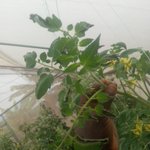
So, what my girls are doing in this video is making use of a fruit set hormone to pollinate and have a better fruit set.
It is never a rocket science. Yet, you need to know that this won't be taught in school.
If you are to be a successful agropreneur, it is all up to you.
#BaaleofMilan
#AgribusinessCoach
#FutureBillionaire
In tomato greenhouse farming, it takes a lot of experience and technical skill to grow quality tomatoes successfully.
One major problem inside the greenhouse is heat stress and high humidity.
When the temperature becomes too high, tomato pollen loses viability and pollination becomes poor. High humidity also makes the pollen sticky, so it does not move freely within the flower.
Unlike open-field farming where wind and insects naturally shake the flowers and assist pollination, greenhouse tomatoes have limited natural pollination activities.
Tomato flowers are self-pollinating, but they still need vibration or movement for the pollen to fall from the anther to the stigma for fertilization to happen. When this process fails, the flower dries off and drops.
To reduce these losses, farmers sometimes apply fruit-set hormones such as auxins or gibberellins.
These are plant growth regulators derived from natural plant hormones, not the “dangerous chemicals” many people imagine online.
Their work is to stimulate the tomato plant to continue fruit development even when pollination or fertilization is incomplete due to heat stress.
That is why some greenhouse tomatoes may have fewer seeds or become seedless.
In open-field tomato farming, natural wind, insects and better airflow often reduce the need for these interventions.
Tomato 🍅 pollination in a greenhouse is quite different from that of an open field.
In open fields, tomato 🍅 relies on pollinators. But it's a different game inside a greenhouse.
Unlike Habanero and Bell peppers, tomatoes 🍅, on the other hand, lack the natural wind and insects needed to shake the pollen loose because it's a protected cultivation.
Hence, there is a need to pollinate them either by introducing beneficial insects that will pollinate or make use of a fruit set hormone to pollinate, or a manual shaking.
So, what my girls are doing in this video is making use of a fruit set hormone to pollinate and have a better fruit set.
It is never a rocket science. Yet, you need to know that this won't be taught in school.
If you are to be a successful agropreneur, it is all up to you.
#BaaleofMilan
#AgribusinessCoach
#FutureBillionaire


Oyeniran Michael retweeted
I'm documenting different tomatoes symptoms and what they can tell us.
This one does not have a cure.
You can loose all your plant with this disease.


Oyeniran Michael retweeted
Most priority at the minimum we must be able to feed ourselves as a nation. Food security is encouraging new commercial agricultural production and then investing heavily in research and development
Umaru Musa Yar'Adua
Oyeniran Michael retweeted

One of the absolute perks of being in Niger State is the sheer abundance of food, especially yam. You can buy quality tubers here at unbelievable prices without breaking the bank.
But if we are being completely honest, my heart, and my taste buds, will always belong to Benue yam, specifically the famous Iyo (Adaka) variety. The sweetness, texture, and rich flavor of that particular yam are simply unmatched.
Niger State yam is great for everyday cooking and gets the job done, but when it comes to pure satisfaction? That Benue Iyo yam stands in a league of its own. It's not just food; it's a whole culinary experience! ❤️
#BIGMANFOOD #FoodieDiaries #NigerianFood #YamLovers

Most priority at the minimum we must be able to feed ourselves as a nation. Food security is encouraging new commercial agricultural production and then investing heavily in research and development
Umaru Musa Yar'Adua
I'm documenting different tomatoes symptoms and what they can tell us.
This one does not have a cure.
You can loose all your plant with this disease.
Oyeniran Michael retweeted

Behind every meal is a farmer who planted, nurtured, and worked hard to bring food to our tables.
Today, we celebrate farmers, appreciate the hands that feed us, and remember that food security begins with agriculture.
No farmers, no food. No food, no future.
Let’s value food, support farmers, and build a world where no one goes to bed hungry.
#WorldFoodDay #AprokoFarmer

Oyeniran Michael retweeted
A farmer harvests 200 crates of pepper (11 kg each) and spends ₦1.8M on production and selling.
Before the glut: ₦3,700/kg → ₦6.34M profit (77.9% margin)
During the glut: ₦1,000/kg → ₦400K profit (18.2% margin)
Price fell 73%. Profit fell 94%, because costs didn't fall with it.
A good harvest doesn't always mean a good business. Production and profitability are not the same thing.
How can we produce smart as a farmer ?
@MikeAgrow


Oyeniran Michael retweeted

We live in a world where people would rather build housing estates than food estates.
Now you want to give people houses.
Which food will they eat?
@MikeAgrow
A farmer harvests 200 crates of pepper (11 kg each) and spends ₦1.8M on production and selling.
Before the glut: ₦3,700/kg → ₦6.34M profit (77.9% margin)
During the glut: ₦1,000/kg → ₦400K profit (18.2% margin)
Price fell 73%. Profit fell 94%, because costs didn't fall with it.
A good harvest doesn't always mean a good business. Production and profitability are not the same thing.
How can we produce smart as a farmer ?
@MikeAgrow


Oyeniran Michael retweeted

50 tons of ginger from just 1 acre?
I know that sounds impossible.
Calm down.
Let me explain.
I just finished watching a detailed documentary on ginger production by an agricultural company in India.
They aren’t growing ginger in soil.
They’re growing ginger and turmeric in a greenhouse using a soilless production system.
But that’s not even the craziest part.
The greenhouse is just 1 acre.
Yet it holds 30,000 ginger plants.
Each seed rhizome they planted weighed about 70 grams.
At harvest, each plant reportedly produced around 2 kg of ginger.
Do the math.
30,000 plants × 2 kg = 60,000 kg of ginger.
The company said they are projecting 50,000 kg (50 tons) instead to account for uncertainty.
That got my attention.
It completely changed the way I’m thinking about the future of commercial ginger production.
Will I switch to soilless ginger farming tomorrow?
No.
Not yet.
For now, I’m doing more research.
I’m speaking with different soilless farming experts.
And I’m trying to understand what can realistically be adapted to Nigerian conditions.
The future belongs to farmers who never stop learning.

Oyeniran Michael retweeted
Good morning, farmers!
Let's settle this debate:
Which is more painful for a farmer?
A. Losing crops to pests and diseases.
B. Harvesting successfully but struggling to find buyers.
C. Selling your produce but discovering you made little or no profit.
D. A buyer refusing to pay after collecting your produce.
Pick your answer and tell us why.

