

Physician-scientist | Professor | Director Research @Texas_Heart and Director of EP @BCMHouston | co-PI with @KennethEllenbo1 of @leftvsleft RCT
Houston, TX
Joined November 2015
- Tweets1.9K
- Following277
- Followers1.7K
- Likes2.2K






Mihail G. Chelu, MD, PhD retweeted

The #HRS2027 Call for Science is open! 🔬 Add your work to the year’s biggest EP science: 1,800+ abstracts, 1,600+ posters, 200+ sessions, 10,000+ heart rhythm professionals.
📄 Submit your research by Dec 16: bit.ly/4yUyWXj
🙋♀ Want to shape the program another way? Volunteer to review submissions by Nov 15: bit.ly/3VP9PGL
Program Chair: @JagSinghMD
Abstract Chair: Christopher Liu, MD, FHRS
Program Committee: @MDTolgaAksu @Mel_Gunawardene @aymanhusseinmd @MoussaMansour10 @nmarrouche @DrSrivatsa @Vortexium32 @Nchatterjeemd @MaggieInfeld @rdschaller @dredcronin @DanielAlyeshmer @BadhwarNitish @MihailChelu @rajeshkabramd @PamelaMasonEP @PassmanRod @HamidGhanbariMD @raebaba @JonathanAriya @SergioPinski @swatirao24 @DrSanatani @aronismd @MaullyShah @Kantharia_EP

Mihail G. Chelu, MD, PhD retweeted

NEK7 activates the NLRP3 inflammasome in atrial cardiomyocytes and contributes to postoperative AF, constituting a potential therapeutic target for AF @naliphd #Epeeps
doi.org/10.1161/CIRCEP.126.0…

Mihail G. Chelu, MD, PhD retweeted

The 10th Annual Physiology of Pacing Symposium (#PPS10) is right around the corner! Reminder to fellows to submit their science (300 word abstract, up to 2 figures) for our abstract competition by October 1, 2026 to [email protected].
cvent.me/XmZMW9
Mihail G. Chelu, MD, PhD retweeted

The HIS Alternative II study is now available in JACC-EP:
kwnsfk27.r.eu-west-1.awstrac…
Mihail G. Chelu, MD, PhD retweeted

Celebrating 10y🎖️at the forefront of Conduction System Pacing
Nov 6
• Live procedural broadcasts
• Breakthrough clinical trial data
• Actionable strategies for CSP implementation
Don’t miss this milestone event! cvent.me/XmZMW9
@gauravaupadhyay @DrRoderickTung

#PPS10 PHYSIOLOGY OF PACING SYMPOSIUM
10th Anniversary ⭐️⭐️⭐️⭐️⭐️⭐️⭐️⭐️⭐️💜
Wait is over; registration 📥for the biggest and best event of the year in Cond. Syst. Pacing 🌿
@gauravaupadhyay @DrRoderickTung @KennethEllenbo1 @pvijayaraman1 @GDandamudiMD
cvent.me/XmZMW9


Mihail G. Chelu, MD, PhD retweeted
Excited to welcome you this Fall to Chicago and the 10th Annual Physiology of Pacing Symposium (#PPS10)! Join us where the #physiologicalpacing movement took off! cvent.me/XmZMW9 @DrRoderickTung @KennethEllenbo1 @Hisdoc1 @GDandamudiMD #EPeeps #HRS #HRSSynchronicity

Excited to share our newest publication in @JACCJournals from Chelu & @naliphd Labs!
👏Congrats to Tingting Li for leading this work!
We show LMNA deficiency causes progressive AV block, with SK3 dysfunction as a novel mechanism and therapeutic target.
authors.elsevier.com/a/1nZoN…
Mihail G. Chelu, MD, PhD retweeted

Enrollment in HIS-CRT is complete!
This milestone would not have been possible without the dedication of our site investigators, study coordinators, and most importantly, the participants.
#HISCRT #ClinicalTrials #Cardiology #HeartFailure #ClinicalResearch
Mihail G. Chelu, MD, PhD retweeted
#PPS10 PHYSIOLOGY OF PACING SYMPOSIUM
10th Anniversary ⭐️⭐️⭐️⭐️⭐️⭐️⭐️⭐️⭐️💜
Wait is over; registration 📥for the biggest and best event of the year in Cond. Syst. Pacing 🌿
@gauravaupadhyay @DrRoderickTung @KennethEllenbo1 @pvijayaraman1 @GDandamudiMD
cvent.me/XmZMW9
Mihail G. Chelu, MD, PhD retweeted
NEW EPISODE OF THE LEAD!
[Ep. 146] A Discussion of LEAP2: A First-In-Human Study of a Chronically-Implanted Novel Leadless Pacemaker for Conduction System Pacing
🎙️ Host: Christopher C Cheung, MD, MPH, FHRS (@ChrisCheungMD)
🎤 Guests: Derek Chew, MD, MS, FHRS (@derek_c1) and Mihail G. Chelu, MD, PhD, FHRS (@MihailChelu)
Listen on your preferred podcast platform
➡️
bit.ly/48bpxNn
#EPeeps #medpod #podcast #CardioTwitter #EPTwitter #PodcastAndChill
Mihail G. Chelu, MD, PhD retweeted

#HeartFailure (HF) affects more than 64 million individuals worldwide, and acute HF is associated with 1-year mortality rates of 23.6% in North America and Europe.
Cardiac resynchronization therapy restores synchronous ventricular activation in patients with HF, reduced LVEF, and left bundle-branch block, or in those requiring chronic ventricular pacing, and may improve LV function, decrease HF hospitalizations, and reduce mortality. 🧵
🔗 Learn more in this JAMA Review: ja.ma/4tTXfSR

Our newest review on CRT is online in JAMA:
jamanetwork.com/journals/jam… @KennethEllenbo1 @CaiqueTernesMD

Our lead extraction experience @Texas_Heart and @bcmhouston published online in Cardiovascular Drugs and Therapy.
rdcu.be/e86d2
Mihail G. Chelu, MD, PhD retweeted

New in The New England Journal of Medicine: Physiologic Pacing in Heart Failure by @MihailChelu. The review summarizes how physiologic pacing has improved outcomes in heart failure.
Read more: lnkd.in/gvRRXndn

Mihail G. Chelu, MD, PhD retweeted

Cardiac physiologic pacing can be achieved with biventricular pacing with a right ventricular lead and coronary sinus lead or conduction system pacing by way of the His bundle or left bundle branch. It is indicated in patients with heart failure, left ventricular ejection fraction (LVEF) of 50% or less, and high or anticipated high ventricular pacing burden and left ventricular resynchronization in patients with a wide QRS complex.
His bundle pacing is the most physiologic pacing mode, because it preserves the natural activation of the left and right ventricles. It is indicated in patients with atrioventricular nodal and intra-Hisian conduction system disease that is associated with symptomatic bradycardia. His bundle pacing can also correct left bundle-branch block in the subgroup of patients who have disease in the His–Purkinje fibers that become the left bundle branch.
Left bundle-branch pacing requires the implantation of a pacing lead through the interventricular septum to the left ventricular subendocardial left bundle branch or its fascicles. This procedure has rapidly become the dominant conduction system pacing approach owing to its higher success rate and lower and more stable pacing thresholds than those obtained with His bundle pacing, and because it provides correction of left bundle-branch block due to disease below the level of the His bundle (seen in figure).
Learn more in the Review Article “Physiologic Pacing in Heart Failure” by @MihailChelu, MD, PhD, Jeanne E. Poole, MD, and Kenneth A. Ellenbogen, MD (@KennethEllenbo1), from the Baylor College of Medicine (@bcmhouston), University of Washington (@UW), and Virginia Commonwealth University School of Medicine: nej.md/4qqjSfI

ALT Panel A: Baseline ECG findings in a patient with left bundle-branch block (LBBB)–induced cardiomyopathy (QRSd, 138 msec) with an LVEF of 30 to 35%. Panel B: An ECG from the same patient with left bundle-branch pacing and a paced QRSd of 86 msec.
Mihail G. Chelu, MD, PhD retweeted
A new review summarizes cardiac physiologic pacing for heart failure, highlighting benefits of biventricular pacing and emerging evidence for His-bundle and left bundle-branch pacing to improve function and outcomes.
Read the Review Article “Physiologic Pacing in Heart Failure” by @MihailChelu, MD, PhD, Jeanne E. Poole, MD, and Kenneth A. Ellenbogen, MD (@KennethEllenbo1), from the Baylor College of Medicine (@bcmhouston), University of Washington (@UW), and Virginia Commonwealth University School of Medicine: nej.md/4qqjSfI
Mihail G. Chelu, MD, PhD retweeted
A new review summarizes cardiac physiologic pacing for heart failure, highlighting benefits of biventricular pacing and emerging evidence for His-bundle and left bundle-branch pacing to improve function and outcomes.
Figure 2 from the review shows His bundle pacing on electrocardiogram (ECG).
Panel A shows an ECG of right ventricular pacing with a paced QRS duration (QRSd) of 190 msec. In this patient, who had complete heart block at baseline and a left ventricular ejection fraction (LVEF) of 60 to 65%, pacing-induced cardiomyopathy developed, leading to a LVEF of 35 to 40% with 100% right ventricular pacing.
Panel B shows an ECG of His bundle pacing with a paced QRSd of 82 msec. Upgrading the patient’s pacemaker to a His bundle pacemaker improved the LVEF to a range of 60 to 65%.
Learn more in the Review Article “Physiologic Pacing in Heart Failure” by @MihailChelu, MD, PhD, Jeanne E. Poole, MD, and Kenneth A. Ellenbogen, MD (@KennethEllenbo1), from the Baylor College of Medicine (@bcmhouston), University of Washington (@UW), and Virginia Commonwealth University School of Medicine: nej.md/4qqjSfI
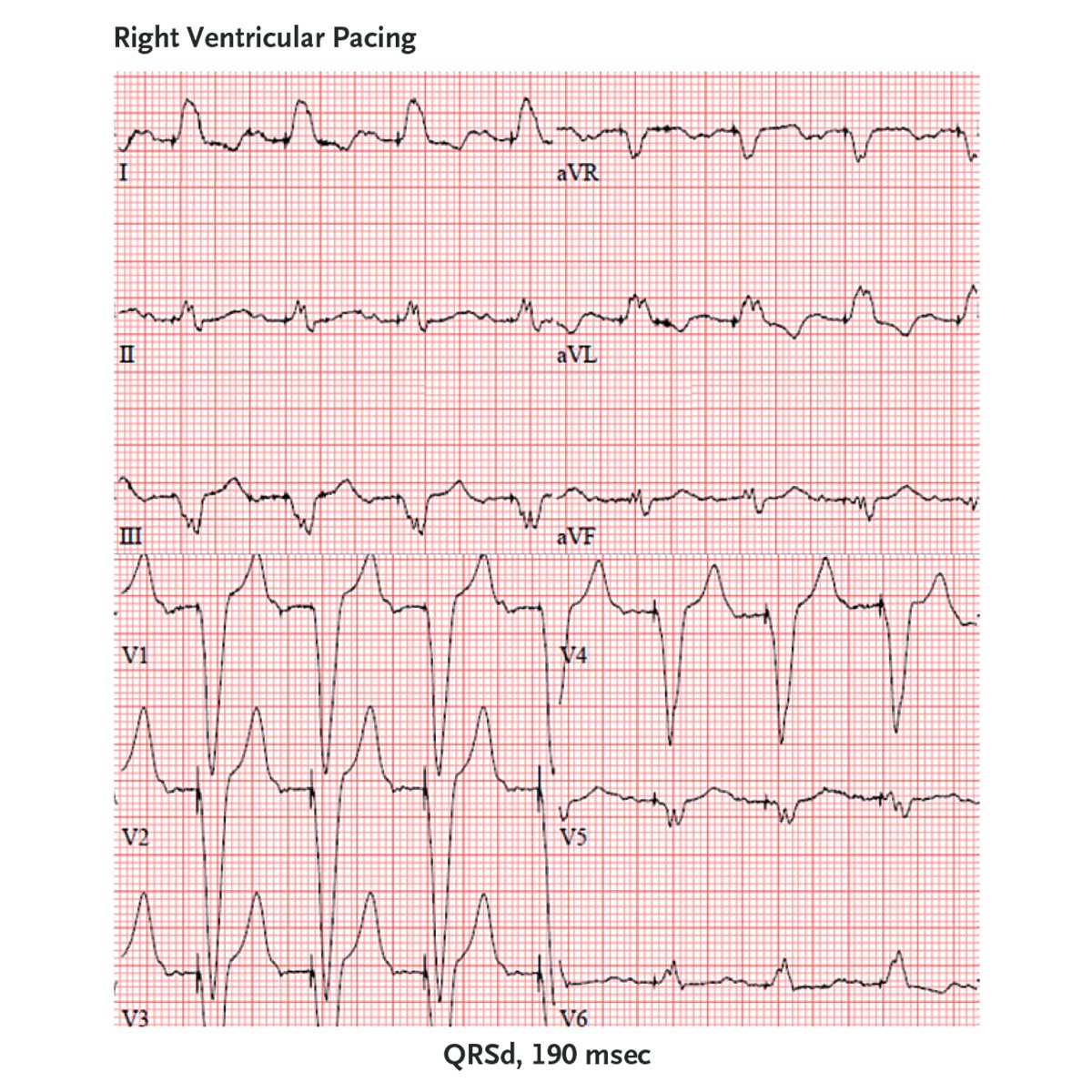
ALT An ECG of right ventricular pacing with a paced QRS duration (QRSd) of 190 msec.
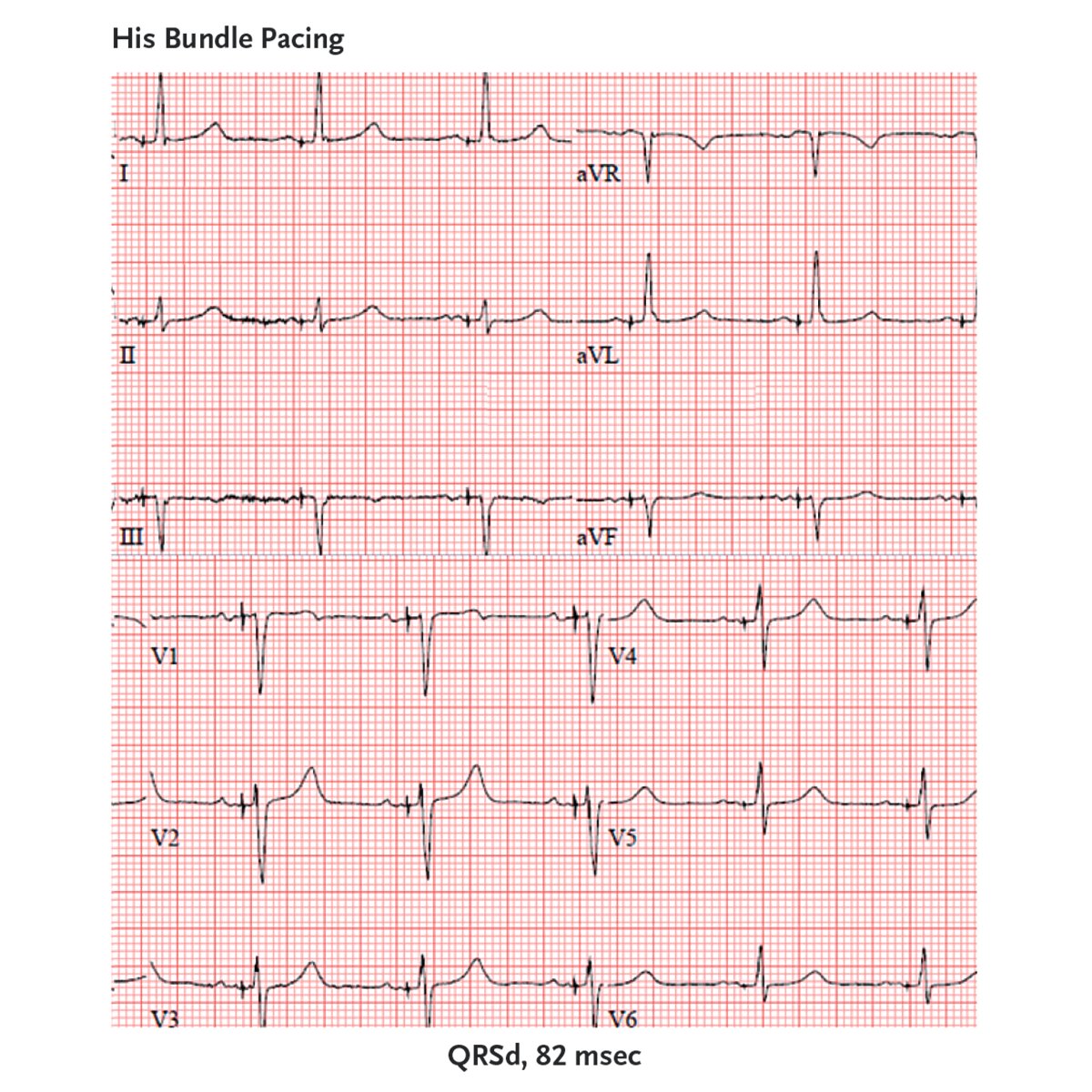
ALT An ECG of His bundle pacing with a paced QRSd of 82 msec.
Mihail G. Chelu, MD, PhD retweeted

HEART ALERT ❤️🔥
Next week’s the big week! Join top experts at the Ali Massumi Symposium—where innovation pulses.
👉 Register now: bit.ly/4pJszAJ
@Texas_Heart @BCMHeart @BCM_Alumni @tcainstitute

📅Mark your Calendar for the Ali Massumi Cardiac Arrhythmia Symposium 2026
📍The Westin Houston Medical Center
January 31, 2026
Register here: bit.ly/4pJszAJ
@Texas_Heart @BCMHeart @bcmhouston #CardioEd @MihailChelu

Mihail G. Chelu, MD, PhD retweeted

Must-read review in the latest issue of the NEJM on physiologic pacing in HF nejm.org/doi/full/10.1056/NE… @NEJM


Mihail G. Chelu, MD, PhD retweeted
Cardiac physiologic pacing, also known as cardiac resynchronization therapy, is indicated in patients with heart failure, reduced left ventricular ejection fraction (LVEF) of 50% or less, and either a high (or anticipated high) ventricular pacing burden or a wide QRS complex. Traditionally, physiologic pacing has been achieved with biventricular pacing with a right ventricular lead and a coronary sinus branch lead. Randomized trials involving more than 10,000 patients with heart failure have shown clinical, exercise, and quality-of-life benefits associated with biventricular pacing, as well as improved LVEF and reduced mitral regurgitation and ventricular volumes. These benefits are greatest in patients with left bundle-branch block and a QRS duration of 150 msec or longer. Recent studies support targeting the His bundle or left bundle branch as an alternative cardiac physiologic pacing strategy. Ongoing randomized trials are expected to more clearly define the comparative efficacy and safety of conduction system pacing as compared with biventricular pacing.
Read the Review Article “Physiologic Pacing in Heart Failure” by @MihailChelu, MD, PhD, Jeanne E. Poole, MD, and Kenneth A. Ellenbogen, MD (@KennethEllenbo1), from the Baylor College of Medicine (@bcmhouston), University of Washington (@UW), and Virginia Commonwealth University School of Medicine: nej.md/4qqjSfI

ALT A figure showing lead configurations.