Earth Science & Astronomy Teacher / @HoffmanBlueCrew & @OutdoorAdv_HEHS & @HEHSGSA sponsor & @HoffmanHawksLax coach. I love my job!!
- Tweets6K
- Following294
- Followers444
- Likes10.6K





ALT An image of Enceladus captured by NASA’s Cassini spacecraft during a 2005 flyby. The circular moon peeks out from the vast black darkness of space. The moon is primarily white and almost looks like it is draped in a blanket of snow and ice. Long fissure lines crisscross along the surface in every direction revealing a light blueish color in the crevice of each fissure, possibly from the ocean below the surface.

ALT A close-up image of the icy crust at the south pole of Enceladus. The top half of the image is hazy blackness. The moon arcs over the lower half of the image with only a portion of the surface lit up and visible. Several geysers are visible on the surface, spraying particles into space.


ALT The curving horizon of Saturn's moon Enceladus as seen from space by the Cassini spacecraft. The surface has a rough, wrinkled texture. From fissures in the surface, misty plumes are seen rising.


ALT The Artemis II Crew Astronauts pose for a photo in their orange spacesuits. Pictured: Commander Reid Wiseman, Pilot Victor Glover, Mission Specialist 1 Christina Koch, Mission Specialist 2 Jeremy Hansen. Credits: NASA/Josh Valcarcel






ALT The background of space is black. Thousands of galaxies appear all across the view. Their shapes and colors vary. Some are various shades of orange, others are white. Most stars appear blue, and are sometimes as large as more distant galaxies that appear next to them. A very bright star is just above and left of center. It has eight bright blue, long diffraction spikes. Between 4 o’clock and 6 o’clock in its spikes are several very bright galaxies. A group of three are in the middle, and two are closer to 4 o’clock. These galaxies are part of the galaxy cluster SMACS 0723, and they are warping the appearances of galaxies seen around them. Long orange arcs appear at left and right toward the center.


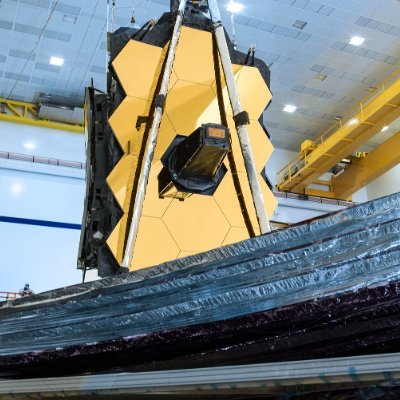
ALT The Webb telescope's primary mirror is inside a facility laying on its side, with engineers in white protective suits. The mirror's two wings that give it its honeycomb shape are not deployed in this image. Its secondary mirror, held by a long boom, is deployed in front of the primary mirror. The primary mirror is made up of multiple hexagonal mirrors assembled into one shape, and are covered in gold.


ALT Friendship 7 on display at the Udvar-Hazy Center