Pinned Tweet
Social needs may be an important part of the acute-to-chronic pain story.
In first-year findings from our PREVENT cohort, ED patients reporting multiple social needs had substantially higher adjusted anxiety and depressive symptoms, pain catastrophizing, and disability compared with patients reporting no social needs.
Importantly, these estimates were adjusted for age, gender, race, ethnicity, and current pain intensity.
These findings reinforce the importance of considering the broader biopsychosocial context when trying to understand recovery after acute musculoskeletal pain—and may help inform how we identify and support patients at risk for persistent pain after ED discharge.
Our first-year PREVENT manuscript has been published open access by the @CambridgeCore Journal of Clinical & Translational Science.
cambridge.org/core/journals/…
#pain #research #recovery
@GWHospital @GW_OVPR @GW_RRIEM @GWtweets @GWSMHS
I’ve been working on this book chapter for the past several months, and I’m happy to report that it is now complete and off to the editors.
This is the first book chapter I’ve written, and I’m grateful for the opportunity to contribute to an educational text focused on pain management in emergency medicine. As both a clinician and a pain researcher, it was an interesting exercise in translating what I know about pain science and assessment into something practical and clinically useful in the emergency department.
I especially enjoyed writing the section on pain assessment when self-report is limited or unavailable.
Thinking carefully about how we assess pain when we cannot rely on a patient’s direct report-using potential sources of pain, adapted communication, behavioral observation, caregiver or proxy information, and response to intervention-was a learning experience for me as well. It also reinforced an important distinction: these approaches can help us infer the likelihood that pain is contributing to a patient’s presentation, but they are not an objective substitute for the patient’s subjective experience.
As I often used to tell my students: we learn by doing.
Writing this chapter certainly reinforced that for me.
I hope clinicians and learners find it useful. I’ll share more when Practical Pain Management in Emergency Medicine is published. #academic #clinician #scientist #bookchapter #pain #emergency
If you’ve recently tried to email me at my GW address, your message may not have been delivered.
For the time being, please reach me at [email protected] instead.
Thanks!
Michael Ray retweeted
Replying to @MichaelRayDC
the link between social burden and pain beliefs is something i've seen in many contexts seeing it here in the data is powerful.
Michael Ray retweeted
New NIH data show that the average age at first R01-equivalent award has remained stable since FY 2021. Read about the trends and NIH's continued commitment to supporting the next generation of biomedical researchers.
đź”— bit.ly/3Sw3H4N

ALT Chart titled "Age at First R01-Equivalent Award Remains Stable Since FY21" with a table showing fiscal years 2021 to 2025. It lists the number of investigators, mean age, and median age for each year. The mean age ranges around 43.1 to 43.6 years, and the median age remains consistently at 42 years. NIH logo is visible at the bottom.
Michael Ray retweeted
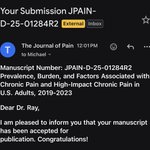
Original: Dr. @MichaelRayDC examined temporal trends, a complementary prevalence-burden framework, and multilevel correlates of chronic pain and high-impact chronic pain.
FULL: jpain.org/article/S1526-5900…
Happy to see this work published in the August issue of @TheJournal_Pain
sciencedirect.com/science/ar…
Using nationally representative data from 91,001 U.S. adults, I found that:
✒️Chronic pain prevalence increased from 20.5% in 2019 to 24.3% in 2023—nearly 1 in 4 adults.
✒️High-impact chronic pain increased from 7.5% to 8.5%.
✒️Chronic pain and high-impact chronic pain were strongly patterned by socioeconomic disadvantage, poor overall health, rheumatic conditions, anxiety and depressive symptoms, health care utilization, and cost-related barriers to care.
One of the most striking findings was that people with chronic pain were not necessarily disconnected from the health care system:
92.5% had health insurance.
91.0% had a usual source of care.
90.7% had seen a physician within the past year.
At the same time, chronic pain prevalence rose substantially with greater health care utilization-from 18.7% among adults with no emergency department visits to 56.5% among those with four or more visits.
Why is this important?
Having insurance and interacting with the health care system do not necessarily translate into timely, affordable, coordinated, or effective pain care. High utilization may be a marker of unresolved needs rather than adequate treatment. These findings suggest that the opportunity to improve pain care is already present within routine clinical encounters-but realizing it will require greater attention to affordability, continuity, coordination, and access to multidisciplinary, evidence-based care.
A special shoutout to Alison McGuire with the GW iMPACT team for creating this compelling artwork embodying that central finding: many Americans living with chronic pain are insured and actively engaging with the health care system, yet substantial unmet needs remain.
I'm grateful to everyone who contributed to this work and hopeful that these findings can support more equitable screening, care planning, and pain-management strategies.
#ChronicPain #PainResearch #PublicHealth
I've enjoyed the process of writing a chapter on pain assessment in the emergency department. It has been an interesting exercise in threading the needle between what I know as a pain researcher and what is practical and useful in emergency clinical care.
My hope is to advocate for multidimensional pain assessment that moves beyond body-region location and numerical pain-intensity ratings-without delaying appropriate care or disrupting patient throughput.
One section of the chapter explores what this could look like in practice. It begins with an overview of nociceptive, neuropathic, and nociplastic pain mechanisms, followed by a discussion of pain location and distribution and how these features can inform clinical reasoning.
If you are an emergency clinician or researcher and would be willing to read a draft and provide feedback, please let me know. Your perspective would be greatly appreciated, particularly in ensuring that the chapter remains clinically pragmatic and applicable to the realities of emergency care.
#research #scientist #clinician #pain #assessment #measurement
Pain outcomes question:
Is there a defensible citation for what constitutes a clinically meaningful between-group difference in change scores?
IMMPACT gives useful benchmarks for within-person pain improvement, but I’m trying to avoid incorrectly applying individual MCID thresholds to between-group contrasts.
Michael Ray retweeted
BMJ Medical Humanities is accepting submissions for an upcoming Topic Collection: "Medicine, Meaning and Metaphor: Arts and Humanities as essential partners in medical and healthcare training". Deadline: 27th October 2026. More information: bit.ly/4eA2ZvJ #medhums
Another grant submitted — this time an R01.
PREPARE Pain is a clinical observational study focused on emergency department patients with acute musculoskeletal injury, with the goal of better characterizing pain trajectories, patient needs, and readiness for intervention.
I’m proud of this one.
Proud because it reflects years of thinking about how acute pain becomes chronic pain, why some patients recover while others do not, and how emergency care might become an earlier point of identification and support.
Proud because large observational work like this is foundational. Before we can build better interventions, we need to understand the people, trajectories, contexts, and needs those interventions are meant to serve.
And proud because getting an R01 out the door takes a tremendous amount of work from a lot of people — mentors, collaborators, research staff, grants teams, institutional partners, and community voices.
At the same time, it feels strange to celebrate a federal grant submission in the current research funding climate. There is no shortage of uncertainty, constraint, and absurdity in the system right now, and so much important work is being submitted into an ecosystem that feels increasingly unpredictable.
But maybe that makes the act of submitting even more meaningful.
We keep asking the questions.
We keep building the teams.
We keep trying to do the work that matters.
Very grateful to everyone who helped get this across the line.
#PainResearch #EmergencyMedicine #ChronicPain #MusculoskeletalPain #NIH #R01 #ImplementationScience #HealthServicesResearch
Nice write-up on the inappropriate use of MCID — a within-person change statistic that is too often misapplied as a between-group comparator to justify or refute interventions. sites.duke.edu/cemmt/2026/02…
@chadcookpt
Michael Ray retweeted
📢 Are you an early career researcher?
Join an NIGMS webinar to learn about PAR-27-032: Maximizing Investigators’ Research Award (MIRA) for Early Stage Investigators (ESI).
📝It’s easier than ever to apply with a new streamlined funding opportunity format.
đź“… July 15 at 2 PM ET
No registration required. Participation is optional.
Learn more: bit.ly/4uH3jh5
Michael Ray retweeted
Interested in applying for a career development (K) award? 📝
Learn all about percent effort and support for the designated project director/principal investigator: bit.ly/4e1FQlv

ALT Chart explaining the "100% Full-Time Professional Percent Effort for K Award PD/PIs" by the National Institutes of Health. It shows a pie chart: 75% is highlighted in blue for minimum effort dedicated to the K award, and 25% in green for effort not devoted to the K award. Additional text clarifies requirements for salary sources.
Over the past two years transitioning full-time into research and attending countless grant-writing conferences and workshops, I’ve found myself wondering how many phenomenal ideas simply die on the vine.
Like many entering academia, I initially believed that strong questions, rigorous methods, and meaningful potential impact would naturally rise to the top and get funded. But science conducted within human systems is rarely that straightforward.
Research funding is still shaped by people, institutions, incentives, timing, networks, communication, and perception. Even with safeguards against bias, we are still operating within systems we constructed ourselves. A well-researched hypothesis paired with a well-designed study does not guarantee extramural funding.
Ironically, some of my greatest assets as a researcher came from the decade I spent owning and operating a business. Learning how to market ideas, advocate relentlessly in unstable environments, build relationships, communicate value clearly, and keep moving despite rejection.
Maybe that’s the disconnect. Academics aren’t immune from the realities of persuasion and visibility. Our science often doesn’t stand on its own — at least not initially.
Maybe the old sales principle applies here too: Always Be Closing.
#research #academic #clinician
🤖 Made with AI
IASP endorses the PAINDIFF recommendations for the inclusion and study of sex and gender in pain research, supporting greater rigor, transparency, and reproducibility across preclinical and clinical pain research. Learn more: bit.ly/4dkFk0f
For me, the postdoctoral position at @GWSMHS through the Primary Care Research Training Program has been invaluable. Beyond the mentorship, resources, and connections, it gave me something equally important: time. Time to further establish myself as an investigator, gather preliminary data, and write grants.
Since July 2025, I have submitted $1.5 million in grant applications, submitted four manuscripts, had three accepted, and have two upcoming research presentations.
None of the grants have been awarded yet, but I’m optimistic that some will be soon.
Feeling grateful and hopeful. #research #grants #academic #clinician