

Assistant Professor of CS at @JohnsHopkins, Part-time Visiting Scientist @AbridgeHQ. Previously: Postdoc at @CarnegieMellon. PhD from @MIT_CSAIL.
Baltimore, MD
Joined August 2011
- Tweets258
- Following1K
- Followers2.1K
- Likes5K




Looking for a postdoc in AI? Consider applying to the @HopkinsDSAI postdoctoral fellowship program at Johns Hopkins!
I mentor postdocs in this program, so feel free to mention my name as a potential mentor in your application :)
Apply by Dec. 11: apply.interfolio.com/196237

Join us in advancing data science and AI research! The Johns Hopkins Data Science and AI Institute Postdoctoral Fellowship Program is now accepting applications for the 2027–2028 academic year. Apply now! Deadline: Dec. 11, 2026.
Details and apply: apply.interfolio.com/196237
If you’re at CHIL in Seattle, check out our paper, led by @andrewzw20 !


Come join my group at Johns Hopkins!
I'm recruiting CS PhD students for Fall'26 (deadline: Dec 15) who are interested in safe/reliable AI in healthcare. See my website (link in reply) for more info.
I'm also headed to #NeurIPS, and happy to chat with prospective students!

For more information about me and my group, see my website, which also has information on applying to the CS PhD program (michaelkoberst.com/)

1
2
234
Excited to welcome a lot of new colleagues!
#HopkinsDSAI welcomes 22 new faculty members, who join more than 150 DSAI faculty members across @JohnsHopkins in advancing the study of data science, machine learning, and #AI and translation to a range of critical and emerging fields.
ai.jhu.edu/news/data-science…

Randomized trials (RCTs) help evaluate if deploying AI/ML systems actually improves outcomes (e.g., increases survival rates in a healthcare context)
But AI/ML models can change: Do we need a new RCT every time we update the model? Not necessarily, as we show in our UAI paper!

ALT Abstract of paper titled "Just Trial Once: Ongoing Causal Validation of Machine Learning Models"
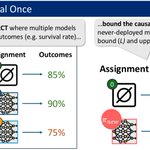
We develop a method for placing bounds on the impact of a *new* ML model, by re-using data from an RCT that did not include the model.
These bounds require some mild assumptions, but those assumptions can be tested in practice using RCT data that includes multiple models.

ALT Conceptual figure: Given data from a cluster RCT where multiple models were trialed with varying outcomes (e.g., survival rate), we bound the causal effect of deploying a new never-deployed model
1
100
I'm recruiting PhD students for Fall 2025! CS PhD Deadline: Dec. 15th.
I work on safe/reliable ML and causal inference, motivated by healthcare applications.
Beyond myself, Johns Hopkins has a rich community of folks doing similar work! Come join us!

Application Link: cs.jhu.edu/academic-programs…
More information on my website: michaelkoberst.com/joining

1
5
1,855
Worth reading, esp. for PhD students stressed about # of pubs. Refreshing to have a take from someone who isn't "on the other side", as Elan puts it.
Since Elan is on the job market, I should note he really puts this into practice - I have deep respect/admiration for his work.

I'll be at NeurIPS next week - excited to see old friends and meet new ones with similar research interests (reliable ML/causal inference/ML for healthcare).
Hit me up (DM or email) if you'll be at NeurIPS and would like to chat! I'm also recruiting PhD students for Fall 2024.

I'm recruiting PhD students for my lab at Johns Hopkins!
Please apply if you're interested in reliable ML / causal inference for decision-making in healthcare. See my website (moberst.com) for more info.
Deadline 12/15. Retweets welcome :)
cs.jhu.edu/academic-programs…

I'm recruiting PhD students for my lab at Johns Hopkins!
Please apply if you're interested in reliable ML / causal inference for decision-making in healthcare. See my website (moberst.com) for more info.
Deadline 12/15. Retweets welcome :)
cs.jhu.edu/academic-programs…
It's official! I'll be joining @JohnsHopkins as an Assistant Professor of Computer Science in summer 2024 - in the interim I'll be a postdoc at @CarnegieMellon in the Machine Learning Department working with @zacharylipton. Excited for the next chapter!

If you're at #NeurIPS2022, come check out this work today from 11-1pm at poster #813!
2⃣ How should you use experimental data in causal inference, if it *excludes* the population you care about?
Idea: Uncover bias in observational data that *does* cover the relevant population
(w/@zeshanmh @rg_shih @david_sontag)
📅 Poster: Thu 11am, #813
arxiv.org/abs/2209.13708

I'm at #NeurIPS2022! Presenting (w/@david_sontag)
1⃣ Evaluating Robustness to Dataset Shift via Parametric Robustness Sets (Tue 4pm, #313)
neurips.cc/virtual/2022/post…
2⃣ Falsification before Extrapolation in Causal Effect Estimation (Thu 11am, #813)
neurips.cc/virtual/2022/post…
🧵(1/3)
1⃣ How sensitive is your prediction model to changes in the causal data-generating process?
We give a method for worst-case evaluation under a flexible class of user-specified changes.
(w/@nikolajthams @david_sontag)
📅 Poster: Tue (today!) 4pm, #313
arxiv.org/abs/2205.15947

For anyone looking at PhD programs in machine learning, having a great advisor is (by far) the most important consideration.
Fredrik is both brilliant and kind - don't sleep on the opportunity to work with him!

We have a PhD student position open in my group—deadline Sunday this week (Oct 2)! chalmers.se/en/about-chalmer…
1
10
Missed our poster at the Spurious Correlation workshop? You're in luck!
We're presenting the poster again at the Principles of Distribution Shift (PODS) workshop at #ICML2022
Poster Session today (Sat) from 11:50am-12:30pm, in Ballroom 3
How should you evaluate the worst-case performance of your model under distribution shift, with only data from the training distribution?
Preprint with @david_sontag, @nikolajthams, at SCIS (Fri) and PODS (Sat) workshops at #ICML2022
Paper: arxiv.org/abs/2205.15947
(1/6)

1
Come check out the poster in the Spurious Correlations, Invariance, and Stability (SCIS) workshop at #ICML2022 !
Come chat 1:30pm-2:45pm today (Fri), in room 340, and again from 5:45pm-7pm.
How should you evaluate the worst-case performance of your model under distribution shift, with only data from the training distribution?
Preprint with @david_sontag, @nikolajthams, at SCIS (Fri) and PODS (Sat) workshops at #ICML2022
Paper: arxiv.org/abs/2205.15947
(1/6)
How should you evaluate the worst-case performance of your model under distribution shift, with only data from the training distribution?
Preprint with @david_sontag, @nikolajthams, at SCIS (Fri) and PODS (Sat) workshops at #ICML2022
Paper: arxiv.org/abs/2205.15947
(1/6)
Very cool idea from colleagues at MIT, with a lot of useful applications, check it out!

Come hear about work on datamodels (arxiv.org/abs/2202.00622) at ICML *tomorrow* in the Deep Learning/Optimization track (Rm 309)! The presentation is at 4:50 with a poster session at 6:30. Joint work with @smsampark @logan_engstrom @gpoleclerc @aleks_madry

7
Just got my badge at #ICML2022, it’s been a while! Excited to reconnect with old friends and meet new ones - DM me if you’re interested in chatting about causality and/or distributional robustness!

Well deserved!

Life update! Starting summer 2023, I'll be an Assistant Professor in UC Berkeley + UCSF's new Computational Precision Health program (computationalhealth.berkeley…) with a joint appt in Berkeley EECS. Starting Aug 2022, I'll be a Postdoc at Microsoft Research New England

6
When can we learn predictive models that are robust to shifts in unobserved variables? With co-authors @nikolajthams, Jonas Peters, and @david_sontag, we tackle this question in our recent ICML paper.
Paper: arxiv.org/abs/2103.02477
Video: youtu.be/8ZiZDtJDIFk
[1/n]
