

The Meteoritical Society (est. 1933) is an international organization dedicated to the research & promotion of planetary science.
- Tweets360
- Following325
- Followers1.1K
- Likes218

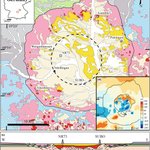







ALT (a) Geographic location of the Nördlinger Ries impact crater in Germany; (b) lithological map of the Ries crater and sampling locations (modified after Zhao et al., 2022); (c) sketch of the crater profile (modified after Zhao et al., 2022); and (d) aeromagnetic anomaly map (nT; after Pohl et al., 2010). Bruno Daniel Leite Mendes et al., 2024


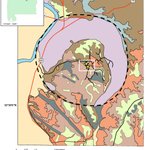
ALT Geologic map of Wetumpka structure, modified after King et al. (2015). Note that the legend is not in stratigraphic order. Yellow stars show the location of the central polymict breccia outcrops in the apparent crater floor that are the subject of this work. Dashed line shows the approximate extent of the crater rim, and dotted line represents the extra-crater terrain (modified from King et al., 2006). Inset shows the location of Wetumpka crater in Alabama. Neeraja S. Chinchalkar et al., 2024
ALT (a) Geographic location of the Nördlinger Ries impact crater in Germany; (b) lithological map of the Ries crater and sampling locations (modified after Zhao et al., 2022); (c) sketch of the crater profile (modified after Zhao et al., 2022); and (d) aeromagnetic anomaly map (nT; after Pohl et al., 2010). Bruno Daniel Leite Mendes et al., 2024


ALT The lunar dust samples obtained from the Apollo 11 Moon landing site; Grain#1 and Grain#4 are suspected agglutinate particles, while Grain#2 and Grain#3 are likely individual common mineral clasts found on the lunar surface. The samples were extracted from mature mare sample 10084 and encased in epoxy resin to minimize contamination. (Tai-Jan Huang et al., 2024)


