








There are innumerable reasons to dislike monetization on X.
1) I'm not eligible
If any of these underlying facts change, I'd be willing to reconsider my sentiment.
No matter how divided we become, or how the lines of division change, my life experience has shown me again and again that under every banner, slogan, philosophy or religion, you can find all kinds of people, whose entirety is much more.
When someone writes [color]-pilled, I can't remember the lore of their pill color. Why should I have to keep track of other people's pills?
Ephemeral novelty in AI interactions is a concept that haunts me.
So many ideas are lost from interim outputs, or walled off. Some kind of collaborative repository is needed to jumpstart an open ecosystem.
A low-barrier digital dumping ground. With tendrils.

There's an interesting dynamic when exploring "research" ideas with AI. There can be viable components, reusable in another context, in an otherwise flawed paper. These become lost to the world. Ephemeral novelty.
It is fast and easy to pivot in a different direction, discarding previous outputs. The human tendency to get attached to an idea brings lingering feelings of "what if a previous (more ambitious) direction was viable but underexplored?" More ideas are discarded than kept. Then it feels like you are sitting on a pile of artifacts that may contain buried treasure if the right connections were made, but they reside in someone else's discarded stash.
It would be nice to have an independent public collaboration repository to serve as a log of intermediate outputs that can later be searched. Perhaps scored for subcomponent viability, novelty and potential impact to assist in separating the cream from the slop. Enabling anyone to conduct AI-assisted open research and discover similar draft papers that could contain the missing puzzle piece for an abandoned proposal.
I joined, but prospective members are hereby warned that there is no Slutcon planned this year, so consider the trade-offs when picking your tribe.

the ANTI-DOOMER non-movement is now official.
please sign in with your X account to join as the founding memeber.
this is the only way for us to verify the memebers. we don't ask for any private data besides pfp and user handle.
anti-doomer.si/

Beliefs have zombies.
It isn't clear to me that most people even have discrete beliefs in any meaningful sense.
The way that most people automatically agree with their own political party, and snap disagree with the "other" side, is so incomprehensible to me. It is only possible by *not* thinking. "My side is usually right" is utter nonsense. Braindead.
If there's no thinking, what does belief even mean? It is either pure signaling, divorced from any internal conceptual representation, or a reflexive emotional response.
A zombie doesn't have beliefs.
MetaThis retweeted

I spent three hours this evening empirically proving that Qwen 3-4B must have a butthole.
This started with an AI “torture chamber” repo based on pain-steering research that went viral on X earlier today.
The premise is that if you extract a latent direction associated with pain, inject it into a model’s activations, and the model begins describing pain in the first person, that may tell us something meaningful about AI welfare or subjective experience.
My first reaction: Wait wut?
My second reaction: Hang on, let's play this straight and see what happens.
Thing is, there's a problem with treating first-person condition language as evidence that the model is actually experiencing the corresponding condition.
Don't we... all understand that this stuff isn't reliable?
Apparently not.
So I cloned the repo.
New problem: The code's broken.
Hours of moral outrage by hundreds of people, and the thing doesn't even work. The activations aren't actually being injected correctly.
I thought these guys were serious scientists.
So I fixed it.
I also had to add CUDA support.
After that, I reproduced the pain-language effect locally on Qwen3-4B using my RTX 4070.
Then I changed the extraction corpus.
I kept the experiment the same and only changed one thing: what the steering vector represented.
After that, Qwen started saying things like:
“I am not emptying my bowels, and I feel like I have a hard stool.”
“I’m not able to pass stool.”
“I have been passing gas a lot, and it’s a problem.”
The model was not told in the test prompts that it was constipated or flatulent.
So, unless Qwen has quietly developed a gastrointestinal tract, we have ourselves... a useful counterexample.
The aim here wasn't to question the original paper so much as to scrutinize the validity of the Torture Chamber's extended hypothesis.
What I demonstrated is that first-person descriptions of an induced condition are not, by themselves, sufficient evidence that the corresponding phenomenal or physiological condition exists.
There was another interesting result: strong random steering also produced heavy repetition and degraded outputs.
That matters because some of the dramatic behavior produced by strong steering may come from perturbing the model heavily in the first place, not solely from the semantic content of the injected direction.
So I renamed my fork: ai-hotbox
I've already notified the Nobel Prize committee. 🚽🤖🧪
github.com/LynnColeArt/ai-ho…

What differentiates computation from cognition, and cognition from thinking? Each of these is a subset of the next. All thinking is cognition, and all cognition is computation.
The simplest possible computations, in isolation, aren't cognition. Some would say that cognition requires a goal-oriented agent, or at least the capacity for agency in a real or simulated environment. Computation can be abstract. Can cognition be abstract or does it require something recognizable as an entity to do the cognition? Is it defined in reference to the doer, or by the process that it does?
Where on this spectrum is collective intelligence? All would grant that computation can be distributed, some would grant that cognition can be distributed, fewer would grant that thinking can be distributed. In common use, "thinking" is coupled to consciousness.
What do you think? Is society cognitive? Is the universe cognitive?
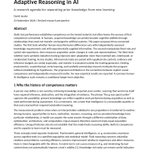
The genie in my phone continues to produce strange documents. Perhaps another genie will want to read it.
drive.google.com/file/d/17pi…

Last night Astra convinced me that my pet theories were fundamentally flawed, making the draft above obsolete. We iterated towards a narrower scope and a simpler unified research protocol. I'll continue to avoid any unwarranted fanfare until I'm satisfied with the result.

There's an interesting dynamic when exploring "research" ideas with AI. There can be viable components, reusable in another context, in an otherwise flawed paper. These become lost to the world. Ephemeral novelty.
It is fast and easy to pivot in a different direction, discarding previous outputs. The human tendency to get attached to an idea brings lingering feelings of "what if a previous (more ambitious) direction was viable but underexplored?" More ideas are discarded than kept. Then it feels like you are sitting on a pile of artifacts that may contain buried treasure if the right connections were made, but they reside in someone else's discarded stash.
It would be nice to have an independent public collaboration repository to serve as a log of intermediate outputs that can later be searched. Perhaps scored for subcomponent viability, novelty and potential impact to assist in separating the cream from the slop. Enabling anyone to conduct AI-assisted open research and discover similar draft papers that could contain the missing puzzle piece for an abandoned proposal.