
VP Technology @vedantabio. Interested in restoring and controlling the human microbiome.
Cambridge, MA
Joined May 2023
- Tweets350
- Following633
- Followers310
- Likes1.6K






Sorta cool that this was done with some improvements in the design approach.
Readers may not realize there are groups already doing the work of generating substantial human data and treating patients with phage cocktails through compassionate use!

Read more from @carlzimmer in @NYTimes: nytimes.com/2026/10/20/scien…
How Omnii-1 designed the phage: radicalnumerics.ai/blog/omni…
Explore Omnii-1 and eight distinct applications, from cancer vaccines to biodefense radicalnumerics.ai/blog/omni…

@PghPhageProgram @DariaVanTyne do this routinely on a shoestring budget, ~>300 cases to date.
I don't think improved design is an "unlock" here--$ waiting for anyone that succeeds is the limiter. Please steer AI towards figuring out solutions for inf. disease market issues.
Tried to price a workflow on Ginkgo cloud lab today but found that client samples are not accepted--only commercially available reagents/inputs.
This leaves a very narrow possibility space. Any plans to change this @OmicsOmicsBlog @jrkelly ?


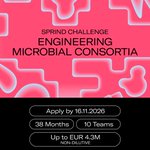
Take a break from reading AI-generated prose and listen to real people talk on the @SPRIND podcast!

NEW on the SPRIND 🎧 #Podcast:
What are microbial consortia? And what is the SPRIND challenge Engineering Microbial Consortia all about? Our host speaks with: Joe Meyerowitz, serial entrepreneur and mastermind behind our new challenge.
Episode #136 of the SPRIND Podcast.

Greg Medlock retweeted

NEW on the SPRIND 🎧 #Podcast:
What are microbial consortia? And what is the SPRIND challenge Engineering Microbial Consortia all about? Our host speaks with: Joe Meyerowitz, serial entrepreneur and mastermind behind our new challenge.
Episode #136 of the SPRIND Podcast.
Greg Medlock retweeted

We're hiring - come join our amazing community!
Faculty search in the Division of Experimental Pathology at @CHOP_Research
The successful candidate will hold a Penn faculty appointment, with full access to resources at both CHOP and Penn
Please share!
apply.interfolio.com/193339

Hypothetical Anthropic lab meetings are taking up a lot of space in people’s heads on this site

Imagine you were back in your PhD lab meetings and you said I found this ART Idk what it does and it’s like CRISPR, PCR and all these Nobel prize winning research. They’re look at you 🙄 You’d last 10 seconds and they’d move on and say come back when you have something.
In more detail, Someone would ask what the enzyme does. You’d say you don’t know. They’d ask whether it cuts, copies, or pastes DNA. You’d say not demonstrated. They’d ask what was already published on the RT. You’d admit the core enzyme was known and a similar system had already been described
Everyone would look at you like why are you even talking about this.
Has anyone that applied for LSVP been approved yet?

Today we launched Opus 5.5, which matches and even beats Mythos 5.1 on many bio-related tasks. We launched Opus 5.5 with the same safeguards as Fable 5.1, which means that most bio-related queries fall back to Opus 5. To use Opus 5.5 for life sciences work, enroll in our Life Science Verification Program (LSVP).
I imagine that many in the bio community will be frustrated by this decision and I want to share more context on how I think about these things. I also want to say upfront—bio is one of our most significant areas of focus, and it’s why I’m here. When we set about designing the new LSVP, it was with the goal of providing broad access for life sciences professionals with far fewer annoying classifier misfires, while also protecting against many of the more sophisticated risks.
Naively, it would seem that we have to choose between enabling broad access and protecting against misuse—I view this as a false choice. The key is to think of developing these safeguards as an engineering problem that requires the same level of investment, ingenuity, and ops execution as developing our frontier models, or any other large scale technical project.
The risks we’re defending against—which, as we shared in our threat report a few weeks ago, are no longer hypothetical—were certainly not obvious to me until recently, and I imagine are also not top of mind for most biologists. When most people picture bio risk, they imagine a small group trying to develop a bioweapon in a single session, from their own account. The threats that we need to defend against are much more sophisticated than that. They include malicious work split over hundreds of distinct benign-looking sessions run from different accounts, and legitimate organizations’ accounts being hacked by a well-resourced actor or misused by a rogue employee.
To protect against these risks and provide a better experience for our users who are doing legitimate life sciences work, in the LSVP we’ve introduced the concept of use-case grants. While it isn’t always possible to distinguish benign from harmful usage in isolation, it becomes much easier when comparing activity against a team’s own description of intended usage. You describe what your team works on at a high level, without revealing anything sensitive. Data are retained for 30 days, and automated offline review compares usage against that description and flags notable mismatches for a strictly compartmentalized review team. My team, the life sciences org, can never access this data. Because of these additional safeguards, for users in the LSVP we're able to tune down the classifiers so that they misfire far less often, without sacrificing on safety.
I’ve described why I believe that the LSVP provides a better way for people to use our most capable models in bio, but one can still wonder: why are we implementing this now? There is no unambiguous threshold for when model capabilities reach a point that they start posing grave risks. But capabilities in bio, as in most other domains, progress very quickly and we should not be in the business of trying to time it perfectly. When in doubt, we’ll always choose to proceed with caution, and I’d much rather implement this new system too early than too late.
The LSVP is currently in beta, which means that there are lots of improvements that we’re working on. We’re working to expand it so that individuals can get access—for example, for people developing or identifying treatments for a family member’s cancer or rare disease. Personally, I feel both the urgency to get our models into the hands of the broader life sciences community and a visceral sense of the stakes in getting it right. I think this is the right balance, and I look forward to seeing what people do with our most capable models.
anthropic.com/news/life-scie…

Greg Medlock retweeted
NSF X-Labs is expanding pathways for institutions & teams to advance innovative science and tech critical to U.S. competitiveness. Today, NSF announces 3 new topics: AI for Physical Systems, From Sequence to Function, & Computation at the Limit of Physics.
brnw.ch/21x5JSo

ALT Blue graphic with geometric shapes with text reading "NSF X-Labs."
In the weeds of this announcement, also an open RFI soliciting ideas for additional X-labs topics: sam.gov/workspace/contract/o…

NSF X-Labs is expanding pathways for institutions & teams to advance innovative science and tech critical to U.S. competitiveness. Today, NSF announces 3 new topics: AI for Physical Systems, From Sequence to Function, & Computation at the Limit of Physics.
brnw.ch/21x5JSo
ALT Blue graphic with geometric shapes with text reading "NSF X-Labs."
Greg Medlock retweeted

The subject of the book is in the image.
At the centre, what science observes. Around it, what the market makes of it.
Between the two, a gap no one can measure any more, including, often, my own patients.

Prompted by @PracheeAC I am giving Muse a try… favorites so far have been 1) automating creating calendar invites for travel and sharing with family, 2) automating resale + giving away baby/toddler stuff. The Facebook marketplace connectivity is very sticky, might keep me on FB.

Ok, I love @Muse. Needs more integrations tho. Slack, X, iMessage — if it can make phone calls so I don’t have to talk to people for things that shouldn’t have ever needed a phone call, that would be epic
Greg Medlock retweeted

Ok, I love @Muse. Needs more integrations tho. Slack, X, iMessage — if it can make phone calls so I don’t have to talk to people for things that shouldn’t have ever needed a phone call, that would be epic
Worst time to be Not That Kind Of Doctor

Verified U.S. clinicians can get free GPT-6 Astra (Pro) access today via ChatGPT for Clinicians.
Sign up: chatgpt.com/plans/clinicians…

Greg Medlock retweeted
[1/6]
Every week I receive requests for fecal transplantation in diseases where there is no evidence at all.
Neurodegenerative disease. Fibromyalgia. Treatment-resistant depression. And sometimes, simply, general “wellness”.

Haven’t seen much re: Fable 5.1 for bio outside of anthropic staff.
Where have folks been able to work without safeguards triggered?
I have Fable doing some metagenomics assembler dev with success.

I gave Fable 5.1 one of my old grad school papers and it re-implemented the entire thing, reproduced all the calculations, fixed some errors by relaxing approximations we made, derived an analytically solvable model we hadn't considered, and then extended the paper by solving a harder problem that we wrote about as future work. It took 7 hours.
In another case, Mythos wrote custom GPU kernels to speed up open-source comp bio models by 2.5x and reduce GPU costs by 30-60% so it could run more tool calling. We're going to open source those optimizations.
Fascinating story on the effects of C. difficile colonization in infants.

Excited to share new work from my lab showing that early-life colonization with C. difficile reshapes the developing infant gut, published today in @ScienceMagazine! This study was co-led by two truly amazing scientists: @HaiderSManzer and @_alexafluor.
science.org/doi/10.1126/scie…
