

Scientist (ETH) | Masters & PhD, Mechanical Engineering (UCSB) | Masters, Electrical Engineering (AUB) | Control Theorist | #SyntheticBiology | Dad & Pianist |
Switzerland
Joined March 2021
- Tweets48
- Following229
- Followers141
- Likes215



Pinned Tweet
Just published: "Inteins: A Swiss Army Knife for #SyntheticBiology" with @St_Anastassov & @KhammashLab in Biotechnology Advances.
One day, #Inteins 𝐜𝐨𝐮𝐥𝐝 make #genetic circuit design as simple as electric ones! 🧬⚡ sciencedirect.com/science/ar…
Check out our paper in the @KhammashLab
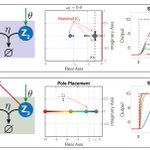
on #biomolecular protection circuits. Integral windup is similar to a trauma inflicted by severe disturbances with lasting effects even after the disturbance ends. How do we mitigate that in biomolecular circuits?1/n science.org/doi/full/10.1126…

An anti-windup strategy is like a therapeutic intervention, helping a controller to move past its traumatic experience by promoting a form of forgetfulness toward the disruptive event. Anti-windup circuits thus avoid windup-induced instabilities and poor dynamic performance. 2/n


Maurice Filo retweeted

My favorite illustration of how geometric intuition fails miserably in high dimensions.

One of the highlights of 2023 is teaching #controlsystems to an incredible cohort at @Ashesi University in #ghana 🇬🇭 as part of the @ETH4D (ETH for Development) master program. It was an absolute pleasure getting to know all of the students!


Maurice Filo retweeted

Are you looking for a versatile and inexpensive illumination platform for optogenetics experiments?
Check out our new DIYA device... It's become the most popular platform in our lab for bacterial, yeast and mammalian optogenetics.
#synbio #optogenetics
doi.org/10.1016/j.isci.2023.…
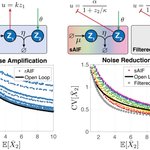
Check out our latest preprint in the @KhammashLab on "A Hidden Proportional Feedback Mechanism Underlies Enhanced Dynamic Performance and Noise Rejection in Sensor-Based Antithetic Integral Control"
biorxiv.org/content/10.1101/…
Special thanks to my coauthor @MucunHou

Actuating by the sensor molecule Z2 (instead of Z1) embeds a (filtered) PI controller in just one actuation reaction. This brings with it the enhanced dynamic performance offered by the P component while maintaining the robustness offered by the integrator.


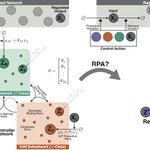
Check out our work in the @KhammashLab on building #integral controllers genetically with split #inteins! (Play the video with sound on for an animation of a genetic circuit!)
nature.com/articles/s41467-0…
Special thanks to my coauthors @St_Anastassov, @Ch_Hs_Chang & @KhammashLab 1/5

Fast post-translational modifications performed by inteins may generate sophisticated #controllers. To study and untangle the underlying dynamics, we have developed two theorems that enable a graphical screening for #RPA and a #modelreduction recipe accessible to non-experts 5/5

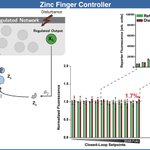
How are feedback controllers built with molecules? Check out our @KhammashLab review paper on "Biomolecular Feedback Controllers: From Theory to Applications" published in Current Opinion in Biotechnology! 1/3
Special thanks to my co-author @Ch_Hs_Chang.
authors.elsevier.com/c/1gPLP…

Biomolecular Integral Controllers, with their remarkable homeostatic properties, are already designed and even built and tested across various cell types. 3/3


Maurice Filo retweeted
How do biological networks maintain tight regulation of variables while being subjected to an onslaught of perturbations?
We establish simple universal principles for maximal robust adaptation in all biomolecular systems.
pnas.org/doi/10.1073/pnas.22…
#sysbio #synbio #cybergenetics