

MD/PhD student @uabmstp | @jamesgeorgeuab & @anupamuab labs | slu grad | amateur cook | tweets my own | he/him
Birmingham, AL
Joined June 2016
- Tweets915
- Following502
- Followers932
- Likes2.3K




Pinned Tweet
FINALLY OUT! Our work using spatial and single-cell transcriptomics to characterize the human immune response in pig-to-human kidney xenotransplantation is now published @NatureComms
🧵
nature.com/articles/s41467-0…


Matthew Cheung retweeted

As a med student who had 2 children during med school I'm often asked what kind of support I need, and besides the obvious like childcare, I never had a good answer. This elective at the University of Minnesota is the definition of support, all med schools should take notes.


Matthew Cheung retweeted

The 3rd Acute Kidney Injury: Bench to Bedside conference is coming May4-7,2025! Save the date! Great program plus an awesome Workforce development program for trainees! Travel awards, lots of great science and networking in beautiful Leesburg Virginia👇

Matthew Cheung retweeted

Limited infiltration of host immune cells in the very first case of 10-gene-edited pig-to-human (brain-dead) Kidney #Xenotransplant
<=74 h
Minimal B/T lymphocytes
CD45+ cells are mainly donor-derived M2-like macrophages, plus neutrophils
Love to see more analysis on endothelial/epithelial compartment (Another paper in progress?)
#SpatialTranscriptomics #Visium
sc- & sn-RNAseq #cell2location
Distinguishing Pig vs Human transcripts/cells
Paige Porrett lab @NatureComms 2024 @MatthewDCheung
nature.com/articles/s41467-0…

Matthew Cheung retweeted

Congratulations to outstanding MDPhD students - now Drs. Matthew Cheung and Gelare Ghajar-Rahimi, who successfully defended their theses. It was my honor to serve as co-mentor with Jim George. @UABMSTP @UABHeersink @MatthewDCheung @G_GhajarRahimi


PhDone!!!! Thank you to my amazing friends, family, colleagues, and mentors - couldn't have done any of this without you!


My work son, @MatthewDCheung, just defended his PhD thesis at @uabmedicine and I am speechless. Matthew, you have accomplished so much in such a brief amount of time and I am so incredibly proud of you! ❤️🫘(these are the only kidneys I could find lol)
@alhkim #AKI


Matthew Cheung retweeted

What an incredible night celebrating the honorees of the @UABgsga Awards, alongside their mentors, family, and friends! We’re immensely proud of these recipients, their outstanding accomplishments & the positive impacts they’ve made on our academic community & beyond! #GoBlazers
Matthew Cheung retweeted
#TBT to a month ago when our @UABgsga’s Senior Associate Dean and Director of Graduate Biomedical Sciences, David Schneider, joined Mathew Cheung, the Three Minute Thesis (3MT®) UAB 1st place winner, in South Carolina for the southern regional 3MT® competition. 🔬🧫🧪


Nonetheless, our data suggest that a standard immunosuppression regimen can control the immune response to the pig kidney, at least early on. Long term studies are needed. These data will still play a key role in propelling pig kidney xenotransplantation to a clinical reality.
It really takes a village. Thank you to the entire UAB xenotransplant team for making this possible! As always, thank you to our donors and their families. And a shout out to my co-mentors (@AnupamUAB and Jim George) for letting me take part in this special project. Cheers!
We did a co-localization analysis to see where these immune cells were found in the kidney. The neutrophils near endothelial cells may be contaminants (which would be good) or a response to the TMA. Interestingly, the human macrophages tended to localize with pig stromal cells

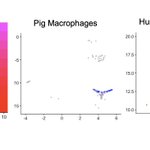
Now we know that in the kidney, these interactions tend to skew macrophages towards a more anti-inflammatory, pro-healing phenotype. And that's exactly what we see in both the pig and human macs when we looked at their gene expression profiles


To our reassurance, we found no presence of human B or T cells in the pig kidney biopsies (note, we had to use marker genes for B/T cells bc not in reference transcriptome)

Knowing what immune cells were present in the explanted kidney, we wanted to track these over time. We performed @10XGenomics Visium spatial transcriptomics on the serial biopsies and used the sc/snRNAseq data to deconvolute the spatial data using cell2location

We detected human neutrophils, monocytes, and macrophaes as well as pig T cells, neutrophils, and macrophages in the explanted pig kidney 3 days after xenotransplant.

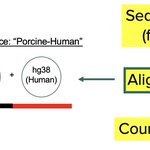
Problem: how do you identify what is a pig cell vs human cell in a mixed sample of pig/humancells? Solution: We built a merged pig-human reference genome to align our sequencing data to, so we could distinguish species and cell types. (Many more details/methods in the paper!)

