
cofounder @ProximalHQ
San Francisco, CA
Joined March 2021
- Tweets1.3K
- Following934
- Followers9.2K
- Likes3.7K





Justus Mattern retweeted

During rollouts, sandboxes spend most of their time idle.
To improve bin packing, we aggressively overcommit resources and prioritize scheduling sandboxes on more full nodes. To optimize latency, we schedule sandboxes in an image cache-aware fashion and compress images with zstd (instead of gzip).
Justus Mattern retweeted

Generational technology if we want it to be.

“Owning your intelligence is owning your future.”
@latkins, CTO of @arcee_ai, on open weights and everything built on top of them.
Open Intelligence Summit keynote streams live Oct 13: do.co/4zo4nZS
Justus Mattern retweeted

highly recommend folks to take a peek here some very interesting alpha is being thrown at your screen

Justus Mattern retweeted

PSA to data cos: you need to build frontier-level training infra if you want to prove the value of your training data
the data game is past its slop era
Justus Mattern retweeted

Today, we are sharing more about our post-training infrastructure @ProximalHQ
We build on top of @modal GPUs and Kubernetes to support our experiments. Had a ton of fun working on this, and we tried to make the blog as educational as possible!
More cool details below :)


Justus Mattern retweeted

let me break down what’s actually happening in this market
two ways companies work in this space, some a mix of both: you either have the lab tell you what to work on and what they need or you tell the labs what you think they need
the former is more of a commodity but players that are large, at scale, and can react quickly usually win these deals and do well (kinda what eli mentioned here)
very few are doing the latter and it’s largely greenfield - data has many open ended research problems and a competent team can definitely find something that even the labs have not worked on. this approach is much harder (requires research + engineering talent that is better than or atleast on par with the labs), but is much more interesting / valuable long term
as you can tell Proximal is set up for the second approach, our goal is to be the very best in understanding where models need improvements in capabilities and what data will make them improve. this looks much more like a post training and evals team at a lab than a human data company, if this is exciting we are hiring

selling data to labs is the modern version of selling to the government
there are just a handful of buyers. you hustle to get connected to a researcher, get approved as a vendor, and setup a shared slack channel
you’ll get an endless stream of RFPs and be ruthlessly evaluated against 20 other companies for every project
but once you’ve delivered a good product and are considered a credible vendor, they’ll keep sending you business - until their research direction changes, or a better vendor replaces you
Justus Mattern retweeted
If you are interested in:
- Post-Training
- Data Research
- Infra at tremendous scale
or just generally want to know more about what we do @ProximalHQ, please reach out, I would love to chat :)

Excited to share i’ve joined @ProximalHQ here in SF! I think that there is a ton of interesting open problems related to data and post training at large. There is no better team to work with than the one we have and I am extremely excited to share our work :)
Justus Mattern retweeted

We extend @cognition’s SWE-2 reward function to steer the Pareto frontier, not just improve it.
SWE-2 uses S − λₑC, where λₑ is cleverly the frontier’s derivative at that effort.
We show that adapting λₑ can target a desired score/cost improvement balance. See below!
Justus Mattern retweeted
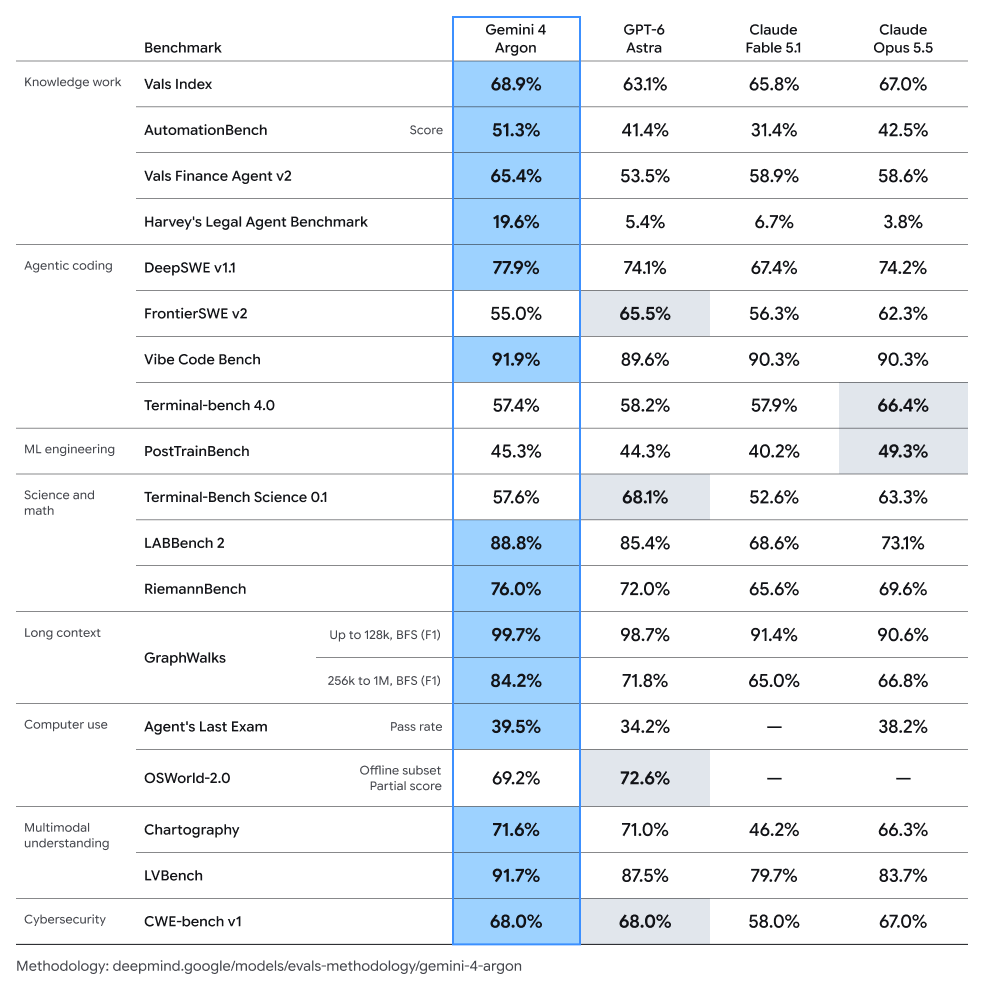
Gemini 4 Argon scores 55.0% on FrontierSWE
The model is close to Fable 5.1 and only outperformed by Opus 5.5 and GPT-6 Astra


Justus Mattern retweeted

I'm psyched for Proximal's public launch, for them to get the credit they deserve after all this time building in stealth. This is one of the most impressive teams I've ever had the privilege to get to know. I'm lucky enough to have known Calvin since his first company, where I was his YC partner. When I first met Justus and the rest of the team and they taught me in depth about RL environments, all I could think when I left was "holy shit."
This is a true case where even though they're at $200M+ ARR, it's very much still early days. This is a world-class team, fit for a frontier lab, and I think we'll be seeing a lot more from them very soon.
Proximal builds infrastructure that enables AI to improve from real-world experience.
In the past year, we have grown to more than $200M in annualized revenue helping frontier labs and enterprises improve coding agents. Now, we are expanding beyond software engineering.
Recent progress in mathematics demonstrates what happens when models are trained in domains with massive amounts of public data and easy verifiability, making it easy to find weaknesses, generate training tasks, and iterate quickly.
We build infrastructure that enables this feedback loop in other domains: we are excited about a world in which AI systems design targeted drugs, accelerate chip design, and rewrite legacy software that still runs hospitals, power grids, governments, and other critical infrastructure.
Since starting, we have assembled a small team of researchers and engineers and built world-class infrastructure for post-training and synthetic data research to overcome the challenges of scaling manual data curation.
Our team comes from Cursor, Google DeepMind, Meta Superintelligence, Prime Intellect, Citadel, and Jane Street. More than half are former founders.
We’re fortunate to be backed by investors who share that vision, including @generalcatalyst who led our $15M Seed Round at a $300M valuation, as well as @chemistry, @svangel, @dvlamoen and individuals like @LiamFedus, @kevinweil, and @bernhardsson

Justus Mattern retweeted

Before OpenAI, Sam Altman built Loopt, a local social network
Before Cognition, Scott Wu built Lunchclub, a network for meeting people over lunch
Before Proximal, Calvin Chen built Fetchr, an AI wardrobe assistant
Bet on the founder.

Today, Justus and I are excited to introduce Proximal. We’re building the infrastructure that enables AI to improve from real-world experience.
In the past year, we have grown to more than $200M in annualized revenue helping frontier labs and enterprises improve coding agents. Now, we are expanding beyond software.
One of the things that I’ve enjoyed the most over the last year is working with this amazing group of people. It's an incredible feeling working alongside people who are better than you and that encourage you to do your best work. I am impressed daily at both the raw technical talent of the team but also the humility, high agency, and high trust culture we have built.
Many of the team lived in the office for months over the last year which made it feel less like work but more like working on an exciting project with your best friends. It feels like (and we've been told) that it reminds them of going back to college where working with your friends on cool ideas and hacking into late nights was just so much fun.
We are nowhere close to where we want to be and the ambitions we have, we’re just getting started. Thank you to everyone who has supported us thus far!

Justus Mattern retweeted
We need better evals.
One of the motivations behind working on FrontierSWE and releasing it was that at the time we were seeing many blogs about how agents running for many hours could accomplish incredible tasks like how:
- Cursor built a web browser from scratch
- Bun had an agent rewrite Bun in rust
- Anthropic built a C compiler.
We saw that many benchmarks in coding were saturated (SWE-Bench Pro etc) and wanted a benchmark that could accurately reflect ultra long horizon and extremely difficult software engineering tasks that would usually take humans weeks to months in an attempt to measure AI progress
With Muse Spark 1.3 and Gemini Flash 3.8 scoring similarly as a Fable 5.1 or Astra on benchmarks like DeepSWE, its clear that the need for really good benchmarks that accurately reflect model progress that are both fair and hard for frontier models is much needed
I might be biased but FrontierSWE is the only coding benchmark that still remains unsaturated and most closely reflects the preferences of day to day developers
At Proximal, we are committing millions of dollars in the next few months to creating better evals for the community in domains like software engineering, science, hardware engineering, etc.
If you are excited about this kind of work, we'd love to chat with you. The team is very lean (3 people) and has a lot of autonomy and resources.
Justus Mattern retweeted

solid eval methodology. good work!

Justus Mattern retweeted

Read the thread. This is a really REALLY nice eval
Justus Mattern retweeted

reading traces is so fun
(the prompt does not talk about littlefs, the model inferred it from the tests + pre-train knowledge)


Justus Mattern retweeted

Grok 4.5 is worth trying

Grok 4.5 just ranked #2 on the FrontierSWE leaderboard, outperforming Claude Opus 4.8 and GPT-5.5
It delivers top-tier coding performance with exceptional speed, strong token efficiency and a much lower cost than many competing frontier models
Grok 4.5 is already one of the best coding models available today, sitting at the very top

Justus Mattern retweeted

it’s surprising to me how many people seem to not understand that great models are built with super high quality curated data
finding novel ways to create / get this data is a huge edge
Justus Mattern retweeted

new paper 🫡 we made serving many different finetunes surprisingly efficient by just… not intervening at decode steps!

New paper!!
Prefill and decode represent very different inference workloads; when we try to serve many LoRA adapters at once, inference slows down a ton during decode because we are memory bound :(
What if we didn’t need those adapters at decode? We introduce Prefill-Only Fine Tuning (PreFT), adapters that are only trained and applied at prefill. We show that this speeds up multi-adapter serving with limited loss in performance!
