

Growth equities • Emerging tech • Asymmetric bets Looking for what the market is missing.
Australia
Joined August 2026
- Tweets100
- Following26
- Followers27
- Likes251




Pinned Tweet
I think the market may be valuing $XPEV completely wrong.
Everyone still looks at XPeng as a Chinese EV manufacturer.
But the Unitree IPO might expose why that framework is becoming outdated.
Unitree has reportedly attracted extraordinary demand, with its IPO valuing the robotics company at roughly $9B despite only generating around $250M of revenue in 2025.
Meanwhile, the entirety of XPeng trades around a similar order of magnitude in market value.
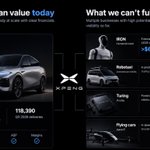
Except XPeng isn’t just cars.
It is building:
• Humanoid robotics through IRON
• Robotaxis
• Autonomous driving
• Proprietary AI chips
• Its VLA physical-AI model
• Flying vehicles
• And an already scaled EV manufacturing platform
The important part is that these aren’t completely separate bets.
XPeng is building toward one physical-AI ecosystem.
Its cars collect real-world data → that improves its VLA/autonomy stack → the same underlying intelligence can extend into Robotaxis and humanoid robots → all while XPeng already possesses manufacturing, supply-chain and hardware expertise.
That’s what I think the market is overlooking.
Unitree is being valued as a robotics/AI company.
XPeng is still largely being valued as an automaker.
Of course there is a reason for the discount. XPeng still needs to prove that IRON and Robotaxi can become meaningful commercial businesses rather than impressive technology demonstrations.
But that’s also where the asymmetry comes from.
If humanoid robotics continues receiving AI-like valuations, you don’t need XPeng to beat Unitree at robotics.
You simply need investors to begin assigning some meaningful value to XPeng’s robotics, autonomy and physical-AI businesses separately from its cars.
At that point the question changes from:
“How many cars will XPeng sell?”
to:
“What is the EV business + autonomy + Robotaxi + humanoid robotics + physical-AI IP actually worth?”
Unitree’s IPO doesn’t prove $XPEV is undervalued.
But it may give the market the comparable it needed to realise XPeng is becoming much more than an EV company.
That’s the part I’m watching.
Elon Musk thinks 200+ neocloud companies are heading for a massive shakeout.
And I actually think he’s probably right.
But I don’t think that means companies like $IREN and $NBIS are doomed.
Look at what’s happening right now.
Meta just announced plans to raise up to $95B to fund its AI expansion.
Nebius secured another $3.5B financing facility from Citi last week.
IREN disclosed $14B in cash, committed financing and customer prepayments in August.
Meanwhile, CoreWeave’s bonds have been getting hammered as investors question how much debt this industry can actually support.
The demand for compute hasn’t disappeared.
But getting the money to build it is becoming a completely different problem.
And I think that’s where the next big divide in AI infrastructure will emerge.
There are hundreds of companies trying to build AI clouds.
How many can actually secure the power, sign the customers, finance the GPUs and get everything running before their funding runs out?
Probably nowhere near 200.
That’s why I’m still interested in $IREN and $NBIS despite the selloff.
Both have serious customers and financing arrangements behind their expansion plans. That doesn’t eliminate dilution, debt or execution risk, but it puts them in a different position from a startup still hoping to raise its first few billion.
I’m starting to think the neocloud shakeout could actually strengthen the companies that make it through.
Less competition, more concentrated capacity and potentially better pricing power.
The question is whether $IREN and $NBIS emerge as the winners, or whether their own capital requirements become too expensive.
3
200
Some of the most popular growth stocks on X have been absolutely destroyed from their highs.
But have a look at how much they’d actually need to rally just to recover.
A stock down 70% needs to gain 233% to get back.
I went through 19 popular names to compare their current prices against their 52-week highs.
Current Price -> 52W High | Potential Gain
$AAOI: $67.51 -> $233.67 | +246%
$FLY: $18.23 -> $62.17 | +241%
$ASTS: $39.79 -> $133.86 | +236%
$NUAI: $2.96 -> $9.45 | +219%
$IREN: $24.91 -> $76.87 | +209%
$XPEV: $9.21 -> $28.24 | +207%
$RKLB: $52.60 -> $151.00 | +187%
$CRWV: $54.24 -> $141.79 | +161%
$IONQ: $31.27 -> $73.65 | +136%
$SOFI: $14.62 -> $32.73 | +124%
$OUST: $29.69 -> $63.79 | +115%
$NBIS: $158.74 -> $299.86 | +89%
$HIMS: $27.71 -> $50.99 | +84%
$DRAM: $47.06 -> $81.34 | +73%
$HOOD: $95.07 -> $150.47 | +58%
$MU: $877.55 -> $1,255 | +43%
$TEM: $67.62 -> $93.38 | +38%
$NVDA: $210.96 -> $243.37 | +15%
$PLTR: $196.75 -> $212.94 | +8%
And here’s what makes the comparison even more interesting.
Wall Street’s average 12-month price targets currently imply roughly:
$NUAI: +294%
$IREN: +212%
$CRWV: +150%
$AAOI: +137%
$FLY: +108%
$OUST: +100%
$XPEV: +96%
$RKLB: +94%
$ASTS: +88%
$MU: +78%
$NBIS: +77%
Obviously, there’s no guarantee any of these stocks return to their highs. Some have sold off for very good reasons, and analyst targets aren’t guarantees either.
But I reckon there’s a pretty interesting opportunity to compare here.
A lot of these companies are trading at a fraction of where they were, even as some of their underlying businesses continue growing.
The question is which ones have actually become cheaper relative to their future earnings potential, and which ones were simply overpriced to begin with.
For a swing trade over the coming months, which of these would you be buying?
Personally, I’m watching $IREN, $OUST and $NBIS pretty closely

4
106
VIX up ~10%, Nasdaq futures down nearly 2%, and high-beta names like $IREN, $NBIS and $CRWV are getting hammered premarket.
Quite a few things going wrong at once.
Brent crude has jumped above $112/barrel as Middle East tensions escalate, raising fresh inflation concerns.
Tech earnings haven’t helped either, especially with investors already questioning how much capital the AI buildout is going to consume.
And European bond markets are under pressure too.
But the selling in AI infrastructure names is what I’m watching closest.
These companies need billions in financing to deliver on their growth plans. When volatility spikes and the market starts worrying about interest rates, investors suddenly become a lot less comfortable paying for revenue that’s still years away.
Even if the underlying demand hasn’t changed.
That’s why the high-beta names tend to get hit so much harder. It’s not necessarily their growth forecasts collapsing overnight. It’s the market repricing the risk of getting there.
Personally, I haven’t seen anything today that fundamentally changes my long-term AI infrastructure thesis.
But I’m watching how these names trade once the market opens.
If the selling continues despite no company-specific deterioration, we could start seeing some pretty interesting valuations again.
3
265
Australia just had its SECOND AI data centre disaster in less than two weeks
And its only making me more bullish on $IREN and $NBIS
First, Firmus tried to IPO at A$44B. Investors weren't having it, and the float collapsed
Now NextDC ($NXT) has fallen nearly 42% in a single day, wiping roughly A$3B off its market cap
The reason is pretty crazy
NextDC already had customers contracted for capacity at its M3 Melbourne data centre
But electricity network upgrades have been delayed following community opposition
That alone has pushed around A$140M in expected revenue into future periods
And the company has now put new developments and land acquisitions on hold
Think about that for a second
-The customers are there
-The demand is there
-The revenue is contracted
But none of it matters if you can't actually get the power delivered
This is exactly why I've been so interested in companies that spent years securing their infrastructure before the AI boom really took off
$IREN has a 5GW+ development pipeline, with roughly $4B in contracted annualised revenue tied to its 2026 capacity
$NBIS has built up around 5GW of contracted power capacity and is racing to bring it online
Obviously neither company is immune to construction delays, financing problems or grid constraints. Not all that power is operational yet
But I reckon we're going to see a pretty big divide develop between companies that can actually deliver capacity and those still trying to get projects off the ground
And every time another data centre gets delayed, the capacity that DOES come online when promised becomes that much more valuable
The AI infrastructure trade isn't just about who can buy the most NVIDIA GPUs anymore
I'm increasingly convinced the real advantage is owning the power, land and infrastructure to actually run them
That's a big part of why I'm bullish on both $IREN and $NBIS

4
301
Julian Petroulas might be preparing to take his OWN AI infrastructure company PUBLIC.
He’s barely posted on X for 6 months. Now he’s following just ONE account: @MotionInfra
I did some digging, and I think I found one of the things he’s been working on behind the scenes. 👀
Julian’s last proper X post was back on April 18. Apart from a random GIF in May, he’s been pretty much silent ever since.
On August 25, he shared an Instagram update explaining he’d been dealing with health issues and had taken time away from content to focus on recovering.
But he also mentioned that he’d continued focusing on his other businesses, trading and investing.
And one part caught my attention:
“A lot has been happening behind the scenes that I haven’t shared which I will soon.”
Fast forward to October.
Julian is now following just ONE account on X: @MotionInfra
So I started looking into it.
Motion Infrastructure has a website, wearemotion.ai, which is currently password-protected.
But search engines still have some of its earlier pages indexed.
And here’s where it gets interesting.
An earlier, search-indexed version of the company’s leadership page names JULIAN PETROULAS as CEO & CHAIRMAN.
It also describes him as an anchor investor responsible for public-market strategy, investor relations and capital formation.
The same page discusses a board structured for a public listing and even references a “combination partner”.
That last detail is particularly interesting, as it could suggest a reverse takeover or another public-market transaction rather than a traditional IPO.
As for the actual business, Motion appears to be focused on AI GPU infrastructure, with plans to own NVIDIA computing hardware and deploy it through operating partners.
Essentially, Julian could be going from investing in AI infrastructure companies to running one himself.
Now, none of this confirms that a listing has been approved, and I haven’t found an official ticker or trading date. The indexed website material could also be preliminary or outdated.
But between his August update, the change to his X following list and the information on Motion’s indexed pages, I think there’s a pretty interesting story developing.
And for everyone who’s been waiting six months for his next stock callout…
He might be about to give us a whole stock instead 😂
If Julian actually takes Motion public, would you invest?


1
12
666
Oliver Curtis just recently tried to IPO Firmus at A$44B.
The float collapsed within days
I’ve been comparing the numbers with $IREN and some of them are pretty hard to ignore.
Firmus was seeking a valuation of roughly US$31B.
It had around 42MW operational and more than 900MW of contracted customer capacity.
Meanwhile, IREN was worth roughly US$14B at Friday’s close.
IREN has a 5GW+ global data centre pipeline, $4B of contracted annualised revenue for its 2026 capacity and around $1B already operating.
So we’re talking about a company that tried to list at more than twice IREN’s market cap, while IREN has a development pipeline several times larger.
Now, those MW figures aren’t directly comparable. Firmus has major contracts of its own with OpenAI and Meta, and IREN’s full 5GW isn’t built or earning revenue either.
And obviously Firmus didn’t actually achieve that valuation. Investors rejected it.
But that’s kinda the point.
Everyone wants to build AI data centres right now. Actually getting power connected, building the facilities and securing customers is a much harder problem.
IREN has spent years doing that work, and it’s already turning some of that infrastructure into revenue.
I’m not saying IREN should be worth A$44B just because Firmus tried to be.
I am starting to wonder how much value the market is assigning to IREN’s existing power position versus the AI cloud business being built on top of it.
Because those are two different sources of value, and I don’t think they should be analysed as one.

2
607
$IREN reportedly just landed Anthropic as a cloud customer. Stock up ~8% overnight.
What’s interesting is that IREN already disclosed a multiyear deal with an unnamed frontier AI lab back in August. Anthropic was one of the names people suspected.
So this most likely a confirmation of an existing deal rather than some massive new contract.
Still, look at how quickly IREN’s customer base has changed.
Microsoft is already signed. Now The Information is reporting Anthropic too.
Two of the biggest names in AI potentially relying on infrastructure built by a company that was mining Bitcoin a few years ago.
And I reckon the power side of this is getting overlooked.
You can buy GPUs. Securing enough electricity, grid connections and infrastructure to actually run them is a completely different problem.
IREN spent years building that position before AI demand got to where it is today.
We still don’t know the value of the reported Anthropic contract, so there’s no point throwing out random revenue estimates.
But if this relationship is confirmed, it’s another pretty significant customer validation for IREN’s cloud business.

1
12
1,588
Been coming back to my $OUST valuation thesis and I think the NVIDIA relationship is becoming one of the more interesting pieces of it.
Another piece got added today.
Stereolabs now supports NVIDIA’s JetPack 7.2 across its ZED X cameras, including systems built around Jetson Orin + Thor.
Not a huge announcement on its own
But look at the direction:
Rev8 -> NVIDIA DRIVE Hyperion
ZED cameras -> Jetson Orin + Thor
Ouster software -> NVIDIA Metropolis
AI compute -> Jetson
This is where the Stereolabs acquisition gets interesting
Ouster doesn’t need to build the brain
NVIDIA is already building the compute platform Physical AI runs on.
Ouster can focus on giving those machines the ability to actually understand what’s around them.
Lidar. Cameras. Depth. Sensor fusion. Perception.
Still a long way from proving Ouster captures meaningful economics from that stack, and obviously NVIDIA isn’t exclusive to them.
But if I’m going to be right about the valuation case below, moving beyond just selling lidar sensors is probably one of the things that has to happen.
Today’s news is another small step in that direction.

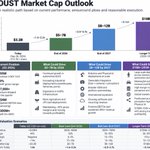
I think $OUST can realistically become a $ 10B+ company
That’s roughly 3x today’s ~$3.2B market cap.
But at this valuation, “Physical AI will be huge” isn’t enough.
The numbers actually have to work.
Right now Ouster is doing ~$55M of quarterly revenue.
That’s +56% YoY.
Gross margin is already 49%.
And adjusted EBITDA loss is down to just ~$4M.
So here’s roughly what I need to see:
2026 -> ~$3-4B
Keep revenue growing 30%+.
Maintain ~50% gross margins.
Get to / very close to positive adjusted EBITDA.
2027-28 -> ~$5-7B
This is where the Physical AI thesis needs to start showing up in volume.
Not just pilots.
Thousands more sensors going into warehouses, traffic systems, agriculture, drones + robots.
And Stereolabs needs to prove the acquisition gave Ouster something bigger than lidar:
Lidar + cameras + perception.
Then ~$10B+ becomes interesting.
To justify that, I’d want Ouster approaching roughly $ 750M-$1B annual revenue with strong growth and actual profitability.
At $1B revenue, a $10B valuation is 10x sales.
Expensive.
But not insane if Ouster has become one of the core perception layers underneath Physical AI with ~50%+ gross margins and 30%+ growth.
That’s really my thesis here.
I’m not betting that lidar suddenly becomes incredibly valuable.
I’m betting that millions of machines are eventually going to need to understand the physical world around them.
Cars.
Robots.
Drones.
Factories.
Warehouses.
Cities.
Farms.
And somebody has to give those machines eyes.
If Ouster becomes one of those companies, I don’t think $3B is where this story ends.

3
497
Been reading into how all these GPUs are actually getting financed and there’s one number I can’t get past.
Banks are apparently underwriting them over ~3-4 years
NVIDIA thinks they can keep earning for potentially a decade
That’s a pretty massive gap
Especially when you look at how much capital is starting to get involved here. NVIDIA + Wall Street are talking about >$500B of third-party compute financing, and NVIDIA itself has investments/backstops across parts of the ecosystem buying its chips.
I’m still bullish on the buildout, but I think this is a legit risk.
If an H100/B200 is still economically useful years after the next few generations arrive, fine. The debt has an asset underneath it that keeps earning.
But if newer GPUs crush the economics of older ones way faster than expected, I wanna know who ends up holding that risk.
Starting to think GPU depreciation might matter almost as much as GPU demand.
2
135
$XPEV delivered 41,256 cars in September.
Weirdly, that’s becoming one of the least interesting numbers in the company to me.
Don’t get me wrong, the car business still has to work. It’s what funds everything else.
But I’m starting to think there’s a growing problem with how we actually value XPeng.
Cars are easy
We get monthly deliveries, ASPs, vehicle margins, revenue etc.
Now try doing the same thing with the rest of the company.
IRON now has an external valuation through the robotics raise.
Robotaxi has entered production.
The same Turing AI chips are moving across cars + robots.
VLA 2.0 is becoming a shared intelligence layer.
Then you’ve got technology licensing and the flying car business sitting around all of that.
And most of those businesses are still at the stage where it’s genuinely hard to put a sensible number on them.
That’s why I’m probably watching XPeng’s disclosures more closely than its monthly delivery number now.
I want separate robotics revenue
Robot pricing + margins
Robotaxi economics
Licensing revenue
Eventually software/AI recurring revenue
41,256 cars tells me how the business XPeng already has is doing.
Those other numbers will tell us what kind of company it’s actually becoming.

1
12
1,014
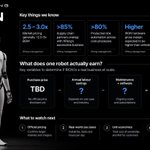
I’m way less interested in how human $XPEV’s IRON looks than I am in what one robot can actually earn.
And XPeng gave a few clues that I think are being overlooked.
They still haven’t given us an official selling price.
But management says robots in the market generally price around 2.5-3x their bill of materials, and they expect IRON’s hardware gross margin to be higher than their cars.
Then there’s software/model upgrades + subscriptions on top.
That’s where this gets interesting to me.
A car gets sold and XPeng hopes to make a margin on it.
A robot is potentially a productive asset for whoever buys it AND a recurring revenue stream for XPeng after the hardware leaves the factory.
So eventually I think the number that matters isn’t robots delivered.
It’s payback period.
If a business can buy an IRON and recover the cost through labour/productivity savings in 2 years, buying robot #2 becomes a pretty easy conversation.
If the payback is 6-8 years, suddenly all the humanoid hype matters a lot less.
XPeng already has >85% overlap between its robot + automotive supply chains and says it can ramp monthly robot production into the thousands during 2027 if demand is there.
That’s a serious manufacturing advantage.
But now I want to see the other side of the equation.
Price
Useful working hours
Labour actually replaced
Maintenance
Software revenue
Payback period
That’s when IRON stops being an impressive robot demo and starts becoming something I can actually model.

8
367
I own AI infrastructure stocks and space stocks.
Didn’t expect those two theses to literally merge.
$FLY just signed Starcloud to put an AI compute payload aboard Elytra and send it into lunar orbit in 2029.
The goal is to test technology for something that sounds ridiculous at first:
Data centers around the Moon.
But the more I thought about it, the more sense it made.
If we actually end up with satellites, rovers, landers and eventually people constantly generating data around the Moon, sending every raw piece of information 384,000km back to Earth just to process it isn’t necessarily the best architecture.
Put compute closer to where the data is created.
Process it there.
Send back what actually matters.
Obviously we’re a LONG way from lunar data centers becoming a meaningful business. I’m not adding some huge number to my $FLY valuation because of this.
I just find it interesting that Elytra is starting to look like more than a spacecraft that moves payloads around.
Hosting compute, communications and other infrastructure in orbit could eventually become a business of its own.
AI infrastructure on Earth is already becoming a power + compute problem.
Apparently the Moon might eventually need its own version too lol.

I think AI agents could make the current data center buildout look conservative.
The Codex usage changes are a pretty interesting example of why.
OpenAI is moving from 20x usage to a new 50x tier, while the effective weekly allowance heavy users were getting on 20x has been cut.
At first that just looks like a pricing change.
But people are actually burning through these limits.
I found one recent Codex example where 8 visible user turns turned into 266 model responses and ~96M input tokens once the agent started working through tools on its own.
That’s a completely different demand model from ChatGPT.
One human isn’t necessarily creating one workload anymore.
You can kick off Codex, leave it working, start another agent on something else, then another. Eventually I don’t see why companies stop at one coding agent either.
That’s where this gets interesting for AI infrastructure.
We spend a lot of time estimating future compute demand from how many people will use AI.
I’m starting to think the more important number might eventually be how many agents each person has working for them.
$IREN already has ~$4B of contracted ARR against roughly ~$1B operating at the last update.
If we’re moving toward a world where one employee can continuously generate multiple autonomous workloads, I’m not convinced the current data center buildout is as crazy as it looks.

1
2
127
AMD just spent $8.2B buying a company that doesn’t make chips.
I think that’s probably more important than it looks.
World Labs is trying to teach AI how to understand 3D space and the physical world. Basically the stuff you need if AI is going to move beyond a screen and actually operate robots, machines, vehicles etc.
And AMD wants that research sitting inside the company helping decide what its future hardware should look like.
That’s the part I keep coming back to.
We’ve spent the last few years building chips around the needs of LLMs.
What happens when the next major workload isn’t predicting the next word, but constantly processing cameras, depth, movement, physics and interactions with the real world?
The hardware requirements could end up looking pretty different.
World Labs was valued at ~$5B only seven months ago. AMD is now paying $8.2B.
Maybe they overpaid. Definitely possible.
But I find it pretty hard to look at AMD spending that much on spatial intelligence while NVIDIA keeps pushing deeper into robotics and conclude Physical AI is still some distant side project.
The chip companies seem to be positioning for it already.
3
54
I think $OUST can realistically become a $ 10B+ company
That’s roughly 3x today’s ~$3.2B market cap.
But at this valuation, “Physical AI will be huge” isn’t enough.
The numbers actually have to work.
Right now Ouster is doing ~$55M of quarterly revenue.
That’s +56% YoY.
Gross margin is already 49%.
And adjusted EBITDA loss is down to just ~$4M.
So here’s roughly what I need to see:
2026 -> ~$3-4B
Keep revenue growing 30%+.
Maintain ~50% gross margins.
Get to / very close to positive adjusted EBITDA.
2027-28 -> ~$5-7B
This is where the Physical AI thesis needs to start showing up in volume.
Not just pilots.
Thousands more sensors going into warehouses, traffic systems, agriculture, drones + robots.
And Stereolabs needs to prove the acquisition gave Ouster something bigger than lidar:
Lidar + cameras + perception.
Then ~$10B+ becomes interesting.
To justify that, I’d want Ouster approaching roughly $ 750M-$1B annual revenue with strong growth and actual profitability.
At $1B revenue, a $10B valuation is 10x sales.
Expensive.
But not insane if Ouster has become one of the core perception layers underneath Physical AI with ~50%+ gross margins and 30%+ growth.
That’s really my thesis here.
I’m not betting that lidar suddenly becomes incredibly valuable.
I’m betting that millions of machines are eventually going to need to understand the physical world around them.
Cars.
Robots.
Drones.
Factories.
Warehouses.
Cities.
Farms.
And somebody has to give those machines eyes.
If Ouster becomes one of those companies, I don’t think $3B is where this story ends.
I think $XPEV can realistically become a $ 45-60B company within ~3 years.
That’s roughly 4.5-6x today’s ~$9.8B market cap.
Not because “robots are the future.”
Here’s how I’m actually getting there.
EOY 2026 -> $ 13-15B
I don’t expect the market to suddenly give XPeng a crazy multiple in 3 months.
The car business still needs to prove consistent profitability.
But Q2 revenue was already $2.9B, gross margin reached 20.7%, they’ve got ~$6B cash and robotics now has an external valuation above $ 6.3B.
At ~$9.8B for the whole company today, that’s hard for me to ignore.
EOY 2027 -> $ 22-28B
This is where I think the story either starts working or breaks.
By then I want to see:
IRON commercially shipping at scale.
Robotaxis carrying passengers without safety drivers.
VLA 2.0 expanding internationally.
More technology customers beyond Volkswagen.
And the core vehicle business profitable / approaching sustainable profitability.
The interesting part is the margin mix.
XPeng’s vehicle margin was only 12.1% in Q2.
Services + other was 75.1%.
If licensing becomes meaningful, every $1 of new revenue isn’t equal.
EOY 2029 -> $ 45-60B
This is where the Physical AI thesis actually has to be real.
Not demos.
Real robot revenue.
Real autonomous mobility revenue.
Real licensing revenue.
A globally scaled EV business underneath it.
The robotics piece is especially interesting.
Outside investors just valued it at >$6.3B.
XPeng is expected to retain ~82% after the initial financing transaction.
So before IRON has even started external commercial deliveries, XPeng’s stake has an implied value of roughly $ 5B.
Compare that with a ~$9.8B valuation for ALL of XPeng today.
That’s why I think the upside can get asymmetric.
My rough framework from today’s market cap:
2026: $ 13-15B -> ~1.3-1.5x
2027: $ 22-28B -> ~2.2-2.9x
2029: $ 45-60B -> ~4.6-6.1x
Obviously none of those numbers are guaranteed.
If robotics doesn’t commercialise, licensing stays small and the EV business keeps burning cash, this falls apart quickly.
But I don’t need XPeng to become the next Tesla for the current valuation to look too low.
I just need several businesses the market currently gives limited value to become real.

Days like today are where I think growth investors make the most mistakes.
A stock being down 8% doesn’t mean it’s 8% more attractive.
And it doesn’t mean your thesis is 8% more wrong either.
Most of the stuff I’m watching today is getting hit while Treasury yields are ripping higher.
That’s a valuation problem.
Not automatically a business problem.
So I’m going through every position asking one thing:
What actually changed?
Did expected revenue change?
Did the competitive position change?
Did a customer disappear?
Did execution slip?
Or did the market just decide future cash flows are worth less at a 5%+ 10-year?
Those are VERY different reasons for a stock to fall.
I’m not blindly buying everything that’s red.
But if I can buy the exact same business, with the exact same thesis, materially cheaper because the discount rate moved…
that’s when sell-offs start getting interesting.
2
67
I think the $IREN thesis has quietly changed.
A year ago I was asking:
Can they actually find enough AI customers to fill all this capacity?
I’m not really worried about that anymore.
2026 capacity is largely sold out.
$4B of ARR is already contracted.
Only ~$1B of that is actually operating today.
That’s a pretty insane gap.
And it completely changes what I’m watching.
I don’t need another massive contract announcement.
I need to see Horizon 2 turn on.
Then 3.
Then 4.
Then Sweetwater.
Because at this point I think the biggest risk to $IREN isn’t demand.
It’s execution.
There’s roughly $3B of contracted ARR sitting between what IREN has operating today and what it’s supposed to have running.
If they close that gap, the financials start looking very different.
If they can’t, the contracts don’t mean nearly as much.
For me, the next leg of this thesis gets won on the construction site.

2
113
I think the next AI trade might look a lot less like tech than people expect.
NVIDIA just qualified Tesla, LG + Hitachi for battery systems inside AI data centres.
Yesterday I was looking into supercapacitors for GPU power spikes.
Now this.
And I’m starting to think I’ve been looking at the AI power trade too narrowly.
It isn’t just:
“AI needs more electricity.”
These clusters need an entire new layer of hardware just to USE that electricity properly.
Batteries for longer interruptions.
Supercapacitors for millisecond power swings.
Liquid cooling.
Transformers.
Switchgear.
Backup generation.
Suddenly the data centre starts looking less like a building full of GPUs…
and more like its own miniature power grid.
Everyone is trying to figure out who sells the next million GPUs.
I’m starting to wonder who sells all the boring stuff those GPUs literally can’t run without.
That’s probably where I’m digging next.
2
44