

Founder & CEO Coach | 2x Founder & Leader | Author
Subscribe to My Newsletter👉
Joined November 2023
- Tweets3.5K
- Following58
- Followers15.8K
- Likes2.7K






Pinned Tweet
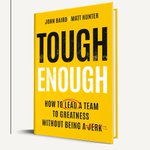
Today I am so excited to publicly announce my new book, Tough Enough: How to Lead a Team to Greatness Without Being a Jerk, which @BasicVenture at @HachetteUS will publish on September 29, 2026. It’s the practical playbook for building the next generation of great companies.
As an ex-founder turned executive coach, I’ve partnered with John Baird, one of Silicon Valley’s most respected executive coaches (Apple, Nike, DoorDash, MasterClass) as co-author to pay forward our hard-earned experiences in this book.
At the core of Tough Enough is a question that we’ve come back to repeatedly in our work:
How can leaders strike a balance between firm and humanizing?
It sounds simple, but actual leadership in practice tends to fall into either end on The Toughness Spectrum. And yet that middle operating mode is what is required to build great teams and lead companies to success without being a jerk.
We call that mode “Tough Enough”—a way of leading that is demanding, fast, and performance-oriented, while still being respectful. We break this down into seven timeless habits that can be taught and applied.
Tough Enough is for ambitious leaders who are too tough and need to keep their edge while reducing harm and those who are not tough enough and need to raise standards, embrace difficult conversations, and hold the line.
You can learn more about Tough Enough and start reading it right away here:
matthunter.co/toughenough
Thank you for your support to develop Tough Enough leaders to guide teams and their companies to greatness.

What do you do if you’re either too tough or not tough enough?
Great leadership is about finding the sweet spot.
Keep the intensity that serves the mission, remove the unnecessary damage, and have the courage to speak up, challenge people, and push harder when the situation demands it.
Buy Tough Enough today and get instant access to the Tough Enough Toolkit: 2 leadership assessments that show you exactly where you stand, plus the companion workbook to put it to work with your team.
matthunter.co/toughenough

There's a comfortable belief in leadership circles that the good fuel (or where you draw your motivation from) is the clean fuel.
Passion.
Purpose.
Love for the mission.
And that the darker drives like ambition, ego, and the need to win, are things to outgrow.
I've coached enough elite performers to know it doesn't work that way.
Love for the mission is real, but it isn't what keeps you awake at 2 AM grinding over a detail nobody else would notice. That kind of relentless, edge-running drive tends to run on something rawer.
Ambition. An unfillable void. The refusal to feel like a failure.
Carl Jung called it the shadow. The parts of ourselves we're trained from childhood to repress because they don't fit the acceptable version of who we're supposed to be.
Not just shame and anger, but the cravings, too.
Power. Control. Winning.
Walter Isaacson said it about as well as anyone, writing about Musk. Strengths and weaknesses are often the same thing flipped inside out. Strip away the chaos, and you strip away the genius too.
The danger is in letting your shadow drive unsupervised. That's the impulsive behavior and the self-destruction you see in brilliant leaders whose dark side took the wheel.
The work is integration.
Turn your insecurity into a drive to do great work.
Channel aggression into a love of competition.
Convert obsession into mastery.
You don't need to operate this way to run a good company. Plenty of balanced, thoughtful people are able to run solid companies.
But at the highest levels, the goal stops being balance and starts being winning or innovating. And that takes every drop of energy you've got, including the parts that make other people uncomfortable.
"This work isn't strong enough" and "you're not strong enough" live in completely different universes.
One sharpens the work. The other wounds the person, and the work never actually improves.
Steve Jobs shared about this (although his personal track record was not close to perfect). He said you have to give feedback in a way that leaves no doubt about the quality of the work, without ever calling the person's ability into question. He called it one of the hardest things a leader has to do.
The move is simple to name and hard to master.
Be relentless about the work, but be careful with the person.
There's one trait I've found in nearly every elite performer I've worked with: insatiability.
Never satisfied.
There's always another level.
No psychologist would call it healthy, and it doesn't track especially well with being happy.
It's usually hidden under a mask of composure. Calm and collected on the surface, relentlessly filling an unfillable void underneath.
You can't eliminate a drive like that, and if you're chasing real greatness, you wouldn't want to. The work is integrating it, so it fuels you without running your whole life.
Turn the void into a reason to build something valuable for the world.
Accountability is about having a clear, fair, and consistent process when performance doesn’t improve.
When everyone understands the consequences of missed expectations, feedback carries more weight, and leaders can intervene earlier and more clearly.
Buy Tough Enough today and get instant access to the Tough Enough Toolkit: 2 leadership assessments that show you exactly where you stand, plus the companion workbook to put it to work with your team.
matthunter.co/toughenough
Most leaders think they've fixed accountability once they start giving feedback.
Then nothing changes, and they can't understand why.
The missing piece is almost always consequences.
A consequence and a punishment are different things.
Punishment controls people through fear.
A consequence simply signals that the standard is real. Without consequences, feedback carries no weight, and your team learns they can miss the mark, ignore expectations, even step on the company's values, and nothing will actually happen.
Once that lesson lands, it's brutally hard to undo.
Think about a sport with no fouls and no penalties. The rules would collapse by halftime. They only mean anything because there's weight behind them.
Every time you fail to follow through, you spend down your own authority. Your team isn't listening to what you say you value. They're watching what you actually tolerate.
Netflix built an entire culture around this. Regularly assessing who's adding value and making the hard calls about who isn’t.
The leaders people trust most are the most consistent ones.
When feedback hasn't moved the needle, something real has to follow.
A narrower scope.
A performance plan.
Sometimes a parting of ways.
Delivered with clarity and respect, a consequence is the proof that your standard is real.
Every hard conversation you hand off is a rep you never take.
The ability to sit across from someone and say the hard thing cleanly only develops through practice.
Pass your toughest moments to a deputy, and you stay weak in the exact place you most need to be strong.
There's respect in it, too. The person on the other side of a hard decision deserves to hear it from whoever made it. Sending someone else to deliver the news tells them you couldn't carry the weight of your own call.
In the first episode of Game of Thrones, Ned Stark carries out the sentence himself. He says, “The one who passes the sentence should swing the sword.”
If it’s your decision, swing the sword yourself.
Effective accountability doesn’t have to be confrontational.
Share the facts, the impact on the team, name the emotion, make a clear and reasonable request for behavior change, and secure a mutual commitment around who will do what by when.
Buy Tough Enough today and get instant access to the Tough Enough Toolkit: 2 leadership assessments that show you exactly where you stand, plus the companion workbook to put it to work with your team.
matthunter.co/toughenough
Most leaders assume that being too soft and being too harsh sit at opposite ends of operating modes.
What they miss is how differently those two failures feel from the inside.
Being too harsh feels bad in real time. You can sense the room tighten. People go quiet.
Being too soft feels wonderful. Everyone likes each other. Meetings are pleasant. Nobody dreads your feedback because there isn't much of it. This is the comfortable approach, and it's dangerous precisely because it feels like success.
I've watched genuinely kind teams stay in that operating mode for years, mistaking the absence of conflict for health, while the best people quietly grew bored and the standards drifted down a little at a time.
The Tough Enough zone (which we advocate for in our new book) sits between the two. It’s not always comfortable. There's tension in it. Hard conversations happen. Someone gets told their work missed the bar.
But it's the only mode where people are both cared for and pushed. Where the feedback is honest, and the relationship survives it.
If your team feels great and nothing exceptional is getting built, don't take the good feeling as proof you're leading well.
Take it as a signal to check which zone you're actually in.
The fastest way to test if your vision is effective and memorable is to ask your team to describe it back to you.
If they stumble, or every person gives a different answer, you don't have a strong vision.
You have a sentence.
A real vision lives in people's heads as a picture. They can tell you what the world looks like once you've won.
Who's better off.
What exists that didn't before.
That clarity is what motivates your team and guides some of the hard calls they make without you in the room. They know where you're all headed, so they can choose the option that moves you most directly toward it.
Vague visions produce vague work.
Make the picture impossible to forget.
In Sapiens, Yuval Noah Harari makes the case that humans coordinate at scale through shared stories.
Company culture is exactly that: a story a group of people agree to believe and act on together.
When the story is strong, cooperation compounds. People move faster, sacrifice more, and take real pride in what they're building.
When it's weak, the whole thing drifts. Having a vague vision, a forgettable mission, and values nobody can name causes a team to lose its edge.
Don Valentine, who founded Sequoia, made it clear: The money flows as a function of the stories.
You have to give your people a compelling story worth fighting for.
Picture a sport with no fouls and no penalties.
Bad behavior would multiply instantly. The rules only mean something because there's weight behind them. There’s a consequence for not following the rules.
Your team operates the same way. Every expectation you set is only as real as what happens when someone misses it.
When you share your standard for something, and a teammate misses that standard, you've just taught everyone watching that the standard was optional.
That lesson spreads fast, and it's brutally hard to reverse once it lands.
Following through with consequences (both positive and negative) is what makes a standard real. Without it, you're just describing a preference and hoping people cooperate.
Most people say they want the truth. Very few will do the uncomfortable work of going to get it.
The truth has a cost.
It means building feedback loops that actually function.
It means hearing that you were wrong, that the work fell short, that an assumption you built the whole plan on no longer holds.
Jeff Bezos named the problem directly: we're social animals, not truth-seeking ones. Every instinct we have pushes us toward harmony and away from friction.
Good leadership is the discipline of overriding that instinct on purpose.
Steve Jobs described it with a rock tumbler. You throw in rough, ugly stones, let them grind against each other overnight, and by morning they come out polished. The best ideas form the same way, through pressure, testing, and honest friction between people who care.
The hard part is that friction feels like a threat in the moment. Someone challenges your idea, and your body reads it as an attack. The leaders who get to the truth learn to treat that discomfort as the cost of doing something valuable rather than a problem to smooth over.
So build the loops. Reward the people who bring you hard truths, especially the ones you didn't want to hear.
And learn to treat the silence in a room as the real danger, not the disagreement.
What a true surprise to wake up this morning to learn that Tough Enough is the #1 Bestselling Nonfiction book in the entire country, an instant National Bestseller!
usatoday.com/booklist/books/…
This doesn't happen without the right book at the right time, launched with the full support of an incredible team and you all in this community. So thank you for pre-ordering, reviewing, and spreading the word far and wide.
Tough Enough leaders are needed now more than ever, so to reach as many people as we have with this launch shows that we're clearly on to something. The good news is that we're just getting started, but I'll never take for granted the impact we're seeing right out of the gate, so thank you for the support. Onward.

Conflict avoidance is one of the most expensive habits a leader can have, and it rarely looks expensive in the moment.
It looks like patience.
It looks like giving someone the benefit of the doubt.
It looks like keeping the peace.
What it actually does is let small problems compound into large ones.
Every issue you leave unaddressed grows. The team member who needed a direct conversation six months ago is now a genuine problem. The co-founder tension you kept working around has hardened into something neither of you can name out loud anymore.
In nearly every dysfunctional organization I've coached, the trouble traces back to the same root: a leader who didn't have the conversation while the problem was still small.
I once worked with a company where the head of operations hadn't delivered a single piece of hard feedback in twenty years.
In that vacuum, a senior employee slowly took over and started bullying junior staff, because nobody had ever told her to stop. It ended in a formal harassment complaint.
That's the real cost. It didn't start as a harassment case. It started as a hard conversation someone chose not to have.
When you turn on honest, direct feedback early, you're not creating conflict.
You're stopping the kind that actually destroys things later.
Absolutely incredible facilitating the executive team offsite at Intel last week.
They have a phenomenally talented team, and John Baird and I were honored to support them during this massive turnaround at the company. They are truly just getting started.
A special shout out to Lip-Bu Tan and Aparna Bawa for having us.


If you're in Boulder, come out this Thursday to learn about the message in my new book :)

Matt Hunter will speak about and sign his new book, Tough Enough: How to Lead a Team to Greatness Without Being a Jerk, on Thursday, October 8th at 6:30pm, at Boulder Bookstore. Purchase tickets here: hunterbbs.eventbrite.com
