
Senior Fellow, Center on Health Policy, The Brookings Institution. Former Chief Economist for Council of Economic Advisers.
Washington, DC
Joined February 2017
- Tweets2.2K
- Following165
- Followers4.4K
- Likes478

Pinned Tweet
My new piece @Health_Affairs Forefront finds that if the House bill becomes law and enhanced premium tax credits expire on schedule, the US will see an unprecedented increase in the uninsured rate, wiping out about ~3/4 of the post-2013 decline.

Full paper here: healthaffairs.org/doi/pdf/10…


The role of brokers in Medicare Advantage remains underexplored in my view, so I was intrigued to see this new paper from @djmeyers2 and @jeffreydmarr examining recent insurer changes in commission payment and the effects on enrollment choices.
Matt Fiedler retweeted

I dug into the finances of the three nonprofit arbitrators resolving No Surprises Act disputes. For every dollar they made in '25, ~half was pure profit.
Read more about these 'mini-gods' and how they're getting rich off their new jobs.
tinyurl.com/5ye2csun via @statnews

Matt Fiedler retweeted

1/ Finally, a paper I've wanted to see for years.
Linehan, Niknam & Buntin test whether Medicare's "site-neutral" rates actually match what physician offices would be paid for the same care.
We raise this in nearly every site-neutral comment letter.
jamanetwork.com/journals/jam…


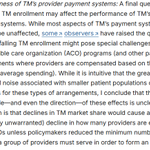
But the fact that there are no real glimmers of that happening so far, even in high-MA-penetration areas, makes us think that MA prices are unlikely to move far from TM prices in the short-to-medium run, even if that remains a possibility in the long run.
The paper discusses whether we should expect prices in MA to remain anchored to TM’s in the future. I have long suspected that competition from TM plays a key role in disciplining prices in MA, which suggests this pattern might ultimately break down if TM withers.
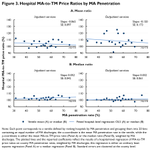
We also examine how the relationship between MA and TM prices varies with MA penetration, finding little evidence of an association. The caveat is that our estimates are somewhat imprecise, especially when looking at mean prices.

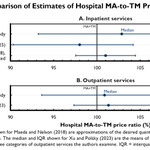
The greater dispersion seen in the studies using transparency data may reflect data quality issues. The data contain many obviously incorrect prices, and while we and others try to filter them out, it’s doubtful we fully succeed. Presumably, more errors = more dispersion.
Our findings are qualitatively similar to those of two other recent studies using price transparency data (Mackleby et al. & Xu and Polsky), but it’s notable that an older study using claims data (Maeda and Nelson) found much less price dispersion.

This figure tells the core story: at the median, MA plans' prices are close to TM's for both inpatient and outpatient care, albeit with meaningful (apparent) dispersion around that median.

New paper w/ Sam Peterson uses hospital price transparency data to take an up-to-date look at how the prices that MA plans pay for hospital care compare to TM’s prices. Bottom line: MA plans continue to pay prices close to TM’s, at least on average. 🧵
Matt Fiedler retweeted
Pallone’s new bill would replace federal No Surprises Act arbitration starting in 2028.
That would likely ↓ premiums over time through two channels:
(1) less spending administering disputes
(2) lower payments for affected services
A 🧵on the economics.
1/11

News: Pallone is unveiling an overhaul of the surprise billing law today
He says private equity backed providers are gaming the system.
He would replace the arbitration system with “benchmarking.” Different approach than Ways and Means
punchbowl.news/article/healt…
Final rule: federalregister.gov/public-i…
Fact sheet: cms.gov/newsroom/fact-sheets…

The comment letter that Yihan Shi and I submitted on the proposed rule lays out why JSON is so poorly suited to this purpose and what better options exist: brookings.edu/articles/comme…