



I disagree on the financial bubble.
I think AI will continue to grow financially as well as technologically. OpenAI and Anthropic could both become significantly bigger companies over the next 1-3 years rather than collapsing or being acquired for a fraction of their current valuations.
There will definitely be hype and some companies will fail, but I don’t think that means the overall AI financial cycle has to burst.
We’re still very early in AI adoption.
$AAOI $SIVE $LITE $OPENAI $ANTHROPIC

My AI predictions.
In the next 1 to 3 years, Open AI or Anthropic, or both, fail / get acquired for a fraction of their current valuations.
Microsoft, Google or a developer tooling company with access to lots of developers and source code like Sonar or JetBrains wins AI in software engineering.
Probably with smaller, local, specialised models.
Other domain specific companies spring up to win domains such as mathematics, legal, writing, etc.
TL/DR: The technology isn’t going away, but the financial bubble will burst.
What do you think?
I have a feeling December could be very bullish for AI stocks.
November brings the US midterms and potentially the Anthropic IPO.
If Anthropic’s IPO is strong, it could reignite AI sentiment and remind the market how much capital is still flowing into AI.
Then December could become the month investors start positioning for the 2027 AI spending cycle.
The big AI names will benefit, but I think the higher-beta AI infrastructure plays could move much harder.
$AAOI $AXTI $SIVE
How are @aleabitoreddit’s posts ending up on KuCoin News for $SIVE?
Is it just a coincidence, or does KuCoin have some kind of API/feed connected to his posts?
Interesting to see his $SIVE analysis getting picked up there.
kucoin.com/news/insight/LITE…

Fear in the market creates some of the best opportunities to buy.
When the market starts running again, everyone will chase the hype - buying when prices are already high.
Look at what happened when the AI bull run started:
$AAOI went from double digits to triple digits.
$AXTI went from double digits to triple digits.
$SIVE ran nearly 10x.
Now all these stocks are down heavily, while AI demand remains strong and supply is still constrained.
Everyone thinks the AI demand story is over.
That’s exactly why I think this could be the opportunity - before the market turns bullish again.
We saw how hard these stocks ran from late last year into mid-2026.
The biggest gains usually don’t come from buying after everyone is excited.
They come from buying when everyone else is scared.
In latest report, interesting to see $SIVE named among the key players driving advancement in the Photonic Integrated Circuits market.
The Photonic Integrated Circuits Market Report 2026 projects the market could expand to $34.6 BILLION by 2030.
And look at some of the names Sivers is being mentioned alongside:
$COHR - Coherent
$GFS - GlobalFoundries
$MTSI - MACOM
$STM - STMicroelectronics
Ayar Labs
Lightmatter
PsiQuantum
Then there’s $SIVE - Sivers Semiconductors.
For a company the size of $SIVE to be included alongside major global semiconductor and photonics players is noteworthy.
AI data centres, optical I/O, CPO and next-generation high-speed connectivity are creating enormous demand across the photonics ecosystem.
Being named on the list isn’t the same as winning production orders - execution still matters.
But Sivers is increasingly appearing in the right conversations, in the right market, at potentially the right time.
$SIVE $COHR $GFS $MTSI $STM


Great post from someone who only discovered $SIVE today, already putting $SIVE on the same watchlist as $MRVL.
People are starting to realise that Sivers belongs in the conversation alongside major names in the optical and AI infrastructure space.
In the optical packaging space, it’s definitely worth putting $SIVE on the same watchlist as Marvell.
The more investors start making that comparison, the more interesting the Sivers story becomes.
“Market cap is around SEK 7.8B right now. TTM revenue is about SEK 278M, so roughly 28x sales. In the optical packaging space, worth putting this on the same watchlist as Marvell.”
$SIVE $MRVL

Learning about a company today: $SIVE.
One of the optical names I’ve spent more time on.
Servers move electrical signals. Fiber runs light. Optical modules do the conversion in between. Sivers sits further upstream — they make the InP lasers that actually generate the light.
As AI clusters move from 800G to 1.6T and 3.2T, bandwidth keeps going up, and the requirements on laser power, efficiency, and stability go up with it. Sivers is already working on 70mW, 100mW, 200mW DFB lasers and laser arrays. That puts them in a position to supply pluggable, NPO, and CPO.
That’s the part I find interesting about their setup. You don’t have to bet which optical architecture wins. As long as AI networking keeps scaling, the light source layer has to improve.
On execution, the key project right now is with Jabil. They’re developing a 1.6T LRO module using Sivers DFB lasers. If that line gets traction, the business model changes.
A big chunk of revenue used to come from NRE — customers paying them to do development work. They’re now trying to shift more toward product revenue. You can see it in the numbers if you look at the reports.
Q2 revenue was only SEK 53.8M, so the top line still looks weak. But product revenue grew 18% year-over-year at constant currency. Opportunity pipeline is now at $1.2B, up 268%.
They’ve also announced $30M to expand the Glasgow InP fab, aiming for over 100 million CW DFB lasers per year by Q4 2027. For a company this size, scaling capacity that aggressively suggests management is preparing for real AI optical volume.
The risk is obvious — if orders don’t show up, that capacity turns into cost. Debt is also worth watching, especially with the cloud spending questions floating around. They did finish a financing round this year: the $12M convertible converted, and the remaining $5M term loan has been paid off. Near-term, the main question has shifted from survival to actually selling product.
Market cap is around SEK 7.8B right now. TTM revenue is about SEK 278M, so roughly 28x sales. In the optical packaging space, worth putting this on the same watchlist as Marvell.
Just my view.

Morgan Stanley says the U.S. market correction may be nearing its end and investors should be ready to buy the dip.
I think AI photonics could be one of the most interesting areas to watch.
The sector has already been heavily de-rated, while the underlying AI infrastructure buildout continues.
If the market turns risk-on again AND the laser/optics bottleneck story accelerates into 2027…
$SIVE
$LITE
$COHR
$AVGO
$MRVL
$AAOI
$AXTI
$POET
The combination of AI capex + optical bandwidth demand + constrained laser supply + recovering risk appetite could create a very powerful setup.
The correction may be painful - but the next leg higher will be even more interesting.
$SIVE $LITE $COHR $AVGO $MRVL $AAOI $AXTI $POET

One thing I find interesting about Serenity is that $AVGO isn’t something he suddenly started mentioning now.
His archived March thesis already referenced Broadcom’s comments about laser supply constraints, and he was already floating an $AVGO/$SIVE M&A-style thought experiment back then.
Now he’s raising the idea of Broadcom potentially locking up $SIVE laser capacity for the next few years.
That doesn’t mean there’s an undisclosed connection between the two - but the recurring $AVGO angle is interesting because Broadcom’s own comments about needing more laser capacity align closely with the core $SIVE thesis.
Laser supply is becoming increasingly strategic for AI infrastructure, and Sivers is positioning itself to become a major merchant CW-DFB supplier.
Maybe it’s just connecting the dots.
But Serenity has clearly been connecting these particular dots for a while.
$SIVE $AVGO $COHR $LITE $NVDA
$LITE CEO interview on demand, counterparty + financing risk:
- "CFO of $GOOGL came on and reported capex going up Y/Y, we expect hyperscalers for report an increase in capex in earnings.
Based on what we see, we see their spend going up."
- "The purchase agreements we have, to a large degree, are noncancellable."
- The difference between Lumentum and companies like $AVGO, "we are not as dependent on AI datacenter buildout going forward"
There's a conversion between electrical products to optical products" creating structural demand.
Q: When do you see able to see yourself having more inventory? (catching up to surge in demand)
- When we look at demand, there is "no end in sight"
TLDR:
Financing risk and demand aren't equally distributed across AI supply chains. But markets are just selling everything off together.
As for photonics in specific, I said this before, but increasing optical content per XPU + CPO/NPO adoption keeps going up so we'll likely see sector spend go up, even if aggregate capex goes down.
There's the usual "no end to demand in sight" commentary, but $LITE does have capacity commitments into 2029 now... and are negotiating for 2030. (with new information that most of which are likely hyperscalers + non-cancellable)
So doesn't quite sound like it's all over for the AI trade, especially photonics.

Memory is the current AI bottleneck.
Lasers could be next as AI datacenters scale to 1.6T, 3.2T and CPO.
The market is already watching the big players - $COHR $LITE.
Don’t overlook $SIVE.
2027 could be the year the laser supply story gets very interesting.

Some AI bubble.
Lumentum CEO in April: “basically sold out” through 2027.
Now: “almost sold out for 2029.”
Under-shipping demand by 30% on some products into 2028; ~70% on others in 2027.
Demand keeps outrunning the fabs.
Laser go pew pew. $LITE
When you go through the $SIVE posts from Serenity, is there anything missing?
At this point, is it mainly a waiting game for 2027?
New AI/datacenter laser production orders
New customer names
Jabil qualification → production orders → volume ramp
Pluggable optics customers converting to production
LiDAR production ramp
US Nasdaq listing
Glasgow capacity ramp
$1.2B pipeline converting into real revenue
Revenue and margins finally inflecting
Sivers has already said it expects Jabil production orders in H1 2027 and ramping in H2 2027. It also says several other pluggable module makers are now engaged.
So what am I missing?
To reach at 200 SEK or even 400 SEK, is the market simply being completely irrational…
or does SIVE genuinely need much more than the 2027 story we already know?

I’m long $SIVE at $140M.
I believe this is the next $LITE that markets and institutions missed.
$SIVE makes InP CW DFB lasers.
Closest comparison is $LITE in the current EML laser bottleneck.
But instead of supplying to Innolight/Eoptolink for current optical transceivers cycles.
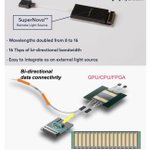
They supply the lasers to $POET Starlight, Ayar SuperNova.
And others for the future CPO/silicon photonics architectures spearheaded by $NVDA.
Current valuations make 0 sense to me personally.
$POET is advanced packaging for $SIVE type lasers…
But $POET commands worth 11x+ more than the company making the laser itself?
It’s feels like valuing a more advanced $FN (~$20B) packaging at $400B when $LITE is valued at $40B.
So now at $130m:
-
- You have a likely mini $LITE like laser supplier to Marvell Celestial + hyperscalers through $POET.
- Laser supplier to Ayar ( $NVDA, $INTC ), though they do multi source with $LITE, Sumitomo, $MTSI.
And other potential up and coming suppliers potentially like Lightmatter that they’ve name dropped (eg. Q2 2023 earnings). This is unconfirmed but supply chain BOM is confidential.
On top, for revenue, they expected $453M "pipeline next few years”.
And, they have capacity expansion through WIN: “Win Semi foundry qualification in progress for volume production from Laser designs from Sivers."
Sivers feels the silicon photonics/CPO version of $LITE, with actual rapidly growing customers like Celestial through $POET, Ayar, with more to come.
I wouldn’t have liked it last year, but just 3 weeks ago, they refinanced all their debt successfully to $12M convertible loan (10.85%) and a $5M term loan (12%), which cleans up debt.
It’s $17m total, which feels like nothing to US markets when $AAOI is doing a $500m ATMs every other week.
Best of all, this is their pure play inp laser segment for silicon/photonics + cpo.
Their Lidar segment is ramping up and they have $53-138M projected revenue coming in.
Downside risk:
- execution (as always)
- dilution to scale up capacity to compete with $LITE and others.
- $LITE, $COHR competition on scale after $NVDA just gave them $4B
- CPO ramp gets delayed.
I have no clue how, $LWLG, a pre-revenue science project with $TSEM, is valued at $1B+ MC.
Or how $POET, is worth ~9-10x more than its laser supplier.
When $SIVE, the mini $LITE equivalent for CPO/Silicon photonics, is valued at $140M.
I do believe this is largely undiscovered by institutions, since this is some random company in OMX Nordic Exchange (similar to micro $AXTI before I started posting about the inp substrate bottleneck).
But I do think it will get a lot of institutional attention as Celestial and Ayar scale up.
Especially if $POET and $SIVE gets qualified with other customers.
If CPO completely replaces pluggable transceivers in the next generation of hyperscaler architectures.
Sivers, with possible WIN Semi qualifcation and if they become the multi-source lasers for NVIDIA, Marvell, Intel, and Broadcom architectures, can be strongly rerated.
Just as how $LITE did today going from $16 -> $622.
This is just my personal thesis I'm sharing, DYOR/NFI.
TLDR:
InP Lasers are the current bottleneck in photonics as seen with $LITE valuations.
$SIVE looks like the mini $LITE for the upcoming CPO/Silicon Photonics ramp.
I personally took long position in $SIVE, as I believe they’re a large beneficiary of the upcoming silicon photonic/CPO architectural changes by $NVDA (with GTC cataylst).
The upside here just way too compelling for me personally as the next possible $LITE.

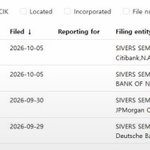
US ownership of $SIVE is getting very interesting.
Latest available ownership data shows:
Morgan Stanley - 18.58M shares - 5.21%
JPMorgan Chase & Co - 9.41M - ~2.84%
BlackRock - 4.38M - ~1.32%
Kairos Venture Investments - 4.58M - ~1.38%
Dimensional Fund Advisors - 1.42M - ~0.43%
State Street Investment Management - 685K - ~0.21%
Charles Schwab Investment Management - 560K - ~0.17%
Tema ETFs - 424K - ~0.13%
Geode Capital Management - 225K - ~0.07%
Edgehill Partners - 210K - ~0.06%
There are also major US custody/nominee accounts:
Charles Schwab FBO Customer - 50.91M
National Financial Services - 48.22M
Morgan Stanley Smith Barney - 13.15M
Morgan Stanley & Co International - 11.07M
Merrill Lynch - 9.93M
JPMorgan Chase Bank - 5.38M
The custody/nominee figures shouldn’t automatically be treated as the institutions’ own investments - they can represent their customers’ shares.
But the Morgan Stanley 5.21% disclosed position, BlackRock, JPMorgan, Dimensional, State Street, Geode and other US institutional holders are certainly worth watching.
And this is happening while $SIVE is building toward the AI/datacenter laser ramp, with >100M CW-DFB laser annual capacity planned in Glasgow.
US capital is clearly showing up around Sivers.
2027 could be very interesting.

People keep talking about the AI photonics race , but here’s an interesting piece of $SIVE history which everyone is missing.
Sivers was one of the 11 founding members of the industry effort to standardise CW multi-wavelength laser sources for next-generation optical interconnects.
The founding group included:
$SIVE
$AYAR
$INTC
$LITE
$MTSI
$ANET
$II-VI
$SUMITOMO
$IMEC
$LUMINOUS COMPUTING
$QUINTESSENT
And interestingly:
$NVDA was an Observer Member.
Sivers wasn’t a company that suddenly appeared in the AI laser story in 2025/26.
Sivers was involved in the standardisation of CW laser sources from the beginning, and later demonstrated its DFB laser arrays with Ayar Labs.
The AI optical infrastructure story has been building for years.
$SIVE $NVDA $AYAR

Photonic stocks will lead the market
$LITE — Optical backbone of AI. Copper fails scaling. $400M backlog signals massive demand surge.
$AAOI — Pure-play transceivers. 1.6T exposure. $1B+ revenue target. Demand exceeds supply into 2027.
$ANET — AI networking king. Connects massive GPU clusters. Targeting $3.25B AI revenue by 2026.
$AXTI — Critical laser substrate supplier. Hidden chokepoint enabling optical scaling across AI infrastructure.

$SIVE already has serious high-power laser capability:
• 8-channel DFB arrays demonstrated with $AYAR
• 16-wavelength DFB array demonstrated with $AYAR
• 65mW+ per channel demonstrated
• 100mW laser arrays now being sampled
• 200mW individual lasers for NPO applications
• $3.4M SemiNex programme targeting high-power, high-channel-count DFB arrays
The key point:
Sivers has not publicly demonstrated an 8×200mW array yet.
But the technology roadmap is clearly moving in that direction.
The SemiNex programme could be a major piece of that next-generation architecture, potentially taking Sivers from proven multi-channel arrays toward much higher-power configurations for AI optical infrastructure.
If they demonstrate 8×200mW-class technology, that’s a very interesting milestone for $SIVE.
$SIVE $AYAR
Nobody said $SIVE was going to be the sole laser provider for Ayar for all generations. 2nd gen Supernova was 16x wavelength that they confirmed Sivers.
Ayar is expected to do multi-vendor for lasers, would be stupid not to. Originally disclosed suppliers were $LITE, $MTSI, and $SIVE, but there's probably only a few companies that can do this new design.
For their new demonstration at OCP it's 8x 200mW range, $LITE is probably the closest one technologically to Ayar's OCP announcement, with 8x 250 mW demonstrated at ECOC just last month that they're targeting availability later in 2027.
I don't see anything where $MTSI has demonstrated remotely similar capabilities yet. Macom were saying they were still working on 75 mW qualifications targeting production H2 2027.
$SIVE has lower power 8/16 channel specs, and individual 200 mW lasers for NPO. I think this might relate to their Seminex partnership for UHP multi channel variants that they were targeting for 2027 so high confidence they'll meet technology specs eventually, more of a matter of timing.
But basically new announced configuration from Ayar, can't really make any assumptions here yet, will need to wait for earnings of these players.

I don’t think $SIVE should be acquired at this stage.
Sivers is only now entering the scaling phase, expanding the Glasgow foundry, building toward 100M+ lasers/year and positioning itself for potentially billions in future revenue.
Why sell now before the AI photonics opportunity fully plays out?
Let Sivers scale first.

By analyzing $SIVE, we can assess its potential in addressing the challenge of scaling AI clusters. And the bottleneck here is not a shortage of GPUs, but the limitations of copper interconnects.
The transition of data centers to CPO makes photonics the main beneficiary of the new cycle, but the technology has a bottleneck: silicon is an inefficient light emitter.
This is precisely where Sivers is positioned to occupy a strategic niche:
• It supplies CW-WDM-standard InP DFB laser arrays.
• It serves as a key link in the ecosystem by integrating solutions with $GFS.
The market, out of habit, views SIVE as a niche R&D player, overlooking the transition of its lasers from test batches to mass production for AI factories.
However, the question is: Will they manage to make the leap from an undervalued player to the primary beneficiary of CPO? Or are they a target for a potential M&A acquisition?

Germany is going BIG on AI.
Major $NVDA partnership reportedly coming, backed by hundreds of millions in government funding.
Siemens, Audi, Deutsche Telekom + industrial AI, robotics and autonomous systems.
More AI infrastructure = more bottlenecks.
Compute → Networking → Power → Optics & Lasers
Could European photonics companies become strategic AI assets?
$NVDA $SIVE $AAOI