Maths Ed retweeted
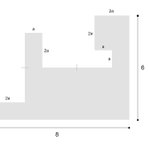
What's the perimeter of this rectilinear shape?
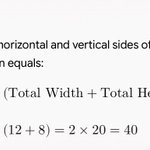
AI's thoughts: @ChatGPT got 2(8) + 2(6) = 28. @GeminiApp got 2 × (8 + 6) = 28. @grok got 28 + 6a and didn't go further. @claudeai 'measured the pixel coordinates' to get 34. @perplexity_ai got 28 + 6a = 28 + 6(1) = 34.
What's the perimeter of this rectilinear shape?
AI's thoughts: @ChatGPT got 2(8) + 2(6) = 28. @GeminiApp got 2 × (8 + 6) = 28. @grok got 28 + 6a and didn't go further. @claudeai 'measured the pixel coordinates' to get 34. @perplexity_ai got 28 + 6a = 28 + 6(1) = 34.
838931536741197143 is prime
8389315367411971 is prime
83893153674119 is prime
838931536741 is prime
8389315367 is prime
83893153 is prime
838931 is prime
8389 is prime
83 is prime
…and the trailing double-digit numbers removed in each step are prime.
Maths Ed retweeted
Mathematics. Strange Universe. Right angles.
What's the perimeter? Do we have sufficient info to solve this? Could AI solve this?
By Maths Ed Ideas, @MathsEdIdeas, mathsedideas.blogspot.com, Used with permission.
By the end of today, the 4! × 3! × 2! × 1! -th day of the year, exactly 6! × 5! × 4! × 3! × 2! × 1! seconds will have passed this year.
String together the
9th prime (23) of 9s
8th prime (19) of 8s
7th prime (17) of 7s
6th prime (13) of 6s
5th prime (11) of 5s
4th prime (7) of 4s
3rd prime (5) of 3s
2nd prime (3) of 2s
1st prime (2) of 1s
and you get the 100-digit pandigital prime
↓
Maths Ed retweeted
Math.
The Probability Trap. The Labyrinth of Decisions. Solving Life, One Path at a Time.
By Maths Ed Ideas, @MathsEdIdeas, mathsedideas.blogspot.com/, Used with permission.
Maths Ed retweeted
🍾 Zeeman, is me, man! 🍾
Incredibly honoured to receive the 2026 Christopher Zeeman Medal, the UK's top gong for maths communication.
So proud for the recognition! Thanks @LondMathSoc and the IMA!
ima.org.uk/29984/alex-bellos…
42 mathsy activities, 42 days of school holidays ⇒ a daily dose of summer maths play. From games of Hex, Sprouts, and Misère Os and Xs (with just Xs), to Lewis Caroll's Amazing Number-Guessing game, fractals and Fibonacci on the beach, and much more: mathsedideas.blogspot.com/20…
#Ramanujan was born #OTD 138 years ago. He created this, his birthday magic square, where all rows, columns, diagonals, corners, corners of 3×3 squares, and 2×2 corner and centre squares sum to the sum of the digits of his birthday in the 1st row. bit.ly/3Gd2K8M
The 'First Equation'… a story about the evolution of the notation we use for addition (+), subtraction (–), and equality (=), which led to the first time an equation was written using the modern notation we use today, 14x + 15 = 71. mathsedideas.blogspot.com/20…
By the end of today, exactly
1×2×3×4×5×6×5×4×3×2×1
seconds will have passed this year.
= 1 day
= 24 hours
= 24×60 minutes
= 24×60×60 seconds
= (2×3×4)×(5×6×2)×(5×4×3) seconds
= 1×2×3×4×5×6×5×4×3×2×1 seconds
#HappyNewYear
#HappyNewYear2025
Math up your countdown to 2025…
= (10×9×8×7÷6÷5×4+3)×(2+1)
= (10+(9+8×7)×6)×5+4×3×2+1
= (10+(9×(8−(7−6×5))))×(4×3)+2-1+0!
= 10×(9+8×7−6+5!+4!)−3×2+1
= 10×9×(8+7+6)+5!+4×3+2+1
= (10+9)×(8+7+6)×5+4!+3+2+1
#HappyNewYear
#HappyNewYear2025
Writing 1 once, 2 twice, 3 three times, and so on, up to 45 forty-five times [or (20+25) (20+25) times], produces a string of 2025 or 45² [or (20+25)²] digits — the only number where this happens. #HappyNewYear2025 • bit.ly/40ct4JR
Happy 2025 — the first year to be a square (whose digits sum to a square) that is equal to the sum of the first [sum of its digits] consecutive cubes and to the square of (and the product of the proper divisors of) the sum of a split of its digits. #HappyNewYear
Curated links to ≈ 400 mathsy radio and podcast programmes for you to peruse and enjoy this Christmas. Including from @stevenstrogatz @FryRsquared @alexbellos @SLSingh @d_spiegel and many more: bit.ly/2w1rHOT
Teachers: Wish your students and their families a mathemagical xMaths with an xMaths card full of problems and curios. Two cards in various formats free to download and customise • bit.ly/3Peu4pN
The largest prime found by hand, in 1876 by Édouard Lucas, has 39 digits bit.ly/2OZXB6l
The first largest prime found by computer, in 1951, has 79 digits go.nature.com/2OXFMqE
The largest known prime, found today in 2024, has 41,024,320 digits bit.ly/48f6bYI