

Your daily destination for everything #math. Exploring elegant theorems, mind-bending puzzles, and the beautiful, logical patterns that shape our universe. 📐
Joined April 2019
- Tweets6.4K
- Following358
- Followers8.7K
- Likes450




Pinned Tweet
This fast mental math trick simplifies graphing forever.
But look closely at the final equation.
Save this geometry guide before it gets patched.
Most engineers line up for the wrong door until negative variables break their backend code.
The crowd is rarely right in algebra.
Save this to test your dev team's rigor tomorrow.

This infinite series cheat sheet looks perfect, but it hides a mind-bending calculus paradox.
Most engineers use these blindly without checking convergence.
Save this before your next proof.

Amateur thinkers blindly assume parallel lines and confidently get this wrong.
Look closely at the intersecting transversals. What is the exact value of x?

93% of software engineers fail this high school math question because they lack basic compiler logic.
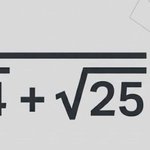
Look closely at the order of operations. What is the real value?

The trap isn't the arithmetic; it's how your brain parses nested structures (AST).
Here is the evaluation tree:
1. Inner roots resolve first
2. Summation follows
3. Outer root applies last
Bookmark this to test your team's code review skills.
90% of students just memorize this math sheet.
But high-level STEM exams exploit the subtle flaws hidden within these basic geometry formulas.
Can you spot the edge case where #16 fails?

The Trap: Parallel Line Bias.
Nowhere does it state the horizontal lines are parallel. Relying on alternate interior angles creates a logical contradiction (140 vs 150).
Geometry requires proof, not assumptions. Bookmark this to test your team.
A linear function written as a quadratic curve?
Is this just a careless notation error, or does it conceptually bridge the gap between basic algebra and calculus approximations?
Explain.
When your physics crush sends a passive-aggressive calculus note.
Understanding higher-order derivatives literally saves relationships.
The ultimate test for kinematics nerds. 📈

Technically, if the third derivative is a jerk, what does that make the fourth derivative ($d^4x/dt^4$)?
Most engineering textbooks stop at snap, crackle, and pop. Prove the chaos.
The ultimate cheat sheet for classifying integral equations.
From Fredholm to Volterra types, mapping the exact anatomy of kernels.
Save this math guide for your advanced calculus research. 📊
