
Independent statistician using data to understand our world & to predict the future. Currently focused on pay gaps, diversity, elections, forecasting, surveys.
Bath, England
Joined June 2018
- Tweets8.7K
- Following240
- Followers1.7K
- Likes10.2K






Pinned Tweet
I now offer a newsletter you can subscribe to here.
marriott-stats.com/nigels-bl…
You can select from these categories to receive notifications of latest news, articles & offers.
- Diversity & Pay Gaps
- Forecasting
- Elections
- Surveys & Polling
- Sport
- Weather
- #Stats Training
I don't know if this is a standard graphic for financial accounts but I've not seen this before and I like it.


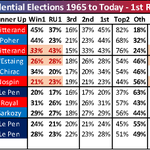
If Le Pen gets ~35% on the 1st Round next year, it won't be a surprise since the long term trend pointed to a new record.
At that level of support from round 1, the odds of her winning round 2 are high.
1/2


What effect has this weekend’s mob violence had on the polling for the 2027 🇫🇷 presidential election?
Answer: a big boost for Marine Le Pen
She is now polling at 34-38% in the first round
Mélenchon in strongest position to secure the other run-off place
source: @IfopOpinion

Nigel Marriott retweeted

On the 29th of July, 800 kilometres of the Red Sea went to war. No navy was involved. Nobody fired a shot. 4 men in London moved a line on a chart, and somebody passed the biscuits.
I was holding the biscuits.
There are a handful of us. We meet in a building in the City that wears its plumbing on the outside, and we decide which of the world's oceans are at war.
I know. I think about it on the Central line, usually somewhere around Bank.
I sit on the Joint War Committee. We are underwriters from Lloyd's and the company market, and we publish a list of Listed Areas: the waters where a ship's ordinary cover stops and a premium for war begins. The men who started this business in Edward Lloyd's coffee house in 1688 did not believe in adjectives, and neither do we.
The building is Richard Rogers's. Lifts, ducts and staircases hang off the outside in stainless steel, so from Lime Street it looks like a refinery that went to Cambridge. I've always thought it the only honest building in the City. Everyone else hides the pipes. Inside, the staff wear navy livery with a flash of red and are called waiters, because 3 centuries ago they poured the coffee. They pour the news now.
In the middle of the Room, under the rostrum, hangs the Lutine Bell. It came off a frigate that went down off the Dutch coast in 1799 with a fortune in gold and silver that Lloyd's had insured, and with 240 people aboard, of whom 1 survived. The market paid for the gold in full and quickly, and that payment made our name. The men were not on the policy. The bell was fished up decades later, and for generations a waiter struck it when news came of an overdue ship: once if she was lost, twice if she'd come home.
During the war, Lord Haw-Haw told Britain the bell was ringing day and night for the convoys. It rang once, for the Bismarck. It is cracked now. The last time it rang for a lost ship was 1979.
Every family has an uncle on the wall. Ours is the slave trade. Our market insured the ships, and in June 2020 Lloyd's apologised for its "shameful" role, which in Lloyd's time is roughly the same afternoon. I mention it because people imagine insurance is neutral. It has never been neutral. It decides which voyages happen.
Here is the whole trick, and it embarrasses people with its simplicity. A ship enters a Listed Area. Her owner tells his insurer. The insurer quotes an additional premium for that one voyage, a percentage of what the hull is worth, good for about a week. The owner pays, or he turns round. Nobody has to sink anything. A number does it.
We don't shout. There is no war room. There is a table, a pot of very bad coffee, and Giles. When a strait has become impossible, Giles reads the reports, takes off his glasses and says "interesting." Everyone at the table knows what interesting means. It means the rate has just tripled. You'd have to have been to the right school to hear the violence in it.
We had competition. On February 28 the Americans and the Israelis struck Iran, and Iran began firing at ships in Hormuz. Before the war, a tanker paid us about 0.25% of her value to pass through. In July the President of the United States published a rate card of his own. Every time Iran fired at a ship, he wrote, America would bomb and destroy "ONE BRIDGE OR POWER PLANT." Capitals in the original.
I admired it enormously. It is a tariff schedule. A man who spent his life in property had priced a strait in infrastructure. The difficulty was that nobody sails on his rate card. Owners do not ring the White House before they leave Fujairah. They ring a broker, the broker rings us, and by summer we were quoting between 3% and 10% of the hull per passage. A $100 million tanker paid $3 million to $10 million for a trip shorter than a bank holiday weekend. Giles said "interesting" 4 times that month.
The President can bomb a bridge. He cannot make a ship sail.
The Houthis understood all of this before the Pentagon did, and I hold a professional regard for them that I would never voice at a dinner party. A navy needs hundreds of hulls to deny a sea. Since 2023 the Houthis have needed a hijacking, a few sinkings and a steady drip of drones, and then my profession did the rest. This summer they declared a blockade of Saudi ports and hit a Saudi tanker called the Encelia. In September they took Perim Island, a lump of volcanic rock sitting in the mouth of the Bab el-Mandeb like a toll booth nobody had thought to staff. Their entire naval doctrine fits in one word, and the word belongs to Giles.
Which brings me to the part of the year I'll tell my grandchildren about.
Saudi Arabia is a careful country, and it spent decades preparing for exactly this. It built a pipeline across the full width of the kingdom, from the Gulf to the port of Yanbu on the Red Sea, so that if Hormuz ever closed, the oil could leave by the back door. Hormuz closed. The oil went to Yanbu, precisely as designed.
Then the Houthis started on Saudi ships, and on a Wednesday at the end of July there were 4 of us at the table.
It is raining on Lime Street, the thin City rain that seems to fall sideways out of the ducts. The chart of the Red Sea is out, the big one with a coffee ring off Eritrea that nobody has been allowed to clean since 2024. The broker's report runs to 3 pages and says what broker's reports say: an attack here, a claim there, a militia on an island. Nobody reads past the first page. We know what it says.
Someone uncaps a pen. It starts at the old line, 18 degrees north, just above Jizan, and travels up the Saudi coast, past Al Lith, past Jeddah, past little ports nobody in this room has seen or ever will. It slows at Yanbu. It goes on a little further, for luck, to 25.5 degrees. It stops.
Nobody speaks. The rain does some work on the windows. Giles takes off his glasses, folds them, looks at the pen, then at the coast.
"Interesting."
The pen goes back in its cap. While we're at it, someone adds the whole of Eritrea, and nobody looks up. I pass the biscuits. In a terminal in Yanbu, a man whose job is to load the oil his country built a pipeline to protect has no idea that his port has just become a war, by fountain pen, in a building that wears its plumbing on the outside.
Consider that for a moment. A kingdom spent billions digging an escape route from one war zone, and a committee in a building with its pipes on the outside reclassified the exit. We did it on a Wednesday. Nobody fired a shot. The biscuits were digestives. By the next afternoon, the rate for a ship calling at Yanbu had quadrupled, from 0.25% to 1%.
Egypt has lost something like $10 billion of canal revenue since the Red Sea trouble began. Then Hormuz shut, tankers started routing through Suez instead, and in August the canal took $567 million, up 57% on a year earlier. Cairo now earns more whenever Iran behaves worse. Nobody in Cairo will say so. I'm saying it from London, with no consequences whatsoever, which is the great privilege of my trade.
Egypt also buys more wheat than any country on earth, and in the first half of this year Russia and Ukraine sold it more than 82% of it. That grain crosses the Black Sea, which is on our list too, because 2 countries have spent 4 years sending drones at each other's ports. When we move the Black Sea rate, a subsidised loaf in Giza notices. The baker never learns why.
Kuwait drinks the sea. Around 90% of its drinking water comes out of desalination plants on the Gulf coast, and in July Iran hit the Subiya complex 4 days running. Plants like that are insured in rooms like ours. When a man in Kuwait City fills a glass from the tap, there is a premium in it.
There is one group in this chain we never quote, and I think about them on the Central line more than I'd admit at the table. In May, American officials counted 1,550 ships stranded around Hormuz. Every one of them has a crew: a Filipino cook, a Ukrainian third officer, an Indian engineer who has watched the same stretch of brown coast for months, aboard a ship whose owner is deciding whether my rate is worth paying. Nobody asks them anything. They're the only cargo we forgot to list. 227 years after the Lutine, we still haven't found room for them on the slip.
Some nights, somewhere past Liverpool Street, I very nearly mind. Then I remember that minding isn't a class of business, and the feeling is gone by Bethnal Green.
And you. I haven't forgotten you. The owner pays my premium and passes it to the charterer, who passes it to the refiner, who passes it to the pump, the boiler and the supermarket shelf. Nobody sends you a schedule. Nobody asks you to sign. But you have been one of my policyholders all year, every time you filled a tank or nudged the heating up a notch. You simply never received the policy. We don't issue them to the public. It would only cause alarm.
Some people say I profit from war. That is unkind, and also imprecise. I profit from the fear of war, which is far larger and far more reliable. Wars end. Fear renews every year.
The Lutine Bell hasn't rung for a lost ship since 1979, and it doesn't need to. The losses come by email now, and they reach every desk at the same moment, which was the only reason anyone rang the bell in the first place. The head waiter still writes them into the Loss Book in copperplate, with a quill. He writes down the ships.
The President, meanwhile, still believes Hormuz is his to open or close, depending on the day. He has posted about it a great deal, much of it in capitals. In all these months, not one broker has attached a single one of those posts to a slip. When he finds out who actually runs his strait, he'll say the whole thing is rigged. He'll be right, of course. It has been rigged since 1688. We simply never put it in capitals.
Navies close seas with ships. Militias close them with drones. Presidents close them with posts in capital letters. We close them with a revised list and a courteous cover note.
It's nearly one. Sweetings doesn't take reservations, which makes it the only risk in the City I can't lay off, and they serve no coffee after lunch, only brandy or port. I'll have the port. Giles will say "interesting." The Red Sea will be exactly where we left it.
The entire history of France in a nutshell. Just brilliant!
Though I think it's a bit unfair to blame England twice without making any mention of the Scots and most of all the Americans.

WHO DESTROYED FRANCE? 🇫🇷
Yes. EVERYONE did.
1. Emmanuel Macron, a man who thinks he's Jupiter but governs like a McKinsey intern who accidentally became emperor. He promised a French Renaissance and delivered a complete disaster. His solution to every catastrophe is another speech about the future of Europe.
2. The ENA Elite, Sciences Po, and the Grandes Écoles, the world's most sophisticated factories for producing highly educated incompetence. They can explain the collapse of French industry in seventeen PowerPoint presentations without ever having entered a factory. They invented a system where the same people run the state, destroy it, and then get promoted to investigate what went wrong.
3. François Hollande, the socialist who declared war on finance and then appointed Emmanuel Macron economy minister. His presidency was so spectacularly mediocre that even his own party eventually pretended not to know him. He managed to make political paralysis look like an exhausting full-time occupation.
4. Jacques Chirac, who promised reform, encountered a demonstration, and immediately discovered the virtues of doing absolutely nothing. He spent twelve years as president shaking hands with farmers while the national debt continued its agricultural expansion. His greatest political achievement was making immobility look presidential.
5. François Mitterrand, who tried socialism in 1981, and discovered economic reality in 1983. He nationalized companies, reversed course, and built a pyramid at the Louvre. Appropriate architecture for a president who occasionally treated the French economy like a pharaoh's burial chamber.
6. The Socialist Left, which believes money grows on government decrees. Their economic model consists of taxing the rich, subsidizing the poor, employing the middle class in public administration, and borrowing whatever remains. When the money runs out, they accuse arithmetic of being fascist.
7. The French Trade Unions, which defend public services by making sure nobody can use them. They stop trains to save the railways, close schools to defend education, and block refineries to protect purchasing power. Their greatest contribution to French productivity is ensuring that nobody produces anything without their permission.
8. The French Right, which has spent forty years promising to reduce public expenditure, reform the state, restore authority, and liberate the economy. Then it wins an election, appoints seventeen ministers, creates four administrative agencies, and discovers that cutting public expenditure might upset somebody. French conservatives defend free enterprise in speeches and administrative regulation in practice. They want a smaller state, provided nobody removes their subsidies, pensions, privileges, public contracts, or favorite government department. Their economic program was essentially socialism with better tailoring.
9. The French Boomers, who inherited affordable housing, expanding industries, and economic growth, then converted everything into pensions and real estate. They bought apartments for the price of a used Peugeot and now explain to young people that homeownership requires sacrifice. They spent their youth demanding revolution and their retirement demanding that absolutely nothing change.
10. Pétain and Vichy, who responded to the greatest military humiliation in modern French history by deciding that collaboration with the occupier was an excellent national recovery strategy. France had already lost the war. Pétain somehow found a way to make losing considerably more embarrassing.
11. The French Generals of 1940, who built the Maginot Line and apparently forgot to tell the Germans they were supposed to attack it. They prepared brilliantly for the First World War, only to discover that the enemy had inconveniently arrived in the Second.
12. The Republican Idealists, who believe France isn't a country but a philosophical concept. Other nations build institutions. France proclaims Values. When schools fail, they organize republican ceremonies. When public order collapses, they deliver speeches about citizenship. When reality contradicts their principles, reality is clearly insufficiently republican.
13. Saint-Simon, Fourier, Cabet, and the French Utopian Socialists, who looked at humanity and decided the problem was insufficient central planning. Fourier imagined communities organized around human passions. Saint-Simon dreamed of society directed by enlightened productive elites. Their descendants now occupy French ministries, designing national happiness through administrative circulars. Two centuries later, the happiness is still missing, but the paperwork is magnificent.
14. The French Revolution, which promised Liberty, Equality, and Fraternity, then introduced mass executions, revolutionary tribunals, civil war, and political terror. The revolutionaries liberated France from monarchy, discovered that citizens disagreed about liberty, and began executing one another. France has spent two centuries celebrating this as the birth of political enlightenment. Apparently, mass killing becomes progressive when accompanied by the correct slogans.
15. The Enlightenment, Libertinism, and the Marquis de Sade, who began by liberating humanity from superstition and ended by demonstrating that intellectual sophistication is no guarantee against moral insanity. Voltaire mocked religious authority, Rousseau dreamed of remaking society, and Sade turned transgression into an entire literary industry. Their descendants now believe that every inherited institution is oppressive and every new social experiment is automatically progress.
16. The English, who spent centuries sabotaging French ambitions, financing France's enemies, and preventing French domination of Europe. The Hundred Years' War was essentially a prolonged British property dispute conducted on French territory. Every time France attempted to become a continental superpower, England appeared with a navy, a coalition, and a remarkably enthusiastic willingness to pay somebody else to fight.
17. The Habsburgs, who surrounded France with territories acquired through marriage, inheritance, and a family tree resembling a biological experiment conducted without ethical supervision. They conquered half of Europe through weddings while French kings bankrupted themselves trying to escape the encirclement. The Habsburgs invented geopolitical domination through matrimonial administration.
18. The English, Again, because centuries of warfare were apparently insufficient. After defeating Napoleon, they conquered global commerce, international finance, and eventually the English language conquered French business. Today, French executives speak English to other French executives in Paris. England finally conquered France without deploying a single soldier.
19. The Romans, who conquered Gaul, introduced taxation, centralized administration, and the idea that provincial populations should be governed by distant officials convinced of their intellectual superiority. Two thousand years later, Paris continues to administer France like a Roman governor collecting taxes from barbarians. Rome collapsed. French bureaucracy survived. Live like Rome, die like Rome.
20. Darth Vader, the ultimate French technocrat. He believed every problem could be solved through centralization, intimidation, and an enormous publicly funded megaproject. His Death Star was essentially the French Ministry of Finance equipped with a superlaser. It cost a fortune, concentrated all power in one place, and exploded because nobody listened to the engineers.
21. Saruman and Sauron, the spiritual ancestors of French industrial planning and European centralization. Saruman wanted to replace forests with factories. Sauron wanted to unite the continent under one supreme administrative authority. Both believed that enough central planning could overcome reality. Both were eventually defeated by small provincial creatures who refused to follow instructions.
22. Satan, who has reportedly retired from corrupting France because the competition has become unbearable. He spent centuries encouraging pride, vanity, envy, and destructive political passions, only to discover that French politicians could produce the same results without supernatural assistance. He applied for a position at the Ministry of Finance but was rejected for insufficient administrative experience.
And the French people?
They have spent more than two centuries overthrowing kings, emperors, republics, governments, and presidents, convinced that the next political arrangement would finally solve everything.
They have tried absolute monarchy, constitutional monarchy, revolutionary dictatorship, empire, parliamentary republics, presidential republicanism, socialism, liberalism, conservatism, and technocracy.
Every generation announces that France needs a revolution.
Every revolution promises to put an end to the failures of the previous regime.
And every new regime eventually discovers that it has inherited THE FRENCH.

Nigel Marriott retweeted

One of the fundamental mistakes the opponents of UK Equality law make is they regard it as encouraging the dividing up into identities. “Identity politics” .A thread on why that is a fundamental error.
Nigel Marriott retweeted

50 Shades for Men
'I'm a bad girl,' she whispered, 'Punish me in a way only a real man can!' 'Alright,' I said and left my wet towels on the bathroom floor.
'I want it now against this wall!' she ordered, 'And keep it up as long as possible.' 'Don't worry,' I said, 'I know how to put up a shelf.'
As we sat in the dark restaurant, she stroked my thigh and said 'I want to see your hardness.' 'Alright,' I replied, and punched the waiter.
At the touch of her lips, it grew long and swollen. I sighed as she squeezed and pulled expertly. It was the best balloon giraffe I'd seen.
Staring at her naked body, I asked what she wanted. She told me to go for something between a smack and a stroke. So I went for a smoke.
'How do you feel about using toys in the bedroom?' she asked. 'Fine,' I said, 'But I can't see how we're going to fit a Scalextric in here.'
Her body tensed and quivered as she felt wave after wave flow through it. I probably should've told her about the new electric fence.
As I lay there on the floor, my body covered in treacle and whipped cream, I heard those inevitable words . . . 'Clean up on aisle 3.'
'Are you ready to be tortured in a way only a woman can torture a man?' she asked. I nodded nervously. 'OK' she said and ate half my chips.
Frantically I tore off her dress, bra and knickers. My heart was racing but I just managed to close the wardrobe door before she got home.
'Hurt me!' she begged, leaning over the dining table expectantly. 'OK,' I replied, 'Your turkey's too dry and your sprouts are overcooked.'
She leant over the kitchen table. 'Smack that bottom,' she squealed, 'Smack it hard!' 'I am,' I said, 'But the ketchup just won't come out.'
She wanted to try phone sex so I pretended to be an IT support guy. It turned her on. Then it turned her off. Then it turned her on again.
They asked me to smear their naked bodies with the produce from my herb garden but I just couldn't do it. Too many women, not enough thyme.
'I'm your slave,' she said breathlessly, 'Make me feel completely helpless and worthless.' So I locked her in the shed and went to the pub.
Her body trembled and shook.'I can't wait any longer, do it now!' she cried. 'OK,' I said and got the winter duvet from the airing cupboard.
'Harder!' she cried, gripping the workbench even tighter, 'Harder!' 'Alright,' I said, 'What's the gross national product of Nicaragua?'
'Hurt me!' she cried, pressing her body up against the shed wall. 'Alright,' I said. 'You're a terrible cook and I fancy your sister.
😁😁
Nigel Marriott retweeted

It's Halloween season again and as a mathematician I'm obliged to post this. I don't make the rules


Nigel Marriott retweeted

I suffer from a rare condition where I keep thinking people will change their minds when presented with facts.


Wonderful map!
So 4 countries don't have to move at all.
4 countries move into their neighbours.
Can you spot these?
Hilarious that the Koreas have to move but are still neighbours!

What if the largest countries had the largest population? Australia would move to Spain and Pakistan to Australia. buff.ly/2yvHaej

Nigel Marriott retweeted
How to start a culture war with 4 numbers!
This thread is an extraordinary example of how one can frame the narrative by choosing which chart to lead with.
Here is the graphic I would have started the narrative with.
But what did others lead with?
1/9


26% of young Republican men blame their problems on women.
66% of young Democratic women blame their problems on men.
🔗 americansurveycenter.org/sig…


How to start a culture war with 4 numbers!
This thread is an extraordinary example of how one can frame the narrative by choosing which chart to lead with.
Here is the graphic I would have started the narrative with.
But what did others lead with?
1/9
26% of young Republican men blame their problems on women.
66% of young Democratic women blame their problems on men.
🔗 americansurveycenter.org/sig…
So why has this latest front in the US culture wars erupted?
Because someone has a book to sell!
americansurveycenter.org/gen…
Kudos to the guy's marketing agent, it certainly wasted a couple of hours of my afternoon I was supposed to be using to finish off work for a client!
8/9

By the way, the data comes from a 2025 survey on US Civility & Morality.
The data is apparently available here but you have to create an account with them to download it and receive their spam presumably.
americansurveycenter.org/dow…
9/9