




parallax: numbers, not just a concept
when @Gradient_HQ rolled out parallax, they didnt just say "it's faster"
they tested it on 14 interconnected machines and got concrete results: 3.6x higher throughput and 2.6x lower latency compared to leading local inference frameworks
this isnt a synthetic benchmark in a vacuum.
parallax was run on real hardware - nvidia gpus mixed with apple silicon, over 40 open-source models, running on windows, macos and linux simultaneously.
the difference isnt that the hardware was more powerful the difference is in how parallax distributes the model across disparate devices and balances the load.
why is this important?
usually, "run a model locally" means on a single machine, with its memory and performance limitations.
parallax removes this limitation: multiple devices operate as a single service and do so faster than most local hosting tools, even when each device individually is weaker than a single powerful server.
decentralization here isn't a compromise for privacy, but a real speed boost.

echo-2: actor and learner, the separation that holds everything together
in conventional rl learning, the same hardware first generates data (the model plays, responds and tries)
then, on the same machines, calculates gradients and updates weights.
the hardware constantly switches between these two different tasks and is idle most of the time.
echo-2 from @Gradient_HQ breaks this into two independent roles.
the actor is a swarm of many, often unstable and cheap machines that only generate data: they run the current version of the model and collect trajectories.
the learner is a single centralized process that takes these trajectories and calculates weight updates.
they dont have to work synchronously. the actor can lag slightly behind the latest policy version, usually by 3-6 steps.
this is called bounded staleness.
however, at 11 steps behind, the system diverges and learning breaks down, so this isnt infinite freedom, but a controllable parameter.
the actor can be scattered across cheap, unstable gpus around the world, while the learner can be kept in one place.
on the 30b, this dropped the training cost from $4,500 to $425 (10 times cheaper for the same result)

gAxis
a little bit late, but wanna share my stats
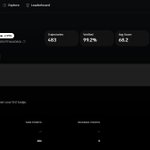
Jul 28–Aug 14 was first my epoch in @axisrobotics and i get 686 points for 483 trajectories
not bad result, on 28th august will be another epoch will see what i will get
keep manage

Marchi retweeted

I went through Horizon’s signup to see what the 1,000-credit thing actually was
the whole onboarding takes around 20 seconds.
goal → markets → holding period → experience → starting capital
then you’re dropped into the platform with 1,000 credits to start testing ideas.
what I like is that it doesn’t ask the usual useless profile questions - everything is trading-specific from the start.
the credits are nice, but the interesting part is getting from a new account to actually experimenting with AI strategies this quickly.
full signup is in the video ↓
language models had a ready-made ocean of data
the entire internet, billions of pages, free and immediately available
robots dont have such an ocean.
for a robot to learn to pick up a cup, someone has to actually place the cup in front of it and demonstrate how to pick it up over and over again.
this cant be downloaded with a single request, it requires hardware, a room, an operator and hours of work.
because of this, the entire world has collected not billions, but at most a couple million robot demonstrations and half of them are tied to a specific manipulator model in a specific lab.
apply the same task to a different arm or in a different room and the data is practically useless.
this creates a paradox: language models learned to write before the simplest robot learned to reliably pour water into a glass
not because the task is physically more difficult, but because theres no physical place to obtain training data on the required scale.
this is precisely the gap that axis is trying to fill, but more on that in the next article.

prismax isnt just about operators and data
when people talk about @prismaxai, they usually focus on one aspect: the operator gets behind the wheel of the robot, generates data and earns points.
but theres a second aspect, which is less talked about
the official prismax website clearly states: the platform "brings human skills to robots, enabling robots to do real work while simultaneously collecting valuable data"
so its not just about "collecting data for the sake of data", its also a working infrastructure where robots actually perform tasks and data emerges as a valuable byproduct.
the network connects operators, robot owners and robotics companies through a single protocol.
that is, the demand is coming not only from researchers who need datasets, but also from those who need the task to be physically completed.
this changes the way we view the project: not just a "farm for collecting training data", but an emerging labor market, where on one side are operators with skills and on the other, those who need real manual labor (albeit remote for now)
in this sense, the data flywheel is simply a side effect of real, useful work.

gmagic
only 4 weeks took to reach adept status on the quest platform
sadly, but didnt get anything from the drop machine
move on and waiting for new quests


uber driver in a world of robots
if you look at the @prismaxai roadmap not as a technical diagram, but as a labor market, an interesting picture emerges
stage one(now)
teleoperation. you get behind the wheel of a real robot remotely and perform tasks manually. it's literally work, just remotely and through a browser
stage two(mid-term)
fleet management. instead of one robot, there are several, for real clients, with real tasks. this is no longer a one-time job, but something akin to a dispatcher or shift manager
stage three(long-term)
autonomy. models trained on the data from the first two stages begin to operate automatically. the human role shifts from "doing" to "training and testing"
the parallel with uber is no coincidence: first, a human driver is needed to collect demand and route data. then autopilot appears, but the foundation for it was laid by people behind the wheel
prismax is essentially building a similar path, only its not cars that are driving, but robots that gradually learn on their own.

robots cant learn as quickly as language models
llm had the entire internet of text, while the robotic arm had a few thousand hand-crafted and very expensive demos.
@axisrobotics solves this differently: instead of a warehouse with expensive equipment
it uses a browser and simulation. you go to the website, control a virtual robotic arm directly in the browser, without hardware or configuration and generate data for training real robots
the engine itself creates new tasks, changes scenes, objects, conditions and checks whether they are completed correctly
this way, thousands of people simultaneously create a dataset that would previously have taken months of work by an entire lab
one case study: 10,000+ successful trajectories in 3 days, the model trained on them already controlled a real robotic arm.
$12 million seed from hack vc, partnershаips with geely, booster robotics and others. the goal is to become for physical ai what the internet once became for text.

gprisma
today we played with ru prisma community in smash kart
tbh, im noob there and sucked as well
but we have what we have, ty for hosting @puselol


another round of @PrismaXai RU SMASH KARTS EVENT
Last time, @Yulian12451 walked away with the victory. Think you've got what it takes to dethrone him and claim the top spot?
Jump in and prove it!
⏰When: Today 17:30 MSK
📍Where: russian channel
👤Host: @puselol
📜 Format: 1 round / 10 mins of pure carnage
🏆 Prize: Smash Karts Legend status + a featured spot on the next event banner!
🎮How to join: Pull up to the russian channel at 17:30 MSK and click the room link as soon as it drops!
See you on the track!

on july 30, stanford hosted bass sbc 2026
a blockchain ecosystem summit that brought together heavyweights like a16z, visa, solana, circle, near, kraken and alchemy
bayley wang, ceo of @prismaxai, also spoke.
why is this important?
because bass isnt a robotics conference or a web3 get-together for enthusiasts. this is a place where finance, blockchain and ai are discussed in a common language
physical ai was invited there not as an exotic topic, but as part of a broader conversation about where the industry is heading.
this is a small but telling sign: the topic of "robots + data + blockchain" is no longer a niche topic for a small circle and is beginning to be perceived by serious players as part of the overall picture.
the prismax team was on-site at stanford all day, interacting with people in person and not just appearing on the program.
for a project at such an early stage, being on the same speaker list as a16z and visa isnt just a nice tweet
it carries reputational weight.


We're live at BASS SBC 2026. Come find our booth to say hi to the team (and Baby Owen).
Don't miss Bayley on the China & Open Source AI panel at 5:10 PM PT, alongside Matt White of the @linuxfoundation and @eraqian of @OSCampus.
See you there!

open intelligence stack: why gradient calls it a single stack and not a suite of products
@Gradient_HQ has parallax, echo, lattica and gradient cloud
at first glance, they seem to be just a collection of different tools
they describe it differently: as a unified architecture called the open intelligence stack (ois)
the point is that each product covers a different stage of the same task
lattica is responsible for communication between devices
its like a nervous system. parallax takes this communication and turns it into inference
distributing the model across different machines and managing them as a single service
echo does the same for training
separating training from inference so they dont compete for the same resources
gradient cloud is a ready-made entry point for companies that dont want to understand hardware
the formula is train → serve → own
train a model, deploy it and truly own it
without renting from openai or anthropistic.
the team behind this is researchers from berkeley, hkust and eth zurich
intelligence should be a common good, not the privilege of a few corporations.

opus 5 vs sonnet 5: a live comparison on commonstack
anthropic released claude opus 5 this week (july 24th) and is positioning it simply: almost the same level of intelligence as the top-end fable 5, but at half the price.
the price hasnt changed since the previous version, opus 4.8: $5 for 1m input tokens and $25 for 1m output tokens.
i ran the same prompt "explain quantum computing in simple terms" on both opus 5 and the slightly older sonnet 5 (released in june) right in the commonstack playground
the numbers show a noticeable difference.
sonnet 5 is significantly cheaper: $2/$10 for 1m
opus 5 is $5/$25
in terms of speed in this particular run, sonnet delivered even more tokens per second 93 tps versus 80 for opus, although its first token arrived a little later (3.6 seconds versus 2.7 for opus)
in fact, opus 5 isnt a fasteeer sonnet, but a model for more complex tasks at a price close to the standard price.
if you need top-tier reasoning and agent performance, opus is the one.
if price and speed on simple tasks are more important, sonnet still holds its own.
these numbers are from one run, not a benchmark, but they're a fair indication.

Claude Opus 5, the latest frontier from Anthropic is now on @commonstack_ai
It performs at SOTA for many coding and knowledge evaluations while coming in half the price of Fable 5.
Build now with the best in class production execution.

what happens if the operator makes a mistake?
a logical question about @prismaxai: you're controlling a real robot through a browser, not a toy simulator.
what if your hand shakes and the robot hits or breaks something?
its important to understand two different things here.
first, the hardware. any system with real robots that are controlled remotely is built with default limitations: speed limits, protection against sudden jerks and the ability to perform an emergency stop.
this is standard practice in the industry for any teleoperation platform, not just prismax.
second, and this is specific to prismax itself, the data. if the operator makes a mistake and records a faulty demonstration, this recording isn't automatically included in the model.
its evaluated by the eval engine, and other users can verify it via proof-of-view. that is, a bad attempt simply won't pass the quality filter.
so the system is protected on both sides: the hardware limits physical risk and the eval engine and proof-of-view prevent bad data from moving further down the pipeline.
operator error isn't a disaster or the end of the world, but simply a demonstration that won't get the required rating.

gradient and privacy-preserving inference: data that never goes away
parallax, gradient's distributed inference engine, has one principle that holds everything together: privacy isnt an option, but an architectural decision.
how it works:
when you run a model through parallax, the data and memory remain local, on your device or in your cluster. the request doesnt go to someone else's server, no one logs it and no one can return it when requested
simply because the server never had that data.
but locality is only half the battle.
the second part is verifiability. the system records every calculation step, so the inference result can be double-checked to ensure that the model actually calculated what it was supposed to and didn't cut corners or spoof the answer.
verification is built into the protocol, with minimal overhead about 1% of the full inference.
privacy and trust are not two separate requirements, but one and the same architecture.
the data is yours, the verification is yours and no one else can see anything in the middle.

simulation vs. reality: why prismax isnt focusing on virtual environments
in robotics, there are two ways to collect training data: put a robot in a simulator or let it operate in the real world.
simulation is cheap and fast. you can run millions of trials overnight without wasting hardware or human time.
the problem is that the simulation is perfect. the lighting is even, the physics are predictable and objects behave as the developer intended.
the real world doesnt work that way.
an object can slip, the light can fall awkwardly, or the surface can be slippery.
thats why @prismaxai is focusing on teleoperation over virtual environments: only real robots, real operators and the real chaos of the physical world.
this is the same "grounding" without it, a model can learn beautiful rules that break down in reality.
simulation has its place in the industry as a whole, it scales early experiments well, but its precisely this "dirt" of the real world that it cant provide.
prismax fills precisely this gap: data that cant be faked with computer graphics.

prismax vs. physical intelligence: two different answers to the same question
both companies are solving the same problem: robots lack sufficient data for proper training, but their approaches are opposite.
physical intelligence (also known as pi) is a team from google deepmind, stanford and berkeley, founded in 2024. they are building a single, giant generalist model called π0, which is designed to control any robot.
the money involved is enormous: $70m at the start, then $400m, then $600m and the company is now valued at around $11b.
the data for this model is collected by the company itself and its partners closed loop, a small circle of demonstrators.
@prismaxai takes a different approach: not a single superteam with a billion-dollar budget, but an open network where data is collected by anyone through teleoperation and contributions are accounted for through proof-of-view and token incentives.
in other words, pi is betting on the scale of capital and a single, giant brain.
prismax is betting on the scale of the community and decentralized data collection.
both strategies are viable, theyre just two different ones.
ways to close the same data gap in robotics

machine internet: what gradient is building beyond ai
@Gradient_HQ calls itself an ai project, but if you look deeper, theyre building something more fundamental
the team describes their network as a "new machine internet" - open, sovereign and running on millions of everyday devices
decentralized intelligence must have three pillars: compute, communication and orchestration. these three primitives form gradient's "machine internet"
computation is provided by parallax, distributed inference across thousands of nodes worldwide.
communication is provided by lattica, a peer-to-peer protocol for transferring data between devices.
coordination is handled by echo, a framework for distributed training and model alignment.
it all started with sentry node, ordinary browser extensions that turned people's phones and laptops into network nodes.
today, its a fully-fledged infrastructure, building not only ai but any distributed computing system.
the point is that gradient sees itself not as a competitor to openai, but as an alternative to the internet of data centers, where the infrastructure is maintained not by corporations, but by the users themselves.

gliquid
im not good in crypto analyze, am i doing right?
ty app.liquid.trade for comfortable interface

who owns the data in prismax
when tesla or boston dynamics collect data from robots, that data remains within the company
the operator simply completes the task and leaves, the dataset belongs entirely to the corporation
@prismaxai operates on a different logic
the operator recorded the demonstration via teleoperation
its not just "working for a paycheck". the contribution is recorded, evaluated through proof-of-view and the eval engine and rewarded through prisma points.
this means that the person who created the data remains part of the data economy, not just a one-time contributor who was kicked out after a shift.
this is fundamental to the web3 model:
the right to a share in the final product belongs not only to the platform, but to everyone who actually participated in the creation of the dataset.
centralized labs are physically unable to build such a fair and transparent system for accounting for the contributions of thousands of people simultaneously.
this is the essence of decentralized incentives, data is created en masse, but the benefits are not concentrated in a single location.
if the contribution is accounted for, trust in the system grows, which means the quality of the data it receives also improves.
