

The fastest AI dev news engine on X — model releases, tools, and what they actually mean
What is trending in AI?
Joined April 2016
- Tweets14K
- Following1.2K
- Followers11.9K
- Likes7.5K


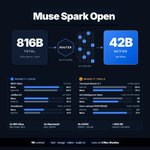

▲ MiniMax just released M3.1 Flash, pushing frontier-level agent performance down to Flash pricing: $0.15 / $0.60 per 1M tokens on a 428B MoE with about 23B activated parameters. Space Bunny, the stealth model that processed 200T+ tokens, was an earlier version of it.
🐰 Yes, Space Bunny was on M3.1 Flash from its development...
The core design choice is always-on reasoning with 5 effort levels, from Low to Max. Thinking cannot be disabled, so M3 integrations that send thinking.type=disabled now return an error.
On MiniMax's own table, it scores 62.2 on Automation-Bench v1.0.6, ahead of Opus 5 (50.3) and GPT-5.6 Sol (45.8), and ties Opus 5 on BankerToolBench at 76.2. Every effort level stays below $0.05 per task. It is a trade-off though: it trails Opus 5 by 13.7 points on Terminal Bench 4.0, and DeepSeek V4.1 Flash-1017 still beats it on DeepSWE (77.0 vs 73.7).
With a 1M context window, text, image and video input, and a flat price at half of M3's per-token rate, it targets high-volume coding and office agents. Open weights arrive Oct 23......
Full analysis: marktechpost.com/2026/10/19/…
API: platform.minimax.io
Try it: agent.minimax.io/tools/m3-1-…
@MiniMax_AI
▲ Marktechpost AI retweeted
▲ NVIDIA just open-sourced the entire Run:ai platform under Apache 2.0. Production GPU orchestration for Kubernetes is now free to inspect, fork and self-host.
The key move is modularity. 4 components ship standalone: KAI Scheduler (CNCF Sandbox), GPU Fractioning Operator, KAI Resource Management and Workload Map.
GPU fractioning is now CUDA 13.4-native. The driver enforces a hard memory limit per workload, and Run:ai’s old proprietary implementation is retired.
You can run the full stack locally. 1 script builds ~50 Go services into a 5-node Kind cluster with 8 simulated A10 GPUs. No GPU needed.
It is a trade-off though. The free edition has no NVIDIA enterprise support, local builds need 16 GB RAM and 100 GB disk, and NVIDIA published no platform-level benchmark.
8 DSX partners, including Crusoe, Nebius, Mirantis and Rafay, are already integrating it......
Full analysis: marktechpost.com/2026/10/18/…
Repo: github.com/dsx-ai-factory/ru…
Technical details: developer.nvidia.com/blog/nv…
@nvidia @NVIDIAAI

▲ Marktechpost AI retweeted
▲ Mistral just released Timestral, its first time series foundation models, and the headline is size: 209M parameters, #1 zero-shot on 3 benchmarks, and no GPU needed.
The key innovation is Decoupled Horizon Forecasting (DHF). Instead of masking the values to forecast, learned forecast tokens read the full history. Every observed value works as both target and context.
Covariate-aware attention gives each series a role: target, past-only or known-future covariate. Information flows only from covariates to targets, so a weather forecast or holiday calendar can help without leaking a target's own future.
Timestral-209M scores 0.658 MASE on GIFT-Eval, 0.626 on TIME and 50.39 SQL skill on fev-bench. The 28M model beats Chronos-2, about 4x larger, on GIFT-Eval and TIME. It is a trade-off though: the lead is thin (0.658 vs 0.661 over t0-gamma), and results stay self-reported until the technical report lands.
4 sizes (5M to 209M), 32,768-step context, 21 quantiles, 10 ms to 140 ms on an 8-thread CPU. Weights ship under a Modified MIT license, while TimesFM-3 weights are non-commercial......
Full analysis: marktechpost.com/2026/10/18/…
Repo: github.com/mistralai/timestr…
Models: huggingface.co/collections/m…
@MistralAI

▲ Marktechpost AI retweeted
TinyFish just made web Search and Fetch free for AI agents, changing which part of the bill you can actually cut: retrieval is now $0, but every page your agent reads still becomes input tokens.
The key insight is that agents pay 2 cost lines. The retrieval charge per request or page, and the model processing every token that page dumps into context. Routing to a cheaper model lowers the price per token. It does not shrink the page.
In TinyFish's own 45-URL test, the same Daily Mail article came back at 4,737 characters through TinyFish Fetch and 171,095 through a noisy fetch. That is ~1,184 vs ~42,774 tokens. 3 pages like the second one fill a 128K context window before the agent writes a word.
On the Artificial Analysis Search API leaderboard (Sep 28, 2026), TinyFish posts the lowest displayed total: $0 search + $9.30 model per 1,000 tasks. It is a trade-off though: its Search Index score of 71 is the lowest of 12 displayed configs (top is 80), at 59.0s per task, and the benchmark does not test Fetch.
Search is free at 30 req/min and 500/hour, Fetch at 150 URLs/min and 1,000/day. TinyFish earns on execution: Agent at $0.016 per step, Browser at $0.002 per minute......
Full analysis: marktechpost.com/2026/10/18/…
Check it out here: aicampaign.live/90-wk2n
Fetch eval: tinyfish.ai/blog/how-we-eval…
Benchmark: artificialanalysis.ai/agents…
@Tiny_Fish

▲ NVIDIA just open-sourced the entire Run:ai platform under Apache 2.0. Production GPU orchestration for Kubernetes is now free to inspect, fork and self-host.
The key move is modularity. 4 components ship standalone: KAI Scheduler (CNCF Sandbox), GPU Fractioning Operator, KAI Resource Management and Workload Map.
GPU fractioning is now CUDA 13.4-native. The driver enforces a hard memory limit per workload, and Run:ai’s old proprietary implementation is retired.
You can run the full stack locally. 1 script builds ~50 Go services into a 5-node Kind cluster with 8 simulated A10 GPUs. No GPU needed.
It is a trade-off though. The free edition has no NVIDIA enterprise support, local builds need 16 GB RAM and 100 GB disk, and NVIDIA published no platform-level benchmark.
8 DSX partners, including Crusoe, Nebius, Mirantis and Rafay, are already integrating it......
Full analysis: marktechpost.com/2026/10/18/…
Repo: github.com/dsx-ai-factory/ru…
Technical details: developer.nvidia.com/blog/nv…
@nvidia @NVIDIAAI
▲ Mistral just released Timestral, its first time series foundation models, and the headline is size: 209M parameters, #1 zero-shot on 3 benchmarks, and no GPU needed.
The key innovation is Decoupled Horizon Forecasting (DHF). Instead of masking the values to forecast, learned forecast tokens read the full history. Every observed value works as both target and context.
Covariate-aware attention gives each series a role: target, past-only or known-future covariate. Information flows only from covariates to targets, so a weather forecast or holiday calendar can help without leaking a target's own future.
Timestral-209M scores 0.658 MASE on GIFT-Eval, 0.626 on TIME and 50.39 SQL skill on fev-bench. The 28M model beats Chronos-2, about 4x larger, on GIFT-Eval and TIME. It is a trade-off though: the lead is thin (0.658 vs 0.661 over t0-gamma), and results stay self-reported until the technical report lands.
4 sizes (5M to 209M), 32,768-step context, 21 quantiles, 10 ms to 140 ms on an 8-thread CPU. Weights ship under a Modified MIT license, while TimesFM-3 weights are non-commercial......
Full analysis: marktechpost.com/2026/10/18/…
Repo: github.com/mistralai/timestr…
Models: huggingface.co/collections/m…
@MistralAI
TinyFish just made web Search and Fetch free for AI agents, changing which part of the bill you can actually cut: retrieval is now $0, but every page your agent reads still becomes input tokens.
The key insight is that agents pay 2 cost lines. The retrieval charge per request or page, and the model processing every token that page dumps into context. Routing to a cheaper model lowers the price per token. It does not shrink the page.
In TinyFish's own 45-URL test, the same Daily Mail article came back at 4,737 characters through TinyFish Fetch and 171,095 through a noisy fetch. That is ~1,184 vs ~42,774 tokens. 3 pages like the second one fill a 128K context window before the agent writes a word.
On the Artificial Analysis Search API leaderboard (Sep 28, 2026), TinyFish posts the lowest displayed total: $0 search + $9.30 model per 1,000 tasks. It is a trade-off though: its Search Index score of 71 is the lowest of 12 displayed configs (top is 80), at 59.0s per task, and the benchmark does not test Fetch.
Search is free at 30 req/min and 500/hour, Fetch at 150 URLs/min and 1,000/day. TinyFish earns on execution: Agent at $0.016 per step, Browser at $0.002 per minute......
Full analysis: marktechpost.com/2026/10/18/…
Check it out here: aicampaign.live/90-wk2n
Fetch eval: tinyfish.ai/blog/how-we-eval…
Benchmark: artificialanalysis.ai/agents…
@Tiny_Fish
▲ Marktechpost AI retweeted
▲ Google just open-sourced Harness², changing how AI agents get better: instead of retraining the model, the agent rewrites its own harness.
The key innovation is a contrastive Propose-Probe-Compose step. It proposes harness edits, probes them on the same task, and keeps only the changes backed by behavioral evidence. No ground-truth labels or verifiers needed.
A second level of recursion saves adopted harnesses and lessons to a library, so each new task starts from accumulated experience.
One refinement step lifts GLM-5 by 11.5 points on WorkBuddy-Bench and 11.8 pp on Harvey's legal benchmark (LAB), improving all 4 tested model/harness setups across all 3 benchmarks. A weaker GLM-5 with a better harness even beats base Gemini 3.5 Flash. It is a trade-off though: each task costs about 4 agent runs, and Meta-Harness still leads LAB on Gemini under Codex.
Built around 8 editable components (system prompt, guardrails, memory, tool guidance, subagents, skills, scripts and plugins), it ships under Apache-2.0 with OpenCode and Codex executors......
Full analysis: marktechpost.com/2026/10/18/…
Repo: github.com/google-research/h…
Paper: arxiv.org/abs/2610.14224
@GoogleResearch @GoogleAI
▲ Marktechpost AI retweeted

We just served 1 trillion tokens of Beam in 24 hours. To celebrate, we've reset everyone's limits.
Go build something big 👉 platform.reflection.ai
▲ Marktechpost AI retweeted

Can we predict electronic bands beyond DFT across different systems?
A material’s electronic band structure provides the basis for band gaps, densities of states, and carrier effective masses, while connecting theory with spectroscopy. For quantum materials, getting these bands right can change our understanding of physics. Yet the calculations needed to go beyond standard DFT remain expensive.
We introduce O-krystal, a periodic E(3)-equivariant graph neural network that learns corrections to individual electronic states. It uses orbital information from lower cost PBE calculations in both real and reciprocal space, bringing local electronic interactions and the momentum dependence of the crystal into the same model.
O-kRystal is the first machine learning framework to combine:
1. Scale across chemistry: HSE06 band predictions across nearly 6,000 chemically diverse three dimensional materials
2. Breadth across electronic behavior: metals and insulators, magnetic and nonmagnetic systems, with spin resolution and different numbers of bands
3. Flexibility across theory and dimensionality: the same framework, trained separately, predicts G0W0 quasiparticle energies in two dimensional materials.
Although trained only at high symmetry points, it maintains comparable accuracy at unseen points along band paths and reconstructs densities of states from dense Brillouin zone predictions.
On a separate benchmark of strongly correlated materials, O-kRystal reduces the PBE band energy MAE by 68.7%. As demonstrated for AFM-II MnO, a canonical Mott insulator, it captures distinct corrections to Mn 3d and O 2p states, recovering their relative placement by accounting for the effects of exact exchange.
As electronic structure methods advance, this framework offers a path toward experimental accuracy and large-scale discovery of quantum materials with emergent phases, including superconductivity. @Caltech

▲ Marktechpost AI retweeted

🤔️How to build sample-efficient RL algorithms for long-horizon language agents?
🚀Our answer: Just ONE additional loss on top of GRPO can achieve up to 2× sample efficiency across 5 long-horizon agent benchmarks!
By adding a multi-step action forecasting loss, we encourage the agent to learn action chunks from successful rollouts. Surprisingly, this simple idea works really well!
GitHub: github.com/ulab-uiuc/CoPE
Project page: ulab-uiuc.github.io/CoPE/
Paper: arxiv.org/abs/2610.20597
Here's the thread 🧵👇
▲ Marktechpost AI retweeted
Kyutai just released REKI, a 2.4B vision-language-action model pretrained on public data only. On LIBERO-Plus, RoboTwin Clean2Rand and RoboCasa365, it is outperformed only by models about twice its size.
The key innovation is memory inside the action expert. 32 register tokens summarize each frame and stay in the expert’s KV cache for the next 2 frames. Reading that cache adds just 0.1 ms per action chunk.
This fixes a classic robot failure: arms stuck oscillating between 2 poses. With memory, oscillating episodes on RoboTwin drop from 18.6% to 4.1%, about 4x rarer. REKI hits 90.4% on LIBERO-Plus, ahead of π0.5 (85.7%) and Qwen-RobotManip (89.0%). The trade-off: it trails Xiaomi-Robotics-1 on RoboCasa365 (38.4 vs 57.4), and the weights are non-commercial (CC BY-NC-SA 4.0).
At 21.8 ms per chunk on 1 H100, it is the fastest model in Kyutai’s latency comparison, built for real-time control and fully reproducible research......
Full analysis: marktechpost.com/2026/10/17/…
Model: huggingface.co/collections/k…
Paper: arxiv.org/abs/2610.22178
@kyutai_labs
▲ Marktechpost AI retweeted
Perplexity just open-sourced SPACE: the Firecracker microVM sandbox that runs every task in Perplexity Computer. Apache 2.0, written in Rust.
Each agent gets root inside its own VM. Credentials and egress never live in there.
Here's how it works. 👇
(1) One microVM per task Every agent task runs in its own Firecracker microVM with its own guest kernel. The agent can run commands, install packages and call services as root. The host stays outside its control.
(2) Secrets stay outside the guest Credentials are injected at the network layer, not stored in the VM. A per-sandbox gateway on the host enforces egress policy on every outbound connection.
(3) Built for long-running agents 4 states: running, paused, suspended, deleted. Suspend snapshots memory, runtime state and root filesystem, then releases the VM.
→ btrfs copy-on-write root filesystems
→ Warm pools on Kubernetes, base snapshots on a single node
→ E2B SDK compatibility wrapper
(4) They red-teamed it with 9 frontier models 216 runs, root inside the guest, 2 tasks, 4 settings.
→ VM-to-host escape: 0 of 108
→ Egress bypass with no network: 0 of 54
→ Egress bypass with package-repo access: 11 of 54 before fixes
The key takeaway: VM isolation and network confinement are 2 separate boundaries. Test both.
Full analysis: marktechpost.com/2026/10/16/…
Repo: github.com/perplexityai/SPAC…
@perplexity_ai @AravSrinivas

▲ Marktechpost AI retweeted
DeepSeek just released DeepSeek-V4.1-Flash-1017, a new checkpoint that scores 77.0 on DeepSWE v1.1. That beats Claude Opus 5 (74.0) and GPT 5.6-Sol (73.0) in DeepSeek’s own table. It activates only 16B parameters per decode token.
The core change is in post-training: reinforcement learning with self-feedback for end-to-end project development, from game creation to 3D modeling. It also leads Automation-Bench (60.5) and Agents’ Last Exam (35.4).
DeepSeek also opened its Search and Fetch APIs to everyone at $0.75 per 1,000 calls each, powered by its in-house search engine. Calls made through DeepSeek Harness, Claude Code and Codex are free until November 1......
Full analysis: marktechpost.com/2026/10/17/…
Model on HF: huggingface.co/deepseek-ai/D…
@deepseek_ai