

Retired host of The Marketing Book Podcast. Former artillery officer, Madison Avenue ad man, and stand-up comedian. Personal: @douglasburdett
Norfolk, Virginia
Joined May 2010
- Tweets80.8K
- Following22.4K
- Followers30.3K
- Likes5.8K










Pinned Tweet
Just in time for #VeteransDay, I'll be performing standup comedy with other veterans at @PushComedy Theater in Norfolk on Wed, Nov. 10th at 7:30pm. It's the graduation show for my just-completed standup comedy course with @ASAP_Vets. Tickets: bit.ly/3n72GOl

Douglas Burdett📚🎙️ retweeted

In 1991 a Xerox regional office in Atlanta had a problem.
Their top salesperson was doing $4.2 million a year. Their second best was doing $800,000. Everyone else was below $400,000.
Same products. Same territory split. Same commission structure. Same manager.
The VP of sales flew in and spent three days trying to understand what the top performer was doing differently. He watched him make calls. Sat in on meetings. Reviewed his pipeline.
He couldn't find it. The guy didn't seem to work harder. Didn't seem smarter. Didn't have better accounts.
Then he watched him walk into a cold meeting with a procurement director who had already said no twice.
He didn't pitch. He didn't present. He sat down, opened a notebook, and said one sentence.
Before I show you anything, I'd like to ask you a few questions about what's actually slowing your team down.
Forty minutes later he had a $340,000 deal.
The VP flew home and hired Brian Tracy.
Tracy had spent 25 years studying exactly what that salesperson did instinctively. He had walked into rooms where every single person on straight commission was making over a quarter million dollars a year. Most of them were making over a million.
He interviewed them all. Studied every pattern. Spent thousands of hours finding what separated the top 10% from everyone else.
His conclusion was not what most people expected.
80% of sales success is psychological. 20% is technical.
Most companies do only technical training. 70% of companies do no sales training at all. They hand people a brochure and say good luck.
The Xerox salesperson in Atlanta was not smarter. He had simply figured out one thing that most salespeople never figure out.
He did not see himself as a salesperson.
Do customers like salespeople? No. Because salespeople represent someone who is going to fast-talk and maneuver and sell them something they don't need with money they don't have.
Do customers like consultants? Always. Because a consultant walks in with one question. What is your problem and how can I help you solve it.
Within 30 seconds of meeting a prospect the prospect knows which one they're dealing with. Tracy said there is no way to fake this. The way you see yourself determines how you walk, talk, ask questions and listen. The customer feels it before you open your mouth.
Top salespeople also see themselves as doctors of selling.
Doctors never skip steps. Examination. Diagnosis. Prescription. In that order. Every time.
A doctor who prescribes before diagnosing is committing malpractice. A salesperson who presents before understanding the problem is committing exactly the same thing. Except the customer just calls it a reason not to buy.
The new model of selling is an upside-down triangle.
40% of the sale is building trust. 30% is identifying the problem. 20% is presenting the solution. 10% is closing.
The old model had it reversed. 40% closing. That's why it stopped working.
He asked thousands of customers across his career to describe their favorite salespeople in one word.
The number one answer across every industry was the same.
Nice.
Not smart. Not aggressive. Not persuasive. Nice.
When he asked what they meant they said positive, easy to talk to, trustworthy. I like them. I feel good when they walk in.
He said everything you do with a customer adds to or takes away from that feeling. Nothing is neutral. Everything counts.
The Xerox salesperson in Atlanta retired at 51. The VP who hired Tracy said it was the best $40,000 the company ever spent.
Tracy recorded the full seminar in the early 1990s. Free on YouTube. Just over an hour.
Almost nobody outside of professional sales has watched it as a complete explanation of why two people in the same office with the same product end up in completely different income brackets for their entire careers.


Douglas Burdett📚🎙️ retweeted

Becky from marketing after her third vodka soda at the company happy hour
Douglas Burdett📚🎙️ retweeted

Nike has lost nearly 80% of its market cap over the last 5 years. When the stock was near its peak, Ethan Strauss wrote the definitive take on how the company was fumbling the bag.
They were a brand defined by Michael Jordan’s competitiveness and machismo, and with a heavily male customer base, they thought they could double in size if they could be that and also be Lululemon at the same time.
But instead, they stopped being that while failing to be Lululemon and now, they are nothing. A bunch of upstart competitors ate their lunch while they destroyed their brand and reputation.


One reason I joined Substack was to freely explore tougher topics, so here we go. Nike’s End of Men: A company at war with its core houseofstrauss.substack.com/…
[Obviously a Marketing Book Podcast listener] Nigerian goalkeeper breaks internet for attractive looks nypost.com/2026/06/12/sports…

Douglas Burdett📚🎙️ retweeted

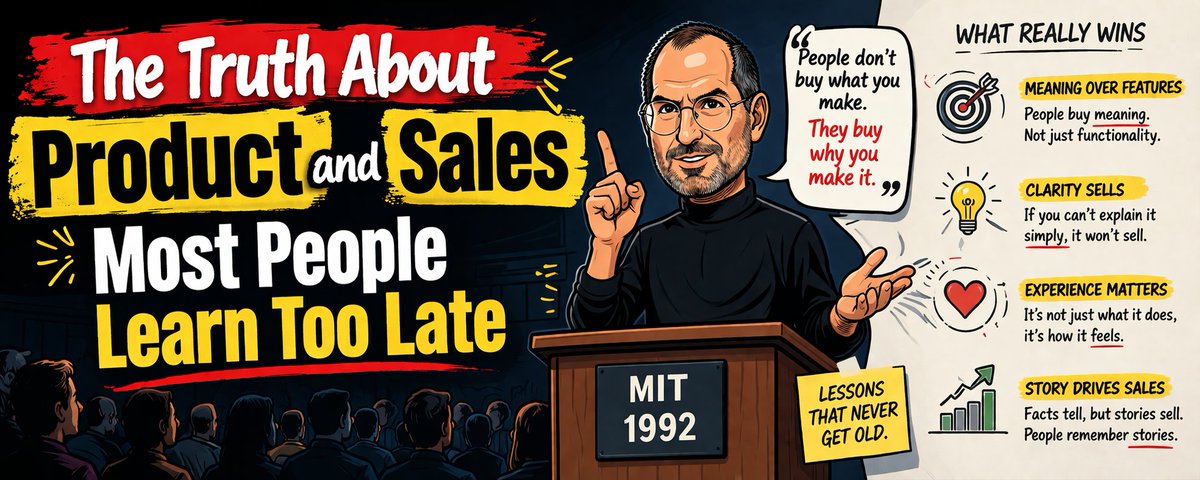
If you hope to succeed in any meaningful sense of that word, you must understand your customers and appreciate what they want. Without customers, your operation is dead. If you fail to satisfy your customers, they will buy from the competition or maybe simply stop buying.



Douglas Burdett📚🎙️ retweeted

Glengarry Glen Ross stands next to LA Confidential as one of the best casts I’ve ever seen in a film. I challenge anyone reading this tweet to find me a film with a better cast than either of these films. You can’t. It’s impossible. These two movies have insanely talented casts.
Douglas Burdett📚🎙️ retweeted

A HARVARD psychologist says: “if you’ve achieved nothing by 25, you’ve avoided the most destructive illusion of youth”
> In 2021, a Harvard psychologist surprised a lecture hall with an unexpected statement:
“If you haven’t accomplished much by 25, you may have escaped one of youth’s biggest illusions.”
At first, the room laughed.
She wasn’t kidding.
> The illusion of early success.
In your early 20s, the brain seeks quick proof of worth ~status, attention, rapid achievements.
But psychologists warn that chasing recognition too soon can lock people into roles or paths they never consciously chose.
They decide too early… and spend years trying to undo it.
> The exploration phase.
Research on career development suggests that people who explore more before 30 often build stronger long-term directions.
Testing ideas.
Making mistakes in public.
Changing course.
At 25 it looks like confusion ….but by 35 it often turns into clarity.
People who feel “behind” in their mid-20s frequently gain something others miss:
Perspective.
Patience.
And a clearer sense of what truly matters to them.
That foundation often leads to better decisions later on.
At the end of the lecture, the psychologist left the students with one final thought:
“You’re not meant to have life fully figured out at 25.”
“You’re meant to discover who you’re not.”


Douglas Burdett📚🎙️ retweeted

Jaguar’s sales have collapsed 97.5% since they put out this ad.
xitter.cf/Jaguar/status/18588008…
Douglas Burdett📚🎙️ retweeted

Hands-down my favorite podcast host - Douglas Burdett @MarketingBook of The Marketing Book Podcast!
ecs.page.link/DmZSy?utm_sour…
#Sales #Marketing #Book #Podcast #Recommended


Douglas Burdett📚🎙️ retweeted

a look back at commercial parodies
#SNL50
What I'm reading: "Audacious: How Humans Win in an AI Marketing World" by Mark Schaefer. Join us for the LIVE interview on Wed, Feb 12, Noon (EDT) linkedin.com/events/72939775… @markwschaefer


