

Chartered Accountant | FP&A | Investor | Crypto Enthusiast
Joined November 2013
- Tweets1.9K
- Following511
- Followers226
- Likes4.8K




Marcus retweeted

$STONKBROKER has officially been integrated into Deblock for direct fiat onboarding. 💼
Deblock brings European banking, an IBAN and self-custodial crypto together in one app, with 500K+ Android downloads.
This opens a powerful new distribution rail for $STONKBROKER:
Fro the EURO → $STONKBROKER in one click.
Making the jump from everyday banking to Robinhood Chain as simple as possible.
Clock in.

Marcus retweeted

UPtober is here so its the perfect time to study $UP @uponrh
Check out the below post.
Clock In
Great job @0xviger

I did a research on one of $stonkBroker special Project: UP @uponrh @ClutchMarkets
Summary
I chose UP because it sits underneath StonkBrokers. UP is a ve(3,3) DEX on Robinhood Chain, and The Stonk Exchange is a community-governed, vote-directed DEX where users swap tokens, pool through Smart LP vaults, and stake LP for $UP emissions. And the question is what UP lets StonkBrokers become.

Marcus retweeted

Safest clean entry on Robinhood Chain: $PRISM.
Buy and forget.
Tokenized stocks and RWAs do not settle on a meme chain.
They settle where the broker already lives.
That’s Robinhood.
Not Near. Near was a pump and dump.
No other chain has the stock narrative.
$PRISM is the gas on the one that does.
Bookmark this.
Proof at $7.5M.
Stackers looks to have been a rug. Apologies to anyone who entered after reading my articles. I lost 0.5E on this. Some learning to take from this. Alas, we move on.
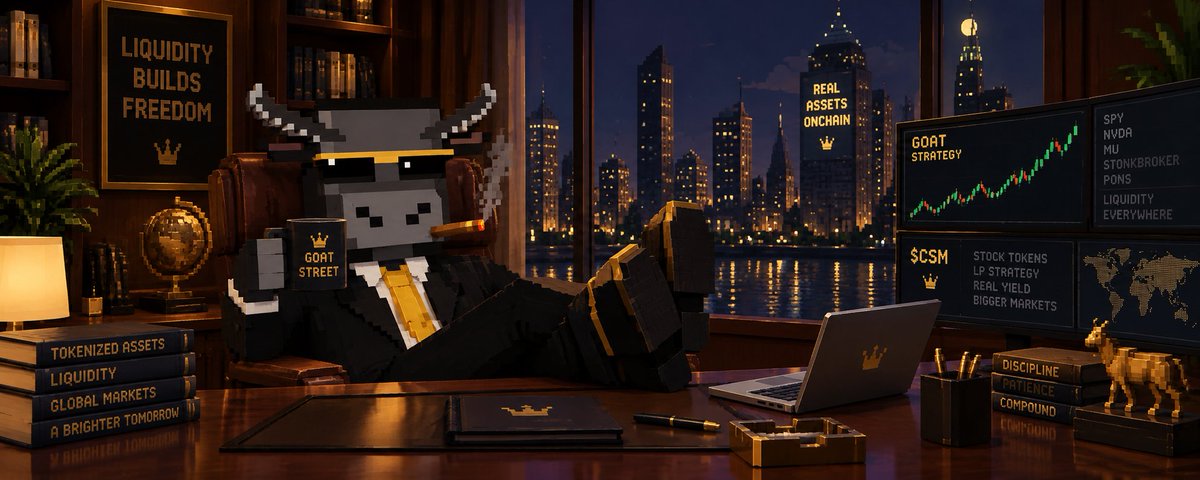
What if Goat Street isn’t just another productive NFT, but an early bet on the liquidity layer for tokenized finance? Cashmere is starting to connect the pieces. 🐐
Marcus retweeted

Adidas has featured Israeli soldier Shaliv Biton, who took part in Israel’s genocidal war on Gaza, to promote its Single Shoe service which allows customers who need only one shoe to purchase it for half the price of a pair.
🔴 More on Aljazeera.com

The external revenue thesis for Stackers may be starting to take shape. Pons is putting its fee flows onchain, while Stackers is giving every NFT an autonomous agent designed to hunt for real yield across Robinhood Chain. Coincidence? Maybe...

NFTX proved outside infrastructure can feed the Stackers payout engine. Now the dev is talking stock and gold pools, following volume, collecting fees and “cutting Stackers in on it.”
This is starting to look a lot bigger than an NFT.


0x42c3…cf23 made the City of Stonks allowlist. My city gets built from my own wallet.
3,333 pixel cities, each one built out of how a wallet actually trades.
cityofstonks.com/key?a=0x42c…

Another little breadcrumb in the Pons x Stackers story 👀
Stackers just launched the Fuse Workshop, making fusion more attractive.
Fused Stackers can now choose which traits they keep from the NFTs they absorbed.
Why does that matter?
Because fusion permanently destroys Stackers.
Anything that makes fusion more desirable potentially accelerates the shrinking supply.
3,000 original Stackers → supply keeps getting burned → remaining Stackers get more weight → now fused Stackers can customise their traits too.
But what caught my attention was who appeared underneath the announcement.
@PonsEcosystem:
“Keep building 🤝”
Stackers:
“🤝”
On its own? Means very little.
But add it to everything else we've been seeing around Pons + Stackers and it becomes another interesting breadcrumb.
And right underneath this, Stackers is highlighting $75k+ already paid to holders AND the addition of NFT royalty fees into payouts.
That's the bigger picture I'm watching:
More revenue sources
→ more reason to hold
→ more reason to fuse
→ shrinking NFT supply
→ increasing weight for survivors
→ while the Pons relationship keeps appearing publicly.
Still no confirmation of the bigger Pons x Stackers thesis.
But the breadcrumbs aren't slowing down.
They're getting louder. 👀
Been digging deeper into @StackersXYZ and I’m starting to think the market may be underestimating what’s being built here.
At first the thesis was simple:
$STACK trading → fees → hourly payouts → each Stacker chooses which assets it wants to accumulate.
Nice yield mechanism, but still dependent on $STACK volume.
What interests me now is everything appearing AROUND that engine.
Pons is the big one.
Pons has publicly talked about NFTs + tokens + RWAs and said NFT development is underway with partners.
Meanwhile we’ve seen:
• Pons assets integrated into Stacker vault selections
• Stackers reposting Pons developments
• Ozzy getting one of only three honorary 1/1 Stackers
• Nobi posting “Robinhood NFTs” and replying @StackersXYZ when asked which
• Lighter functionality being integrated into the wider Stackers product
None of this confirms a major partnership.
But the breadcrumbs are getting difficult to ignore.
And this is where @NFTkrit’s thesis gets really interesting.
Credit to Krit because he was the first person I saw articulate this properly:
Pons may not need to build NFT distribution infrastructure from scratch. Stackers already has the vault + hourly payout rails.
Imagine:
Pons launch
→ paired NFT
→ token generates fees
→ Stackers infrastructure handles distribution
→ NFT holders continuously accumulate assets.
Potentially every project gets its own productive NFT economy without rebuilding the infrastructure.
Krit even speculated Stackers could eventually take a rails fee from paired launches.
NOT confirmed.
But if that ever happened, you suddenly have:
external Pons activity → Stackers infrastructure → economic value captured through Stackers.
That would fundamentally change how I value the ecosystem.
And there’s another possibility I’ve been thinking about.
Stacker Wars.
Every Stacker chooses what it wants its payouts to buy.
Imagine enough capital eventually flowing through the network that hundreds/thousands of Stackers are making recurring purchases.
If you launch a token, you WANT Stackers selecting you.
Why?
Recurring buys.
Distributed holders.
Continual exposure.
Potential sticky demand.
Projects could eventually compete to get selected by Stackers through incentives, allocations or revenue sharing.
Instead of Stackers chasing projects...
projects compete for Stacker allocation.
Pure speculation, obviously.
But the infrastructure makes that game possible.
And then there’s the other side of this thesis:
SUPPLY.
Only 3,000 Stackers originally existed.
Fusion permanently destroys them.
So supply isn't fixed.
It continuously shrinks.
We've already watched the number fall substantially below 3,000.
And at the same time, we're seeing wallets/accounts accumulating multiple Stackers.
Some appear to be buying repeatedly across different price levels.
I am NOT claiming these wallets belong to Pons, Lighter or insiders. We haven't proven that.
But the behaviour itself matters.
Whales accumulating
holders fusing
NFTs being held because they produce assets
= less liquid supply.
Recently I counted only around 73 Stackers listed below 0.25 ETH.
At the same time we saw around 29 ETH 24h volume, with the floor pushing towards the 0.16–0.20 ETH area.
That combination is interesting.
Because if a major catalyst brings new buyers...
they aren't competing for 3,000 Stackers.
They're competing for whatever tiny number holders are actually willing to sell.
👇 2/2
---
2/2
And THIS is why I keep thinking about StonkBrokers.
People forget how cheap StonkBrokers once were.
Then the market started understanding that there was more economic value attached to them than originally thought.
Once the external revenue story became obvious, the repricing was brutal.
Eventually they touched around 13 ETH.
A lot of people watched that happen from the sidelines.
They aren't going to want to miss the next productive NFT narrative if one emerges.
And the macro environment matters too.
Liquidity has been returning to crypto.
ETH has moved hard. Alts have been moving. Attention is coming back.
When people make money in majors, capital starts moving further out on the risk curve looking for asymmetric opportunities.
Now put all of this together:
Stackers already have live hourly payouts.
Each NFT chooses what it accumulates.
Pons assets are already integrated.
Pons is publicly interested in NFTs + token pairing.
There are visible relationships between the ecosystems.
Lighter adds another piece of financial infrastructure.
The original supply was only 3,000.
Fusion permanently destroys supply.
Whales/multi-NFT holders appear to be accumulating.
Listings are relatively thin.
Crypto liquidity is improving.
And an entire market just watched StonkBrokers demonstrate how violently a productive NFT can reprice when its economic story changes.
That's the setup I'm watching.
The bull case isn't simply:
"$STACK pumps so Stackers earn more."
That's the obvious version.
The much bigger question is:
Can Stackers become infrastructure through which OTHER ecosystems generate and distribute value?
Because if the answer eventually becomes yes, the valuation model changes.
Stackers could potentially go from:
NFT earning from its own token
to
NFT financial infrastructure plugged into multiple external economic engines.
Pons could be one.
Lighter could expand utility.
Other tokens/projects could potentially follow.
And because each Stacker chooses where its capital goes, the Stackers themselves could eventually become valuable distribution targets.
That's where this gets interesting.
You potentially have:
More integrations → more utility → more demand for Stackers → more fusion/activation → less supply → larger productive balances → stronger incentive to hold → even less liquid supply.
Then imagine a major external revenue announcement landing into that structure.
That's the part I think people may be sleeping on.
To be clear:
Pons revenue flowing to existing Stackers has NOT been announced.
A Pons × Stackers rails partnership has NOT been confirmed.
The accumulating wallets are NOT proven insiders.
And Lighter currently represents additional functionality rather than a proven new holder revenue stream.
Those distinctions matter.
I'm not presenting speculation as fact.
I'm looking at the pieces already sitting on the board.
The engine is live.
The payouts are real.
The integrations are appearing.
Supply is being destroyed.
Accumulation is visible.
Liquidity is returning to crypto.
And the connections around Stackers are becoming increasingly interesting.
Maybe nothing comes of the breadcrumbs.
But if Stackers eventually becomes the productive NFT/distribution layer sitting beside the Pons ecosystem, while supply continues disappearing...
then the question won't be:
"Why would anyone pay more than 0.2 ETH for a Stacker?"
It'll be:
"How many Stackers are actually available when everyone figures out what they're being used for?"
That's the bet I'm watching. 👀
And credit where it's due: @NFTkrit first articulated the Pons × Stackers rails thesis. That idea was his. The wider thesis above is where I think it could potentially lead.
By the end of this year, it will have been a decade since I made my first investment in crypto.
What first pulled me into the space wasn't actually the price action. It was audit.
I was spending hours verifying financial information. Tracing transactions back to invoices, checking bank statements, confirming balances and making sure what was being reported was actually accurate.
And I remember thinking: surely there has to be a better way.
So much money and time is spent simply verifying things. Audit fees, brokerage fees, exchange fees, conveyancing, settlement, ownership changes. Blockchain showed me that you could potentially build systems where a lot of this information could be verified on-chain.
That's where my conviction in the technology started.
Almost 10 years later, these are probably the biggest lessons I've learnt.
Lesson 1: Nobody can give you conviction. You have to build it yourself.
This is why DYOR is so important.
You can listen to analysts, influencers, friends, Twitter, Discord, whatever. But when your investment is down 70%, 80% or 90%, none of those people are going to give you the conviction to keep buying.
That has to come from your own research.
In 2022, I managed to buy Bitcoin around the $16k bottom.
But I didn't just magically buy everything at $16k.
I was buying at $30k, $25k, $20k, $18k, $17k and then $16k.
Every time I bought, it went lower.
That's where conviction gets tested.
It is very easy to say "I'll buy the dip" when markets are going up. It is completely different when you're buying and immediately watching that investment go further underwater.
But bottoms are normally a process.
You don't need to catch the exact bottom. If you've done your research, your thesis hasn't changed and the asset keeps getting cheaper, you accumulate through that process.
The market will constantly try to convince you that you're wrong.
Sometimes you need to zoom out.
Lesson 2: Buy good projects. Don't build your whole portfolio around getting lucky.
Small caps can make you ridiculous amounts of money.
I've experienced it myself.
I bought SOL below $5 before its massive 2021 run. I also bought TAO around $40 before it eventually ran towards $800.
But those are two winners out of probably 30+ smaller projects I've invested in over the years that went close to zero.
That part normally gets left out.
Everyone remembers the 50x. Nobody remembers all the coins that died.
You can absolutely take bets on small caps, but from my experience, the odds are not in your favour if your entire strategy is trying to find the next 100x.
I'd rather have the majority of my exposure in projects that have actually shipped something, have users, liquidity, traction and are attracting serious capital.
Then if you want to take a few smaller bets on top of that, fine.
But don't put all your eggs in the lottery-ticket basket.
Lesson 3: Take profits.
This is probably one of the hardest lessons in crypto.
Greed can destroy you.
You watch something go 3x and think it can go 5x.
Then it goes 5x and suddenly you're waiting for 10x.
Then 10x comes and now you want 20x.
Before you know it, the entire move has retraced and the profit you once had only exists in a screenshot.
Have a strategy before the euphoria starts.
Set levels where you're going to take some money off the table and actually execute when those levels are reached.
You don't need to sell the exact top.
You just need to make sure a winning investment actually becomes a realised profit.
Lesson 4: Have a long-term investment horizon.
This space moves ridiculously fast day to day, but the real changes take years.
When I first got interested in blockchain, a lot of the use cases were mostly theoretical.
It has taken almost a decade, but we're finally starting to see the infrastructure and regulatory environment develop around it.
Governments are becoming more accommodating. Regulatory frameworks are becoming clearer. Institutions are participating. Tokenisation is becoming a serious conversation.
These things don't happen overnight.
If your investment thesis depends on something happening next month, you're probably going to spend most of your time frustrated.
Sometimes a good thesis just needs time.
Lesson 5: Don't put all your eggs in crypto either.
Conviction doesn't mean everything you own needs to be in one asset class.
I've invested across crypto, equities, gold, silver and property.
If every investment I owned was in crypto, I'd be feeling very different right now.
Different asset classes lead at different points in the cycle.
Money rotates.
Sometimes equities are leading. Sometimes commodities. Sometimes crypto. Sometimes defensive assets.
If you can understand those rotations and position yourself accordingly, there are opportunities far beyond just picking the right coin.
That's something I've increasingly been trying to do.
After almost a decade in crypto, I still have a lot of conviction in where blockchain is going.
But the way I invest today is very different from how I invested when I started.
Do your own research because nobody else can give you conviction.
Buy good projects and don't rely on getting lucky.
Take profits.
Think in years, not weeks.
Diversify.
And most importantly, zoom out.
The crypto market has already come an incredibly long way.
But compared to global financial markets, it's still small.
I still think there is a lot more ahead.
Marcus retweeted

Sounds like clarity is coming either way:
1. 60+ votes in the Senate on September 15th
2. Or a new set of rules from the CFTC and SEC on September 16th

If CLARITY continues to stall because of Democratic obstruction, the @CFTC will utilize its existing authorities to begin establishing a regime for crypto asset markets. We owe it to the American people to do so.
Here's how we'll get it done ⬇️
Marcus retweeted

If CLARITY continues to stall because of Democratic obstruction, the @CFTC will utilize its existing authorities to begin establishing a regime for crypto asset markets. We owe it to the American people to do so.
Here's how we'll get it done ⬇️
One thing I think people are missing with Stackers is what the flywheel could become.
The obvious question is what happens to the hourly payout if trading volume dies down.
Fair question.
Right now the pot is mainly being fed by trading activity. The new contract adds another source because every secondary Stacker sale on OpenSea can now pay royalties back into the hourly pot.
So you start getting:
Trading activity → fees → pot
Stacker sales → royalties → pot
Bigger pot → more demand for Stackers → potentially more activity
But I think the more interesting part is the tokens themselves.
Some Pons ecosystem tokens are already integrated into Stackers. Stackers are constantly allocating into different assets based on their picks.
Now think about this from the side of a new token launching.
Every new token wants people buying it.
The problem is getting attention after the initial launch hype dies down.
Launch day is easy compared to keeping people buying your token 2 weeks, 1 month or 3 months later.
That is where Stackers could become valuable.
If Stackers grows to the point where meaningful capital is constantly flowing through these picks, projects are going to want some of that flow.
You could eventually get something similar to the Curve Wars.
Projects could compete to get integrated, offer incentives, contribute revenue or somehow reward the Stackers ecosystem for directing flow towards their token.
Why?
Because instead of paying for another marketing campaign and hoping people buy, you are plugging into a system where capital is already being deployed continuously.
More Stackers → more capital being allocated
More capital → more valuable that flow becomes
More valuable flow → more reason for projects to compete for it
More project incentives → bigger pot for Stacker holders
Bigger pot → more demand for Stackers
That is the potential flywheel.
At that point Stackers is not just dependent on organic trading fees.
You could have:
Trading fees
NFT royalties
Project incentives
Potential revenue from integrations
Obviously none of this is guaranteed and some of it would still need to be built.
But if Stackers gets enough users and enough capital flowing through it, the most valuable thing might not even be the NFTs themselves.
It could be the flow.
New tokens are always looking for buyers.
Stackers could potentially become one of the places they compete to get them. $Stackers @StackersXYZ @MEADGod @0xnobi