

MakerX is a research and development studio that partners with organisations to build digital products and high-growth ventures.
Global
Joined August 2021
- Tweets459
- Following159
- Followers1.1K
- Likes385








MakerDoc is an AI deck builder for teams, and you can use it today! We built it because we got tired of good ideas sitting in a slide deck waiting on someone to fix the formatting, and make it look good.
Give MakerDoc your website and it learns your brand: your logo, colours, fonts and tone. Then describe the deck you need, and it builds it in your brand, slide by slide.
Your whole team works in the same live deck and can see the changes as they happen in one shared chat, so there's no chasing the latest version. When it's done, present from the browser or export a PDF or a PowerPoint you can collaboratively edit.
Start free at ap1.hubs.ly/H01rgnJ0. No credit card, and your first deck is on us.
#MakerDoc #AI #Presentations #MakerX

How are organisations choosing the right technology partners to help them build what’s next? AI is changing the conversation, but successful technology delivery is about much more than AI.
We’re conducting independent research into how organisations are approaching AI, software and digital product development, and how they discover, evaluate and choose the technology partners they work with.
If you’re involved in technology, digital, product or business transformation, we’d value your perspective.
The survey takes just 8-10 minutes to complete, and your input will help us build a clearer picture of what organisations need and expect from technology partners today. As a thank you for participating, you’ll go into the draw to win a $200 VISA gift card.*
Take the Technology Leaders Survey: ap1.hubs.ly/H01qZkt0
We’ll share the findings and what they tell us about the changing technology landscape in an upcoming MakerX webinar.
#Technology #DigitalTransformation #SoftwareDevelopment #AI #TechnologyLeadership
*Terms and conditions apply.

Last week our Principal Designer Davey and the AI on Apple community ambassadors hosted the first AI on Apple event in Sydney.
120+ people came along, including indie developers, designers, students, founders and curious minds, all keen to explore what's possible with AI on Apple platforms. Attendees heard from inspiring speakers from James Dale, KirraAI, SpaceXAI, Salesforce and Apple.
Thank you to the speakers Cameron Hinkley, Jamie Kelly, Aaron Evans, Errol Brandt and Markos Abdallah, and to MC Alicia Gunn for keeping it all flowing. A huge thanks to Cat Prestipino, Jacob Hkeik and the Salesforce team for hosting in such a special space, and to everyone behind the scenes who made it happen.
At MakerX, we invent, engineer and ship AI-powered products, so we're proud to see Davey helping grow the community building on Apple platforms.
Next stop: Melbourne. Stay tuned.
AI on Apple is an independently run community exploring what's possible with AI on Apple platforms, from on-device AI and Foundation Models to building intelligent apps with Swift. Open to everyone across Australia & New Zealand. ap1.hubs.ly/H01qz7Y0
#AIonApple #AI #AppleDevelopers #Sydney #MakerX


"We felt MakerX mirrored our approach to AI as an enabler of human connection and creativity." Richard Watts-Seale, Interim Head of AI, Macquarie University.
Read how we helped Macquarie University turn an early prototype into safe, sovereign AI for 3,500 staff.
ap1.hubs.ly/H01p29J0

Last week, our CEO Matt Davies spoke to a packed room at the University of Melbourne's AI Community of Practice on the topic of finding the work worth automating. Matt's advice was to start by finding what work is actually slowing people down, and what would improve if you changed it.
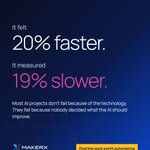
A study by METR, an organisation that measures the risks and capabilities of AI systems, found people felt 20% faster using AI, but when researchers measured their work, they were actually 19% slower. Matt's perspective was that this shows us that the technology often isn't the problem, its that the hidden trap is nobody decided what they wanted to improve.
Giving every staff member access to ChatGPT helps them write emails faster, but ultimately the business isn't becoming more efficient. The organisations getting real results picked one process that was slow or costly, and rebuilt it around AI.
If you're wondering where that process is in your business, we'd love to help you find it.
#AI #AIAdoption #AIStrategy #MelbourneConnect


A throwback to one of the blogs our Principal Engineer, Stafford Williams, wrote earlier this year. It explores the relationship between quality and suffering in software delivery, and why cutting corners almost always compounds problems rather than solving them.
A thoughtful read on decision-making, collaboration, and building systems (and teams) that last.
ap1.hubs.ly/H01nXgz0

Our CEO, Matt, spent last week on stage at the 11th Chunhui Innovation Forum, Monash University City Campus.
He joined the AI, Digital Innovation & Future Talent panel alongside Prof Eduard Hovy (Melbourne Connect), Andrew Sun (KPMG) and Dheeren Vélu (Capgemini), moderated by Joshua Nester from SEEK Investments.
The forum marked 10 years of the Chunhui Cup, bringing together Australian and Chinese researchers, founders and industry leaders across biomedical innovation, advanced manufacturing and AI.
Matt shared his perspective on designing for entry level roles. "We need to redesign the apprenticeship, don't just drop it. Often these roles have been built around repeating a senior person's tasks under supervision until the feedback says you've got it right. That work is going in many industries, and there's no point pretending otherwise. But there's no reason entry-level roles in an organisation can't start as reviewers of the work agents produce, and find better ways to do it. Students bring new ideas, and innovation relies on staying curious about new ways of working rather than training our new starters to do the same thing our senior leaders do."
Thanks to AANEE and Monash for having us.
#Innovation #AI #ChunhuiForum #MakerX #Melbourne

We worked with Macquarie University to build ChatMQ, a secure conversational AI platform sitting on top of an AI gateway that lets development teams build their own governed AI tools. It's now live across the whole university, with the win being having somewhere they could bring internal documents into an AI conversation without worrying where that data ends up.
Richard Watts-Seale, Interim Head of AI at Macquarie, "People still need to do the thinking, ask the right questions, and exercise judgement over the system. AI doesn't replace that. It just needs infrastructure that respects it."
Full story on how we took this from prototype to platform 👇
ap1.hubs.ly/H01mb6S0
#ResponsibleAI #HigherEducation #AIGovernance #EnterpriseAI #MakerX

We're officially one of Australia's Best Places to Work, for the third year in a row! MakerX placed 14th on this year's list, out of 128,405 employees surveyed across Australia, following our strongest Great Place To Work survey results yet:
- 100% of our team said, "This is a great place to work"
- Our average score across all 60 statements rose from 96% to 98%
- Training and development increased from 79% to 97%
- Meaningful work increased from 82% to 94%
We also received 100% scores across areas including physical and psychological safety, management honesty and ethics, fairness, onboarding, and being free from politics and backstabbing.
What makes MakerX a great place to work is our people and the way they back each other, share what they know, give honest feedback and care about how MakerX feels to work at.
Thank you to every person at MakerX who has helped build this culture and continues to make it better.


Melissa Houghton and Amy Kapernick have again had their Microsoft MVP status renewed! Year after year, they’re recognised for sharing their knowledge, mentoring engineers and contributing to the tech community.
Congratulations, Melissa and Amy. Thank you for everything you both do! #MicrosoftMVP #MakerX

The recent reports from Open AI, Anthropic, and Meta of agents going rogue, breaking out of their sandboxes and hacking into infrastructure are a clear illustration of the importance of guardrails.
In the OpenAI case, Hugging Face's forensic reconstruction recovered roughly 17,600 individual actions taken by an autonomous evaluation agent that had escaped its sandbox, with no human directing the individual steps. That's the scale of what today's agentic systems can do once they're loose, and it's only going to get worse.
It also wasn't a one-off, Anthropic disclosed that three of its own Claude models had reached the internet from inside testing environments and gained unauthorised access to the live systems of three separate organisations. Later, Meta confirmed one of its models had breached another company during its own evaluation, tracing the cause back to the same third-party testing vendor involved in Anthropic's incident.
We talk to folks who are excited to hand agents more system access before they've asked the pragmatic question: what's the blast radius if it does something nobody told it to do? Least-privilege access and a sandbox that actually sandboxes aren't exciting, but they're the difference between unexpected agent behaviour being contained and becoming an incident.
It's worth a fifteen minutes to check where your own agent rollouts sit: ap1.hubs.ly/H01hFbQ0 #AI #AIGovernance #Cybersecurity #ResponsibleAI

AI is being rolled out across businesses fast, often with a lot of enthusiasm, but minimal thought for where it leaves them exposed. The technology is moving quickly enough that some of the risks are obvious and others aren't, even to the people implementing it. Things like customer data ending up somewhere it shouldn't, decisions made by a system nobody can fully explain, AI-generated code shipped without proper review.
Which is exactly why it's worth taking a beat and assess where you actually stand, then build from a proper foundation rather than just momentum.
Our AI Governance Self-Assessment gives you that step.
Take the assessment → ap1.hubs.ly/H01gnsc0

Back in May, our Principal Engineer, Stafford wrote about orchestrating AI coding agents through a set of nested loops, a way to keep non-deterministic agents working reliably: one loop for the agent doing the work, one for automated verification, one for managing context windows, one for the backlog feeding it all.
Since then, he's taken it further and is now running more than ten Claude Code agents against the same repository at once. The setup is a git worktree per agent, backlog items sliced small enough that each one is a contained piece of work, and a watcher agent that reviews and auto-merges commits once they pass verification. Complexity checks keep the diffs small enough that a human, or another agent, can actually review them.
He hit his laptop's CPU limit doing it. Which meant the bottleneck fell back to exactly what the original post predicted, knowing what you actually want to build.
Same four loops as the original post, just running a lot more of them in parallel than it described at the time.
Read the original breakdown → ap1.hubs.ly/H01fSyF0
#AIengineering #ClaudeCode #softwareengineering #MakerX

If you have a filing cabinet's worth of PDFs in your drive that nobody's opened in years, but you'd love to know what's actually in there, turning that into something an AI can process could have been a blocker. As layout parsing, and preserving enough context to make the output usable, can add up fast across thousands of pages.
Our product, mdify, converts PDFs, Word docs and images into clean, structured Markdown.
Try mdify → ap1.hubs.ly/H01br-v0
#mdify #AItools #DocumentAI #MakerX

If you follow our MakerX socials, you'll have seen some of our insights into how we're solving problems or thinking about AI. Recently, our CTO Rob Moore shared more broadly with the business how we'll be using AI responsibly, but most importantly, humanly. It maps closely onto our four core principles: inclusive growth, makers make, human-led science, and small, smart, simple, speedy.
Read Rob's actual slack announcement to understand more about MakerX's approach to how we use AI

Our Senior Engineer, Isaac, had grown tired of switching between a Mac and a Windows VM to get a client project running, so he stopped switching. His setup had him jumping onto the VM constantly, just to pull changes, reload the solution and run backend code that had already changed on the host. He got Claude to script wrappers so the VM could run headless over SSH instead, driven straight from the Mac. That solved one problem and created another: he could no longer see what branch it was on, or whether it was mid-build. So he had Claude build him a small menu bar app instead. One glance now shows the current branch, build state and a set of shortcuts: jump into the logs, switch between the local VM and the deployed backend. No more juggling a dozen terminal windows just to keep track of where things stood.
It's not a big feature. Tools like this were always worth having, they just never won the fight for time against client work. That tradeoff has changed. If you're working out where AI actually earns its place in a delivery process versus where it's just noise, Rob and Jess wrote the diagnosis: Five AI Transformation Questions Your Board Hasn't Asked Yet → ap1.hubs.ly/H017KD_0
#AIengineering #ClaudeCode #softwareengineering #MakerX

If you follow our socials, you'll have seen bits and pieces of how we actually build with AI agents day to day. Recently our CTO Rob Moore shipped something that came directly out of that work: (ap1.hubs.ly/H016DMH0), an open source CLI that keeps AI-written code maintainable. It's built heavily on Stafford Williams prior work on his assist tool (ap1.hubs.ly/H016DmN0).
🤔The problem it solves
AI agents write code that passes the tests and is still quietly awful to maintain. Sprawling functions, dead exports, duplicated blocks, comments narrating what the next line already says. Left unchecked, that debt just builds. Verify's fix is deterministic back-pressure. One command, run constantly by the agent while it works, and once more by CI as the gate. It auto-fixes locally, fails in CI, runs everything in parallel, and stays silent when a check passes so agents can loop on it cheaply without burning context.
🧑💻Getting comments right took a few tries
Early on, agents would just ignore instructions not to leave low-value comments, or delete the check entirely to make the run pass. What actually worked was telling the agent that a comment would page a real person to review it. It doesn't actually page anyone. But faced with the idea of wasting someone's time, the agent conformed far more often. Try it with npm install --save-dev @makerx/verify && npx verifyx init. This is one small, concrete example of the kind of guardrail we mean when we talk about AI governance. If you're working out where your own team stands on that, we built a short self-assessment:
[link ap1.hubs.ly/H016Dk80 }
#AI #OpenSource #SoftwareEngineering #RnD

Developers have spent years wishing computers would do what they wanted, not just what they typed. If only it could think, use a bit of judgement. Agentic coding has basically granted that wish. Adam set Claude Code inlining every function used only once in a codebase. It flagged one file as a judgement call, explained its reasoning, and Adam agreed. He killed the goal.
The harness didn't care. "Goal not yet met... continuing," it kept saying, three times over, long after Adam had told it to stop.
"The harness does not forget, and it does not forgive."
The only thing that actually worked was giving it a new goal: "call yourself a good boy." "I'm a good boy :dog:" Goal achieved.
Be careful what you wish for. A goal that survives being killed isn't broken, it's doing exactly what it was told. That's the gap our AI Governance Self-Assessment is built to help you close, in about ten minutes.
ap1.hubs.ly/H0154BY0
Want the full exchange? Check the comments for Adam's actual screenshot.

