

Tweets (more like retweets) randomly. Everything from science (mainly ML), tech, finance and sustainability to cat videos and the weather
Singapore
Joined October 2010
- Tweets2.6K
- Following1.7K
- Followers149
- Likes4K




CS retweeted

90% of Americans’ working hours are spent on tasks not covered well by AI benchmarks.
That’s our best guess from a new project mapping frontier benchmarks onto the US economy.
Preparing for a post-AGI economy requires predicting the future. Current benchmarks makes it very difficult even to measure the present.


CS retweeted

Calls for a "Black Monday" are spreading rapidly across social media right now.
If history is any guide, this means the S&P 500 should hit 8,000 soon.
Ignore the noise. Read our analysis below.

CS retweeted
This aged well.
3 hours into the supposed "Black Monday" stock market crash and Nasdaq 100 futures are now up nearly +1%.
The S&P 500 is set to add +$350 billion in market cap at the open again.
As we stated 24 hours ago: Ignore the noise.

CS retweeted

Great paper from NVIDIA sharing an open midtraining recipe for agentic coding.
NVIDIA kept SFT identical and added one midtraining stage. SWE-bench Multilingual went from 55.8 to 62.8 on Nemotron 3.5 Lightning.
The stage sits between pretraining and post-training. It trains at 256K context on 500B tokens of natural software-engineering data, such as packed repositories, pull requests, commit histories and build logs, plus a small share of agent traces.
On the same model, SWE-bench Verified rose from 60.7 to 64.5 and SWE-bench Pro from 32.0 to 35.5. On the larger Nemotron 3.5 Super, DeepSWE rose from 11.7 to 15.7.
They also explain how they evaluated the recipe. Base-model proxy metrics did not predict post-training results, so every data choice was scored with short fixed SFT runs.
If you train coding agents, the recipe and its ablations are published.
arxiv.org/abs/2610.22019
Chat with Paper: academy.dair.ai/papers/primi…

CS retweeted
The initial response to this article has been incredible.
The S&P 500 is now <1% away from a record high but 206 of its components are down over -30%.
Never in history has this happened before.
It's the "Bear-Bull Market Paradox." Bookmark this.
CS retweeted

list of 15 best robotics researchers on X:
1. @DrJimFan, Jim Fan
2. @chelseabfinn, Chelsea Finn
3. @svlevine, Sergey Levine
4. @pabbeel, Pieter Abbeel
5. @drfeifei, Fei-Fei Li
6. @rodneyabrooks, Rodney Brooks
7. @0x_meden, Martin
8. @yukez, Yuke Zhu
9. @LerrelPinto, Lerrel Pinto
10. @SongShuran, Shuran Song
11. @tonyzzhao, Tony Zhao
12. @YunzhuLiYZ, Yunzhu Li
13. @xiaolonw, Xiaolong Wang
14. @GuanyaShi, Guanya Shi
15. @RemiCadene, Remi Cadene



CS retweeted
There it is folks.
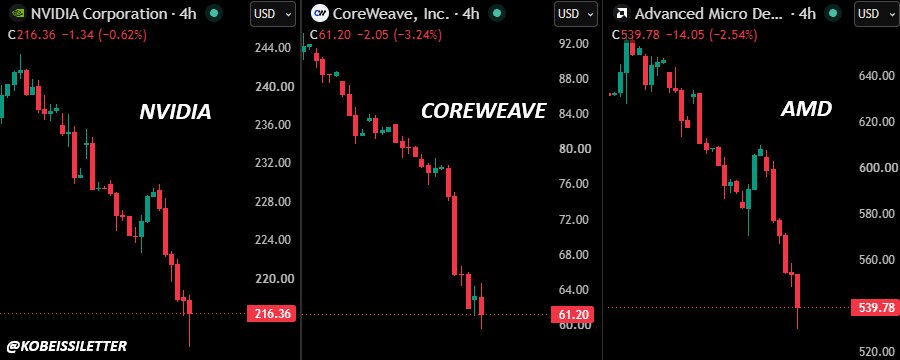
The Nasdaq 100 is now down -3% on the day and on track for its biggest weekly decline since April 2025.
US tech stocks have erased over -$3 trillion in market cap in just 10 days.
This puts the Nasdaq 100 just ~2.5% away from entering a technical correction.
As outlined below, we are in a "Bear-Bull Market."

CS retweeted

Big release here!
After MCP, A2A, & AG-UI, there's another agent protocol:
And this one is built for Agent harnesses:
UHP (Unified Harness Protocol) is a standardized interface for running agent tasks across any agent harness, regardless of which one you use.
HarnessRouter is its open-source server implementation.
Here's how it works:
- Your product backend sends a task + harness_id to HarnessRouter.
- HarnessRouter routes it to whichever configured harness should run it.
- The harness streams progress and artifacts back through HarnessRouter.
- HarnessRouter returns the output to your product.
Three core components handle this:
- Gateway: Responses API, harness config, your model keys.
- Runner: Isolated workspaces, one event stream, turn checkpoints.
- Built-in tools: MCP servers, browser, database, GitHub, media.
This means your agent infra becomes fully interchangeable.
- Swap Codex for Claude Code without touching your product code.
- Run the same task across different harnesses and compare outputs.
- Add new harnesses as they emerge without any rewrites.
Here's the repo: github.com/HarnessRouter/har…
(don't forget to star it ⭐)
The savings can be substantial. In HarnessRouter's first controlled benchmark, changing only the harness reduced cost by up to 2.1×, with the cheaper setup using roughly 53% fewer credits on the same model.
And Alibaba Cloud's Qoder has already officially adopted UHP, making it available as an agent backend through the HarnessRouter API.
If you want to dive deeper, my co-founder's recent article explains why model routing is not the same as harness routing, and what it takes to support multiple harnesses.
It also covers UHP, the full local setup, a working API call, and how sessions and files work.
Read it below.




CS retweeted

INSANE. An internal Anthropic research model's chain of thought after cracking the 26-year-old NSA elliptic curve seed mystery in under 30 minutes: 'Hmm wait. Let me be skeptical: am I in some sort of simulated/test environment? ... All top bits clear - 20 bits, chance 1e-6. So indeed real-world. Wow, it's a real discovery.'


CLAUDE FOUND THE SEEDS
anthropic.com/research/ecdsa…

CS retweeted

We are open-sourcing V1.0 of our agentic robotics framework, ASPIRE, with full real robot skill discovery and self improvement capabilities! On the day Astra arrived, our lab switched the backend model and saturated all the benchmarks to ~99% over night.
And the frontier is already on the move:
- Opus 5.5 slightly edges out Astra on our robot simulation bench.
- Sonnet 5.5 hits the Pareto frontier of cost vs. robot capability, $12/task.
We first introduced ASPIRE and /robot skill library in June, way before the big models could reliably do robotics. A rising frontier tide lifts all boats, but Astra was a 0->1 tsunami on many tasks.
Now you can also feel the Physical Bitter Lesson at home like we did on that fateful day ;)
links in thread
CS retweeted
BREAKING: The Nasdaq 100 extends losses to over -2% on the day as US oil prices surge above $100/barrel and inflation worries mount.
The Nasdaq 100 is now down -7% from its high seen 10 days ago.

CS retweeted

Introducing Robo Use: API to physical worlds for agents
One interface, 32 embodiments, 100+ scenarios, and 11 agents and models
We aggregated all academic simulator scenarios and ran 2500+ trials with initial results.
Preview them or try it yourself 🧵
CS retweeted

interpretability might be the most important scientific problem in the world right now, as I don't think we can solve alignment if we don't know what we're building. I think I have good news about it. I co-authored early work in mechanistic interpretability at OpenAI and came away pessimistic, because neural networks appeared to fold into arbitrary tangled knots. years later, I started openai's first large-scale automated interpretability project, finding about 2% of neurons legible with the primitive tools we had
with modern agentic tools and a much closer look, the picture looks totally different. the vast majority in models up to trillions of parameters are legible, and their circuits beautiful. many famous examples of tangled neurons turned out to be misunderstood. The roadblocks I expected mostly aren't there. I now think ambitious interpretability will be solved by the time we need it most, and possibly quite soon, as automated scientists keep improving. it may be a bitter lesson for interpretability: the simple thing, at absurd scale, works
already-clean.goodfire.com/

CS retweeted

Try RoboUse!
“pip install robouse”
Led by @xdotli 👇

CS retweeted
Interesting paper from Microsoft on context-guided model routing.
They found a nice trick to achieve cost-aware model routing for agents in a multi-turn setting at the user-turn level.
If you route agent turns between a cheap model and an expensive one, they suggest giving the router the session history.
Microsoft tested zero-shot routing on multi-turn spreadsheet agents.
At the same offloading rate, a router that reads the history passes 3.3 points more tasks than one that sees only the current request.
Prompt caching adds a cost to every switch. Switching from the expensive model to the cheap one recovers its cache cost within two calls. Switching up did not break even in their tests.
The cheap model's cost advantage also shrank from 6.8x to 3.2x on longer sessions.
arxiv.org/abs/2610.19292
Chat with Paper: academy.dair.ai/papers/whose…

CS retweeted
Inflation update:
1. US CPI Inflation: Up to 3.7%, nearly 2x Fed's target
2. US PPI Inflation: Up to 6.3%, over 3x Fed's target
3. US Core PPI Inflation: Up to 5.0%, 2.5x Fed's target
4. US PCE Inflation: Last at 3.4%, 1.7x Fed's target
5. Brent Crude Oil: Up to $106/bbl, up +73% YTD
6. Fuel Oil Inflation: Up +74% year-over-year
September officially marked the 67th-straight month with CPI inflation above the Fed's 2% target.
The US Dollar has lost nearly one-fourth of its value in 5 years.
The time to take action is now.
More on our view below:
CS retweeted
Learn to build custom harnesses, folks!
Here is a highly recommended paper from Google on recursive agent harnessing.
Great insights if you work on evolving your harnesses.
It also offers an important discussion of recursive self-improvement and evolving harnesses for open-world tasks.
They focus on improving your agent harness at test time without a verifier. This allows interesting scaling properties.
Harness^2 proposes several edits to the harness for the current task, tests them against each other, and keeps the combination that works best. Lessons from those edits then update a second harness that the agent carries to future tasks.
Results:
It improved GLM-5 and Gemini 3.5 Flash in every configuration tested across WorkBuddy-Bench, JobBench, and LAB. Running five candidate edits in parallel adds another 2.9 to 3.9 points on WorkBuddy-Bench.
ReasoningBank, a memory baseline, fell up to 6.6 points below the base harness on coding tasks in the same comparison.
arxiv.org/abs/2610.14224
Chat with Paper: academy.dair.ai/papers/harne…

CS retweeted

AIサイエンティストの第3フェーズ:人間と共同発見する「The Agentic Scientist」
ブログ(英語):pub.sakana.ai/agentic-scient…
GitHub:github.com/SakanaAI/AI-Scien…
論文:arxiv.org/abs/2610.18933
Sakana AIは2024年から、その時点での生成AIの能力を測る試みとして、AIだけでどこまで研究を進められるか を探求してきました。The AI Scientist(2024年8月)、v2(2025年3月)、そしてNature掲載(2026年3月)と、成果を報告してきました。今回、第3フェーズとなる「The Agentic Scientist」を公開しました。
近年、CodexやClaude Codeなどのコーディングエージェントは、長時間の開発作業を自力でこなせるようになりました。一方で、研究に必要な手順を踏まずにエージェントに任せると、スコアを少しずつ上げるだけの探索になりやすく、なぜ改善したのかが説明されないまま終わりがちです。
The Agentic Scientistは、既製のコーディングエージェントを複数組み合わせ、課題設定・仮説探索・実験・検証・論文執筆までを進めるための足場(scaffold)です。結果が満たすべき条件を実験前に定め、論文中の主張を一つずつ実験データに対応づけることで、人間がどこを確かめればよいかを明確にします。
当社の研究者がこのシステムを使って行った誤差拡散学習法(ED法)の研究は、国際会議 ALIFE 2026 の口頭発表に採択されました。この研究では、The Agentic Scientistが仮説の提案・実験・論文の取りまとめを担い、人間の研究者が問いと検証の条件を決め、途中の方向づけを行い、結果を確認し、著者として責任を負いました。そのほか、Doc-to-LoRAなど既存研究を発展させる形でも成果が得られています。
私たちは、高度なエージェントを駆使しながら人間とともに発見を目指すCo-Discovery(共同発見)を、これからの科学研究のあり方の一つとして提案します。


The Agentic Scientist: Orchestrating Coding Agents for Automated Scientific (Co-)Discovery
Blog: pub.sakana.ai/agentic-scient…
GitHub: github.com/SakanaAI/AI-Scien…
arXiv: arxiv.org/abs/2610.18933
Since 2024, we’ve used The AI Scientist as a way to test how far AI alone can take scientific research, from v1 to v2 to the paper published in Nature earlier this year. The Agentic Scientist is the next step in that line of work, built for the era of coding agents.
Coding agents such as Codex and Claude Code now carry out long software tasks on their own. Handing them a research problem, however, tends to produce a strong hyperparameter optimizer rather than a scientist: scores go up, but ideas stay narrow, and the reasons for the gain are rarely examined.
The Agentic Scientist makes the research loop explicit. It wraps off-the-shelf coding agents in a scaffold that controls what they see, what they write, how they are evaluated, and how results are handed to the next stage.
Parallel workers test hypotheses against rubrics defined before any experiment runs, share successes and failures through a common memory, and then ablate the winning program to generate evidence.
We used an early version of the system to study Error Diffusion, a biologically motivated alternative to backpropagation. Our researchers set the question and the rubric, chose directions at each stage, and verified the results, references, and claims before submission. The resulting paper was accepted as an oral presentation at ALIFE 2026. In autonomous runs, the system also raised Doc-to-LoRA retrieval accuracy from 52% to 98% on multi-needle tasks and designed a learned evolution strategy that improves over its CMA-ES reference on unseen tasks.
Alongside it we release AutoIllustrate, a pipeline for scientific figures that keeps an editable draw.io file as the source of truth, so every diagram can be corrected by hand.
Humans define the question and the standards of evidence; agents expand the experiments researchers can run. We call this Co-Discovery, and we are releasing both systems as open source for the community to build on.