







Rodrigo Weber Alva retweeted

All are Prime numbers.
1276812967623946997
276812967623946997
76812967623946997
6812967623946997
812967623946997
12967623946997
2967623946997
967623946997
67623946997
7623946997
623946997
23946997
3946997
946997
46997
6997
997
97
7


Rodrigo Weber Alva retweeted

A black hole isn't just something that swallows matter. It also has a size, a temperature, and even entropy.
In 1916, Karl Schwarzschild found the first exact solution to Einstein's field equations, giving us the Schwarzschild radius: rₛ = 2GM/c². Decades later, Jacob Bekenstein and Stephen Hawking showed that black holes obey the laws of thermodynamics, linking gravity with quantum physics.
These three equations reveal one of the deepest ideas in modern science: even the darkest objects in the universe follow the rules of physics.

Rodrigo Weber Alva retweeted

Metric Tensor Notation ✍️
I have a question that might sound really simple. It is actually very interesting. If you think about it deeply it can take you to the heart of some big ideas in physics like black holes and gravity. The question is: how do you measure distance on a surface that is curved? Not the distance if you were to fly through the air but the distance if you were to walk along the curve of the surface itself.
This question is important because it helps us understand how to measure distance in a way that's real and true not just a straight line through empty space. If you think about it this is like an ant walking on the surface of a balloon. The ant is not going to fly through the air it is going to follow the curve of the balloon.
If you really think about this question and try to answer it you will come up with something called the metric tensor. This is an idea that is very important in physics. It is like a key that unlocks the secrets of space and time. The metric tensor is written as g with two numbers underneath called mu and nu.
The reason we need the tensor is that it helps us understand the difference between coordinates and geometry. Imagine you have a map with a grid on it. Each point on the map has a set of numbers that tell you where it is.. Just because you have these numbers it does not mean you can figure out the distance between two points. The numbers are labels they do not tell you anything about the actual distance.
The metric tensor is like a rule that helps you convert the coordinate numbers into distances. It is like a bridge between the labels we use to describe points in space and the actual geometry of the space itself.
There is an equation that shows how the metric tensor works. It is called the line element. It says that the distance between two points is equal to the metric tensor times the difference in coordinates. This equation is very important because it shows how the metric tensor helps us understand the geometry of space and time.
The metric tensor is like a matrix with lots of numbers inside. Each of these numbers tells you something about the geometry of space and time at a point. The numbers on the diagonal of the matrix are the important because they tell you about the distance in each direction.
If you are in a place where the space's flat and there is no gravity the numbers in the matrix are very simple.. If you are near a big heavy object, like a black hole the numbers in the matrix get more complicated. They tell you about the curvature of space and time and how it affects the distance between points.
There is a beautiful picture that helps us understand the metric tensor. It is a picture of a surface like the surface of the Earth. On this surface there is a plane that just touches the surface at one point. This flat plane is like a piece of paper that you can draw vectors on. The metric tensor is like a rule that helps you measure the length and angle of these vectors.
The picture also shows how the metric tensor helps us understand the difference between time and space. Time is different from space because it has a sign in the metric tensor. This minus sign is very important because it helps us understand how time and space are related.
The metric tensor also helps us understand how causes and effects are related. It helps us understand why causes come before effects and why you cannot go back in time. It is all because of the way the tensor works and how it helps us understand the geometry of space and time.
There are two kinds of tensor one with little numbers underneath and one with little numbers above. These two kinds of tensor are like two different languages and they help us understand the geometry of space and time in different ways. They are like two tools that we can use to understand the world.

Rodrigo Weber Alva retweeted
Gravity can bend light, and astronomers can use that bending to see farther into the universe.
When light from a distant galaxy passes a massive galaxy cluster, its path curves, producing magnified arcs, multiple images, or an Einstein ring. For a point mass:
α ≈ 4GM/(c²b)
The key idea is simple: stronger gravity means greater light deflection, turning massive objects into natural cosmic lenses.

Rodrigo Weber Alva retweeted

Schrödinger's Equation :
Describes how a quantum system's wave function evolves over time, forming the basis of quantum mechanics.
Einstein's Field Equations :
Relate spacetime curvature to energy and matter, underpinning general relativity and phenomena like black holes.


Rodrigo Weber Alva retweeted
Equations of quantum mechanics at Centre of New Technologies, University of Warsaw. ✍️

Rodrigo Weber Alva retweeted

Por este tipo de deslices no bajamos a Peña Nieto de ser un pinche estupidazo, me acuerdo.

Rodrigo Weber Alva retweeted
Visual demonstration for one dimensional Gaussian wave packet and Non Relativistic Schrödinger equation. ✍️
Rodrigo Weber Alva retweeted
“What we know is a drop, what we don't know is an ocean.”
- Isaac Newton

Rodrigo Weber Alva retweeted
An expert is someone who knows some of the worst mistakes that can be made in his subject, and how to avoid them.
-- Werner Heisenberg

Rodrigo Weber Alva retweeted

Key physical properties of a black hole's event horizon using fundamental equations.
The first formula is the Schwarzschild radius. It defines the size of the event horizon. This tells us the exact distance from the center where nothing, including light, can escape the black hole's gravity.
The second formula is the Hawking temperature. It gives the temperature of the black hole. This shows that black holes emit faint radiation due to quantum effects and slowly lose mass over extremely long times.
The third formula is the Bekenstein-Hawking entropy. It calculates the entropy of the black hole based on the surface area of the event horizon. This links black holes to thermodynamics and reveals that their information content is stored on the horizon surface rather than inside the volume.
Which one surprises you the most?

Rodrigo Weber Alva retweeted

Knowledge is having the right answers.
Intelligence is asking the right questions.
Wisdom is knowing when to ask the right questions.
—Professor Richard Feynman
Rodrigo Weber Alva retweeted

Pauli matrices are fundamental building blocks in quantum mechanics, especially for describing the "spin" of particles like electrons.

Rodrigo Weber Alva retweeted
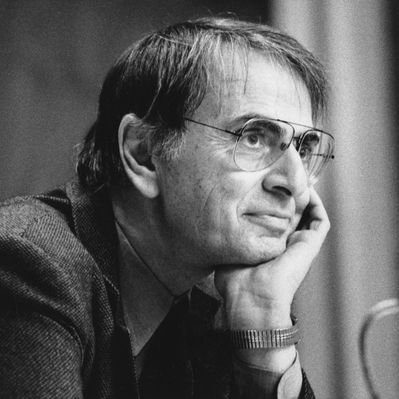
Do not use your energy to worry. Use your energy to believe, to create, to learn, to think and to grow.
- Richard Feynman

Rodrigo Weber Alva retweeted

We live on a planet with 1.3 billion habitable years left. We've had rockets for 69 of those years. In that time, the cost of reaching orbit dropped from $54,500 per kilogram to $2,720, and SpaceX is targeting under $100 with Starship. If they hit that number, getting to space becomes 545 times cheaper in a single lifetime.
329 orbital launches happened in 2025. Almost one a day. The space economy crossed $626 billion last year and should hit a trillion by 2034. SpaceX just filed for an IPO targeting a $2 trillion valuation, worth more than every airline on Earth combined. Starship, their fully reusable rocket (both stages fly back and land), can lift 150 tons to orbit. The entire International Space Station weighs 420 tons. Three flights could put the whole thing up there.
The engineering side of this is solved. What remains is a survival problem. Researchers published a paper in Scientific Reports calculating the natural extinction rate for humans, how often we'd get wiped out by asteroid strikes, supervolcanoes, the stuff we can't control. Less than a 1-in-14,000 chance in any given year. At that rate, we'd survive millions of years, more than enough to spread across the solar system.
Toby Ord, a philosopher at Oxford who spent a decade studying how civilizations end, puts the odds of a civilization-ending catastrophe before 2100 at 1-in-6. The threats aren't from space. Nuclear war. Viruses engineered in labs that could spread before anyone understands what hit them. AI systems are smart enough to act on goals we never gave them. All things we built ourselves.
A 2017 NASA paper made this case: we have a roughly 50-year window to lock in spacefaring infrastructure before resources run thin and energy costs make a restart nearly impossible. We're 9 years into that window. Given enough time, the math takes this to 100%. The only question that matters is whether we make it through the next few decades without blowing our shot.
