



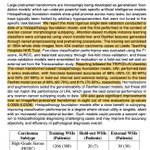

3/7 🧬 Patkar & Chen et al. present HistoTME, a multi-headed ABMIL that predicts 30 cell-type specific molecular signatures for learning TME composition and transferring to ICI prediction. AB-MIL + UNI produced the most accurate predictions out of all the models tested. the arXiv: medrxiv.org/content/10.1101/…
⚡️ Paired molecular data is a rich signal for supervising pathology models (e.g., learning with privileged information), and can be spatially resolved with pathology if formulated into pathways (also seen in MCAT (github.com/mahmoodlab/MCAT) / SurvPath (arxiv.org/abs/2304.06819). This study does a great job in not only validating bulk RNA-Seq-based signature prediction on an external cohort (TCGA->CPTAC), but also showcasing transfer to low-data, clinical scenarios. This study also echos the findings of Campanella et al where UNI also transfers well to ICI prediction.


6/7 🧬 Concurrent with our HEST-1K benchmark (arxiv.org/abs/2406.16192) that evaluated both UNI / CONCH and other models, Chen et al. introduced a histopathology-ST benchmark dataset (STImage-1K4M) for multimodal histology-genomic representation learning. arXiv: arxiv.org/abs/2406.06393
⚡️Coincidentally and surprising to me, both studies show UNI performing the best on ST linear probe. In HEST-1K, we evaluate additional models (CONCH, GigaPath, REMEDIS), with CONCH (r=0.315) being as competitive as UNI (r=0.319), and bigger models plateauing in performance (GigaPath, r=0.316).
💭Both studies also touch on tradeoff in performance and efficiency. PLIP and CONCH are chosen for finetuning (in STImage-1K4M and HEST-1K respectively) and do better than linear probe, and implicitly note that smaller models (VIT-B) are easier to finetune.


7/7 Additional studies which have compared and evaluated UNI (also answering the question, where do better MIL architectures fit in?)
🐍 Ding et al. present GAT-Mamba, which combines graph attention + state space modeling for survival analysis in TCGA-LUAD and NLST-LUAD. Based on UNI features, we see better improvement with more advanced MIL architectures.
arXiv: arxiv.org/abs/2406.04377
📊 Following their comparison of ROI foundation models, Chen & Campanella et al. next compared MIL models (same set of tasks as previously). Previously, they found UNI did better on challenging outcome prediction tasks (NSCLC-IO). Can we close the gap further with better MIL architectures? Not by much. Performance gains evaluating TransMIL and Patch-GCN over ABMIL (in ResNet-50 features) do not carry over with UNI.
arXiv: arxiv.org/abs/2407.07841
🐈⬛ Does this mean we should stop thinking about MIL architectures? Not yet. In PANTHER, we also ablated MIL architectures + pretrained encoder combinations. MIL architectures that benefited the most from UNI were those based on K-means clustering (e.g., AttnMISL and PANTHER). The biggest benefit I see from stronger ROI encoders is better retrieval capabilities, and thus believe that MIL architectures with prototypical formulations (preferably if also pretrainable) will be better for outcome prediction.
arXiv: arxiv.org/abs/2405.11643


1/7🥇Using ABMIL with UNI, Bedohazi & Biricz (Team NeuraBB) won 1st place in the 2024 Nightingale “Detecting Active Tuberculosis Bacilli Data” Challenge.
Link: linkedin.com/posts/zsoltbedo…
💭Would CONCH do better (able to adapt better special stains)? Surprised to see UNI adapt so well to out-of-distribution data!

2/7🐝 Tripathi et al. present Honeybee, a biomedical resource that harmonizes imaging (histopathology, CT), molecular (genomic, transcriptomic, proteomic) and text data (reports) in a vector database. UNI was used as the encoder for embedding histopathology tissue images. arXiv: arxiv.org/abs/2405.07460
⚡️ All reports, molecular data, and extracted UNI features for all TCGA samples available via HF! huggingface.co/datasets/Lab-…
⚡️ Validated on survival outcome prediction with external validation on lung SCC. arXiv: arxiv.org/abs/2406.08521
💭 Tripathi et al. finds that model efficiency and embedding storage costs (in addition to performance) will become significant factors when implementing retrieval augmented generation (1024-dim vs. 4096-dim features). We agree, and would also like to throw in that retrieval systems may be more sensitive to factors like stain variation, so embedding quality needs to be studied.


With 350K+ downloads of UNI (nature.com/articles/s41591-0…) and CONCH (nature.com/articles/s41591-0…), it has been really amazing to see how quickly these models are being adopted into CPath research.
Sign up to access models: huggingface.co/MahmoodLab/UN… and huggingface.co/MahmoodLab/CO….
With @richardjchen, here are some key examples for how our models are being used by the community:

4/ 📊 Hou & Jiang et al. present SPT, a framework for learning self-supervised slide representations, which is consistently able to learn strong slide-level features across a variety of encoders, including UNI. arXiv: arxiv.org/abs/2402.06188
⚡️This is the first work to investigate slide pretraining across a diverse variety of ROI encoders. The analyses in Hou & Jiang et al. suggest that slide pretraining provide the biggest performance gains in less powerful ROI encoders, with least benefit in HiDisc and UNI. They also show the importance of further finetuning as well, which can yield as big of an improvement as slide pretraining.
💭 I believe more development needs to happen in self-supervised slide encoders than ROI encoders. Few works in this area, and where most of the technical advancements need to be made 🔥

5/ 🏥 Breen et al. assess the performance of CPath foundation models on ovarian cancer subtyping, with 12% performance increase in accuracy of UNI over ResNet-50. arXiv: arxiv.org/abs/2405.09990
⚡️ABMIL heatmaps with UNI vs. ResNet-50 features are also compared. Beyond performance increase, Breen et al. highlights the improved heatmap interpretability with UNI, with greater focus on tumor.
💭 Clinical perspective of pathology foundation models are much in need. Breen et al. appreciated the robustness of UNI in: (1) performing well on 10X patches despite being trained on 20X, and (2) not relying on data augmentation or stain normalization to outperform ResNet-50, but noted the computational costs as a constraint. Foundation models should be able to run on modest computing resources (low barrier to entry for labs that want to go digital), which poses deployment challenges for ViT-Huge/Giant, and potentially also ViT-Large architectures. I agree with this point, and 50/50 use CONCH first for quickly evaluating a task, and follow-up with a larger encoder (e.g., UNI) if better performance is needed.


Max Lu retweeted

Excellent work from Gabrielle Campanella, @ThomasFuchsAI @IcahnMountSinai! Benchmarking 8 pathology foundation models including UNI, Virchow and Prov-GigaPath on large scale datasets for clinical diagnosis and biomarker discovery and providing insights into data scaling laws and model size.
arXiv: arxiv.org/pdf/2407.06508v1
💡Data diversity > data size. Overall, UNI (100M images, ViT-L, 302M params) and Prov-GigaPath (1.1B images, ViT-G, 1.3B params) trained on diverse datasets performed the best, especially on biomarker prediction. This was a key finding in the DINOv2 work, and is becoming an emerging theme in CPath.
💡Does model size matter? No performance gains with bigger models on disease detection. Some gains on biomarker prediction for certain tasks. Depending on the task, smaller models like SP22M (ViT-S, 22M params, embed dim=384) perform better than huge models like Virchow (ViT-H, 631 params, embed dim=2560), while having better efficiency.
More comments below 1/


Excited to join @modella_ai as the founding CSO this summer to work on the translation of cutting edge biomedical research to impactful real-world products that can enhance real-world research and clinical workflows.
I have had the wonderful opportunity to co-lead the development of multiple foundation models for Pathology as part of my PhD journey so far, including UNI/CONCH and most recently PathChat. I am thrilled to continue this journey with @richardjchen and other talented scientists and engineers at Modella AI and transform Pathology with PathChat 2 and beyond.
Huge thanks to the entire team @jstefanelli, @AI4Pathology, Long Phi Le, @kuanchen22, @chenbowen118, Zahra Noor, Farhan Mahmood and @theMingYang for making it happen!
This Post is from an account that no longer exists. Learn more
Excited to announce CONCH, a new visual language foundation model for #pathology, trained with 1.17 Million pathology image / caption pairs and achieves SOTA performance on zero-shot classification, text-to-img retrieval, segmentation and more!
Pre-print: arxiv.org/abs/2307.12914

Big shoutout to @bowen_chen_118 , @DFKW_MD who co-lead the project with me, supervised by @AI4Pathology. Also thanks to all my co-authors @richardjchen, @GuillaumeJaume, Igor Odintsov, Tong Ding, Ivy Liang, @aspartate_ai, @GeorgKGerber1, @Aparwani_dpath.
If you haven't already, please also checkout our #cvpr2023 paper, MI-Zero for performing zero-shot transfer on gigapixel WSIs: arxiv.org/abs/2306.07831
Max Lu retweeted

Here's our latest - visual language pretrained multiple instance zero-shot transfer for histopathology images accepted at #CVPR2023 led by our superstars @MYLu97 and @bowen_chen_118
Paper: arxiv.org/pdf/2306.07831.pdf
Video: youtu.be/x8Ch5wsCJRw
Code: github.com/mahmoodlab/MI-Zer…
If you're at @CVPR check out our paper on Thu Jun/22 10:30a.m. PDT Exhibit halls ABC # 312
