

ML in PL Association is a non-profit organization devoted to fostering the machine learning community in Poland and promoting a deep understanding of ML methods
Warsaw, Poland
Joined April 2018
- Tweets1K
- Following60
- Followers1.7K
- Likes34






Warsaw AI Safety Day runs two parallel tracks, and the governance one is where some of the harder questions of the day are sitting.
How does a middle power go from rule-taker to rule-shaper when the models are trained elsewhere? And what do we mean by “loss of control”: frontier risk, or European sovereignty? They’re easy to blur and not the same problem. Later come talks on how anyone outside a lab verifies what the lab claims, what defence AI looks like on NATO’s eastern flank, and whether existential risk is a real problem right now. The day closes with a panel in Polish on the less obvious risks of AI development, and the first enforcement of the EU AI Act gets its own slot in the shared programme.
The technical track is just as concrete: why RL training of frontier LLMs fails, how a model’s own values silently shape its answers, what makes an alignment eval worth building, plus biosecurity, robotics safety, and why monitoring has to go beyond the chain-of-thought. Tracks are picked per time block, so you can split your day.
24 October, University of Warsaw, 99 PLN (free tickets on request). We’re a strategic partner, and if you’d like a seat in either room, registration is open at warsawaisafety.day


Tens of billions of real-time ad auctions a day, each one scored inside a sub-50ms latency budget. That's the environment the ML Research team at @RTBHouse works in, and they're looking for a Senior Machine Learning Researcher to join them in Warsaw.
The core challenge, in their words: moving beyond static feature embeddings to model user behavior as continuous, long-term event trajectories. The role involves researching and designing new deep learning architectures, including their Transformer-based Giga Model family, for CTR, conversion rate, and user value estimation.
What the work actually looks like: formulating hypotheses, reading recent literature, and testing new model topologies and loss functions in PyTorch. Running distributed training experiments on dedicated multi-GPU clusters across terabyte-scale behavioral datasets. Working directly on models that go to production.
No corporate red tape, they say, with a preference for fast iteration, clean ablation studies, and reproducible research that moves measurable online performance.
RTB House was a Platinum Sponsor of ML in PL Conference 2026. Application details in the comments.
#MLinPL #MachineLearning #AI


@ElevenLabs is hiring Research Engineers for its growing Warsaw office. Four roles are open, and each one is a different bound on how good their models can get.
The reasoning behind that setup, as their team puts it: research is the foundation. The advances they make in speech, emotion and latency reach users immediately, and what they learn about quality and edge cases feeds back into the models to refine them.
Research Engineer: training models across modalities, then pushing existing ones further through post-training, data curation, architectural improvements and new training paradigms. Plus the part that gets underrated, designing benchmarks and evaluations rigorous enough to tell you whether a new iteration is genuinely better, and why.
Research Engineer, Inference: model quality only counts if it can be served fast, reliably and at scale. You own the path from research checkpoint to serving infrastructure, including quantization, distillation, KV-cache optimization, batching strategies, custom kernels, and serving systems tuned for real-time streaming workloads where every millisecond is load-bearing.
Research Engineer, Data Infrastructure: large-scale pipelines for collecting, processing, filtering and transforming training datasets, the classifiers, quality filters and labeling models that run inside those pipelines, and curation strategies (deduplication, quality scoring, augmentation) that measurably improve model performance.
Research Engineer, Web Crawlers: sourcing that data from the open web, across billions of pages. Content extraction from messy HTML, deduplication at web scale, freshness and recrawl strategies, politeness and rate-limit handling, and targeted pipelines that find high-value audio, video and multilingual sources and turn them into clean, training-ready datasets.
No formal certifications or degrees required. They look for engineers who can show impressively hard problems solved through artifacts: past projects, designs, GitHub contributions.
ElevenLabs was a Strategic Sponsor of ML in PL Conference 2026. All four role descriptions in the comments.
#MLinPL #MachineLearning #AI


Found it? Now for the harder question: could an AI agent spot it, understand the surrounding code, fix it without breaking anything else, and do that reliably across a large codebase?
That's the challenge @jetbrains is hiring AI and ML researchers and engineers for.
JetBrains is redesigning developer tooling for a world where agents plan tasks, use tools, and operate across complex codebases. Its products include:
- Mellum, a family of fast, open-source language models for code intelligence and low-latency AI workloads
- Junie, a coding agent
- Air, a development environment where multiple coding agents run independent task loops side by side
The majority of the AI research and engineering behind these products happens in-house. The work includes training and post-training language models, optimizing inference, and developing evaluations that measure how reliably agents understand code, use tools, and complete real development tasks.
It also means tackling task routing and multi-agent orchestration: deciding which model or agent should handle a task, coordinating parallel work, and making the resulting systems dependable at scale.
Want to build these systems for 15 million developers and counting?
Explore JetBrains' AI and ML roles: jb.gg/jb-at-mlinpl-roles

The 10th edition of the ML in PL Conference is officially behind us! 💛
The dust has barely settled at the Copernicus Science Centre, the last tutorial sessions at the Faculty of Physics, University of Warsaw have wrapped up, and we're still trying to take it all in.
Ten editions ago, a group of students had a fairly simple idea: bring together people who shared a passion for machine learning.
A decade later, that idea has grown into something we could hardly have imagined back then. And honestly, we're still trying to wrap our heads around it.
This year's anniversary edition brought together:
- 820 participants from the ML community
- 24 sponsors, including 13 sponsor stands at the Copernicus Science Centre
- 83 posters presented across 3 poster sessions
- 60 talks, covering an incredible range of research topics
- A discussion panel, hands-on tutorials, and countless conversations
Looking back at the past decade, it's quite a journey.
We've had the privilege of welcoming researchers such as Yoshua Bengio, Daphne Koller, Leon Bottou, Kyunghyun Cho, Łukasz Kaiser, and many, many others who have helped shape machine learning as we know it. We've received support from some of the world's leading AI companies, welcomed brilliant minds from leading research institutions, and watched our little student initiative grow into an international scientific conference.
But perhaps the most incredible thing we've built over these ten editions isn't the conference itself.
It's the community. And that's something we're particularly proud of.
Of course, before we get too sentimental, we have some well-deserved congratulations to share!
🏆 Best Poster Awards 2026
Congratulations to:
- - Model-Aware Tokenizer Transfer
- Jolanta Śliwa - Counterfactual Explanations for Monster Design in Tabletop RPGs
- Piotr Kacprzak - Towards Discrete Multi-Scale Time Series Foundation Models
🏆 Best Talk Award 2026
Congratulations to Dawid Rymarczyk for Surgical Unlearning: Precise Concepts Removal from AI Models!
🎮 Conference Game Winners
Congratulations to Hanna Nowicka and the team from AGH University of Krakow: Mateusz Praski, , Piotr Kacprzak, and Michał Szymocha!
And now, the most important part.
To our speakers, sponsors, partners, organizers, and volunteers - thank you for your time, support, dedication, and for making this edition possible.
And above all, to our participants : thank you for being the heart of ML in PL. Whether it was your first edition or your tenth, you're the reason we keep doing this.
When we asked people for their birthday wishes this year, we kept hearing two things: keep growing, but please don't lose that special ML in PL atmosphere.
And you know what? We couldn't have wished for anything better ourselves.
What would you love to see at future editions of ML in PL? We'd genuinely love to hear your ideas.
Thank you, from the bottom of our hearts.
See you next year! 💛
ML in PL Team
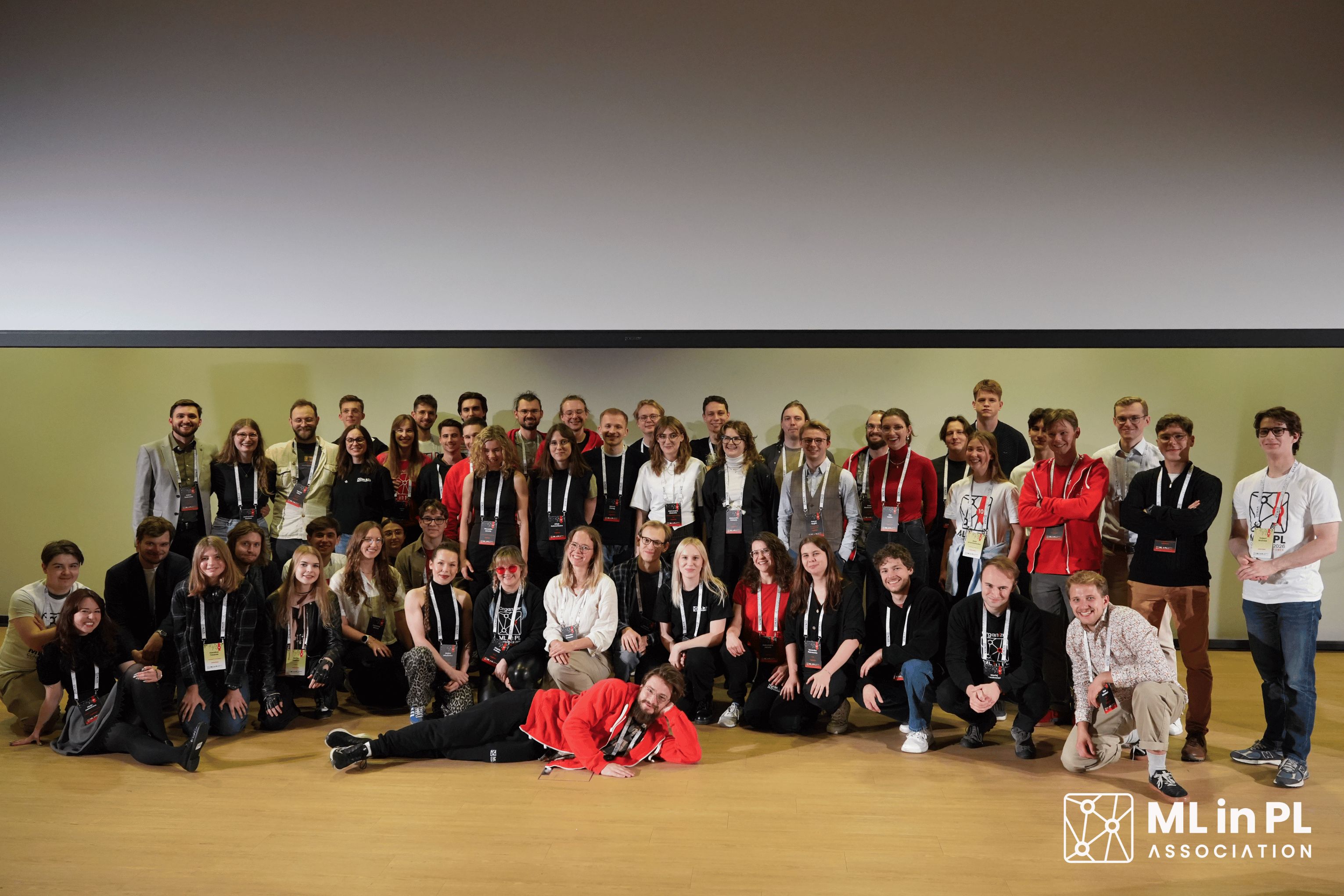
Day 3 of ML in PL Conference 2026 brought three things we love about research: difficult questions, fresh ideas, and discussions that don't end when the slides do.
The final day at Warsaw's Copernicus Science Centre covered a wide range of research, from machine unlearning and interpretable representations to diffusion models, optimization theory, and AI-driven scientific discovery.
Dawid Rymarczyk and Franziska Boenisch explored concept removal in AI models, while Diogo Soares presented work on interpretable representation alignment. Mikołaj Zasada discussed SoftMoE for mixture-of-experts in LLMs, and Julianna Piskorz examined context comprehension in diffusion language models.
Patryk Marszałek presented ZEUS for unsupervised tabular data embeddings. Jonas Kneifl explored physical understanding in video diffusion models, Łukasz Janisiów presented PhAME for molecular editing, and Bartłomiej Sobieski discussed explanations of deep lung cancer risk predictions.
The invited talks brought wide perspective: Peter Richtárik on optimization theory, Tomáš Pluskal on machine learning for plant chemistry, João F. Henriques on synthetic and real data in 3D vision, Johannes von Oswald on retrieval-centric deep learning, and Stanisław Jastrzębski on AI-driven discovery in organic chemistry.
Different research questions, different approaches, and plenty to discuss after the presentations.
Thanks to all the speakers, participants, and volunteers who made these three days possible!


One more thing to add to your ML in PL agenda: explore Warsaw.
Four days of talks, workshops, new ideas, and new connections. But if you’ve only seen the conference venue so far, there’s still more to discover.
From historic architecture and museums to modern neighbourhoods and green spaces, Warsaw has plenty to explore once the last session of the day is over.
So before you head home, make some room in your schedule for the city hosting us.
Second day is in full swing.
Morning after the party, and the 9:30 crowd still showed up for drug design and data contamination.
We opened with a question that runs both ways: how do you teach humans and machines to design drugs? Paulina Szymczak took it further with generative models for antimicrobial peptides. Down the hall, Julia Bazinska and Mateusz Dziemian showed how easily AI agents get hijacked, and Michał Zawalski asked whether a model has already seen its own test. Anna Kołos checked whether vision-language models understand Polish culture at all.
At 11:15, Lenka Zdeborová took on ML theory in the age of attention, Paweł Budzianowski on supervising physical AI, and an ELLIS panel asked the question many of us have been asking: is Europe losing the AI race?
The afternoon belonged to the Witold Lipski Award laureates, opened by Deputy Prime Minister Krzysztof Gawkowski. A morning spent asking whether Europe is keeping up, and an afternoon with the Minister of Digital Affairs in the room.
Kamil Deja, Hubert Baniecki and Michał Nauman presented their work on control, explainability and scaling value-based RL, while sparse autoencoders, neural collapse and Jan Chorowski's BDH (the missing link between the transformer and models of the brain) filled the other halls.
Emanuele Rodolà and Valentina Boeva close the day.
See you tomorrow at Copernicus Science Centre.


Autumn in Warsaw
Day 2 of ML in PL is here!
If you’re joining us from outside Warsaw, we hope you’ll get a chance to see a bit more of the city while you’re here.
October is a great time to explore Warsaw, take a walk between sessions, grab a coffee nearby, or stay out a little longer after the conference and enjoy the city in its autumn colours.
See you at the conference!
The ML in PL Conference 2026 is on. The first session ran at 8:00 this morning, open to anyone, and the first speakers on stage were students.
The talks ran from pruning attention heads in vision transformers to a talk titled "Your CLIP has 164 dimensions of noise," and from goal-conditioned RL to steering peptide models for antimicrobial design.
At 12:15 the invited talks began. Razvan Pascanu asked in the Main Hall whether the reliance on scale is unavoidable, while Piotr Sankowski in Hall A described global AI governance from inside the UN AI panel.
The afternoon is still going. Sponsor talks started at 15:30, with JetBrains on what training Mellum 2 from scratch taught them and Allegro on the lifecycle of a neural ranking model.
At 17:00, Pierre Stock explains how Mistral develops agent scaffolds and models together (Main Hall), Adam Paszke looks back at ten years of ML systems from PyTorch to JAX to Pallas (Hall A), and Markus Wulfmeier takes physical AI past the demo stage (Hall B).
After party starts at 19:30 at Bolek Pub & Restaurant, powered by ElevenLabs. Badge and ID get you in.
Stay tuned for more from the Copernicus Science Centre.

Welcome to Warsaw!
ML in PL Conference is officially underway, and for the next few days, Warsaw is home to our community of researchers, engineers, students, and ML enthusiasts from Poland and beyond.
And there’s plenty to discover outside the conference venue too. From the Warsaw skyline and the Royal Łazienki to the Old Town and the Vistula, we hope you’ll find some time to experience Warsaw while you’re here.
A big thank you to the Warsaw Tourism Organization and the City of Warsaw for supporting ML in PL Conference and helping us welcome our community to Warsaw!
Enjoy the conference, and enjoy Warsaw!

Two talks you both want? The booklet has the abstracts, posters, rooms, and tips for Warsaw.
If you've registered, it's already in your email, along with the Slack invite.
Transformers have become the dominant architecture in AI, but fundamental questions remain around memory, continual adaptation, reasoning, efficiency, and learning from experience.
During ML in PL Conference 2026, @pathway_com is hosting a research dinner bringing together experienced researchers and technical practitioners to discuss where current approaches fall short, which alternatives look most promising, and what it will take to evaluate them at scale.
The discussion will be led by @JChorowski, CTO and co-founder of Pathway, and is intended as an exchange among peers working on advanced AI research and systems.
📆 Friday, 9 October | 18:00-20:00
📍 Powiśle, Warsaw
Dinner and drinks are hosted by Pathway. Registration is free and subject to approval — please check the registration details before applying.
luma.com/59414jr9

Predicting a reaction is one problem. Closing the discovery loop, proposing a route, running it, and deciding what to try next, is another.
@kudkudakpl (Molecule.one) builds Maria for autonomous discovery in organic chemistry, recently used with OpenAI on near-autonomous chemical discovery.

ML in PL is more than a conference. It’s a space to share research, exchange ideas, and take ML projects further.
On October 8, the Student Research Workshop brings eight student researchers to the Main Hall of the Copernicus Science Centre, covering topics from Vision Transformers and reinforcement learning to T2I safety and Gaussian Splatting. The event is open to everyone and free to attend.
Looking for something more hands-on? On October 11, ML in PL tutorials at the Faculty of Physics of the University of Warsaw will cover topics including generative design, ML security, reinforcement learning, and Gaussian Splatting.
Tutorials require separate registration, available in the link below.
See you in Warsaw!

