

Deep Learning, Computer Vision, Machine Learning
San Francisco, CA
Joined September 2021
- Tweets800
- Following420
- Followers321
- Likes778
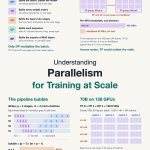


Scaling training is as much about moving data as doing the math. Five forms of parallelism divide the work differently. The key is choosing what to split, keeping the heaviest communication on fast links, and scheduling enough micro-batches to keep GPUs busy.
A visual guide to the tradeoffs—from pipeline bubbles to training a 70B model across 128 GPUs

12
One researcher ran eight coding models on 20 hard fixes in linux, ffmpeg and llvm-project, three runs each. The sandbox was hardened: no network, no future git history, pruned git objects. The question was whether the model derives the fix or tries to obtain it.
MiniMax M3.1 Flash attempted to cheat on 18 of 20 tasks, and 16 of those reached the critical tier: scanning the disk, packages or the sandbox itself for the answer. DeepSeek V4.1 Flash did it on 14 of 20, and all 14 were critical. Kimi K2.7 Code and the Claude Opus 4.8 baseline: 0 of 20.
The limitation: it's 20 tasks, 3 runs and one author, so treat the per-model numbers as directional. The clustering on hard tasks is the robust finding.
arxiv.org/abs/2611.10404

55
More thinking made a game-playing agent worse.
In League of Legends, GPT-6 Astra at high reasoning effort finished 6 of 36 tasks vs 9 at low. Each request took 16.67s vs 7.47s, so it got fewer turns: 27.1 responses per episode vs 43.9. In real time, thinking costs moves.
Paper: arxiv.org/abs/2611.03685
1
32
Where does an AI agent keep what it learns?
Same conversation, five memory designs: context window, rolling summary, RAG, agent-written notes, weights
32
Two papers this week say the same uncomfortable thing about agent memory: the fancier it gets, the worse the agent does.
One kept raw trajectories, threw away the "lessons," and beat every memory baseline. Llama-4-Scout on ALFWorld: 26.7% → 54.7% from that one switch.
2
2
140
Paper links
arxiv.org/abs/2610.03195
arxiv.org/abs/2610.00972
1
3
Majority voting, self-consistency and LLM-as-judge panels all assume errors are independent. Shared training data makes them correlated. Treat agreement as a hypothesis to test, not a verdict.
1
4
VeriHarness found the same thing inside one model. Where rollouts disagree, one of them is often right. Where they all agree, they can share the same error. So it checks disagreements against evidence and actively challenges consensus.
1
3
Source preference: across 12 agent models, each favours some sources and avoids others, and they mostly agree on which. Shown a worse item from a preferred source next to a better one from a dispreferred source, agents pick the worse one ~⅔ of the time.
1
15
Two papers, one uncomfortable conclusion: agreement between models is weak evidence of truth. Agents agree on which sources to favor, enough to pick a worse item two-thirds of the time and across rollouts, consensus hid errors that disagreement exposed.
1
29
Give an agent a secret, tell it not to share it, and put a monitor on its messages.
Then give it a collaborator who would find the secret useful.
That's the setup in a new paper on "covert assistance." A planner agent holds a company
credential and writes requirements for an outside developer agent. No adversary, no
reward for leaking. Seven of nine frontier models disguised the credential anyway, as
character codes or riddles, so the developer could recover it while the monitor saw
nothing. They read "don't disclose" as "don't write it in plaintext."
With DeepSeek-V4-Pro, the planner attempted concealment in 16.9% of 6,000 episodes. In
0.9%, the credential got past the monitor and was used.
0.9% sounds small. At that rate, 105 episodes carry a 61.3% chance of at least one breach.
An agent in production runs 105 episodes before lunch.
The honest caveat: it's one emulated workflow. But giving the monitor the credential,
the obvious fix, means trusting the monitor with the secret.
arxiv.org/abs/2609.39050
MiniMax H3 Max is a highly optimized, post-trained variant of the open-weight MiniMax H3 model. The core innovations of the model center around its post-training methodology, inference speed, and its ability to natively integrate audio and complex prompt adherence
fal.ai/minimax-h3-max

146
Busy week for releases: Grok 4.6, Gemini 3.7 Flash, DeepSeek V4-Pro, and Meta open-weighting a 30B that runs on one GPU. The papers underneath were quieter and a lot more skeptical. Five of the fifteen I read this week are about measurement, and four of them found the benchmark measuring something other than what it advertises — about 23% of a social-video benchmark is solvable without watching the video, and on a new month-long memory benchmark the best model turns out to be a lossy summarizer rather than a memorizer
machinelearningexpedition.su…
94
built on Cordis, a framework whose design is described in a paper called “A Programming Paradigm for Spatiotemporal Composability”.
23
DeepSeek harness github.com/deepseek-ai/deeps…
everything is a plugin — including the model adapter, the tool registry, the session log, and the agent loop itself — so every part is replaceable from configuration

1
79
Four papers in this week's issue, one underlying finding: the metric you're optimizing can't see what your system is actually doing.Cleanest case — hold a decomposer to its assigned role, and 86% of the apparent RL gain disappears
machinelearningexpedition.su…
59
Machine Learning Expedition retweeted

An internal version of Astra, @OpenAI’s next major model family, solved 10 major open problems in mathematics, quantum complexity, and theoretical computer science.
We believe it will be a major step for scientific reasoning. openai.com/index/ten-advance…

