When a qualified buyer with a perfect-fit solution says, "I need to think about it," what's really happening?
It's not your pricing.
It's not your competitors.
It's not timing.
There's a communication gap you didn't even know existed.
Your pitch didn't reflect what they value most. So, even though you explained everything clearly and addressed their stated needs, something felt... off. Not wrong exactly. Just not quite right.
And when a decision doesn't feel right, buyers hesitate.
Here’s an example:
You're selling marketing automation software. You deliver a thorough presentation covering time savings, lead nurturing workflows, detailed analytics, integrations, and case studies.
Your prospect nods along, asks good questions, and seems engaged.
Then you hear, "This looks great. Let me think about it and get back to you."
Ugh. Seriously?! What just happened?
You emphasized efficiency, data, and process optimization because that's what you've been trained to emphasize.
But this particular buyer is a Visionary.
They're not motivated by optimizing current processes. They're motivated by transformation and future possibilities. They don't want to hear about saving 10 hours a week. They want to hear about pioneering a new approach to customer engagement that positions them ahead of market shifts.
Same product.
Different emphasis.
Completely different level of resonance.
When you lead with process optimization for someone motivated by transformation, your solution feels incremental. So they hesitate — not because the solution is wrong, but because the message didn't align with how they make decisions.
Now imagine you'd identified their motivation earlier in the conversation.
Instead of leading with "streamlined workflows," you lead with, "This will transform how you engage with prospects before they even know they need you. You'll pioneer an approach that positions you ahead of market evolution."
Same software.
Same features.
Deep resonance.
The "I need to think about it" hesitation disappears.
Want to learn the framework?
Take the MCode assessment and discover the why behind how you make decisions. Then, check out our free sales personalization webinar and learn to recognize buyer Motivations early.
Most people assume high performers work more than everyone else. Yes, they do, and no, they don't. 😉
High performers put in longer, harder pushes against a deadline.
They also take more breaks, use all their vacation days, and protect their evenings and weekends more carefully than average performers do.
Average performers are often the ones working without rest.
They grind through the day without stepping away, spill over into evenings and weekends, skip vacation days, and hit burnout regularly. Their productivity stays flat because the fuel runs out.
🧠 High performers know the math 🧠
To run fast, you also need to rest. So, between big efforts, they spend time in their sweet spot, doing work they're wired for, which restores their energy without the friction of work that doesn't fit them.
The irony is that the behavior most organizations read as "less committed" (taking all the vacation days, logging off at a reasonable hour) is often a marker of the employees producing the most.
There are 14 traits that separate high performers from average performers, including the ones that look counterintuitive until you understand the motivational wiring behind them.
Want to learn about them all? This article gets into the dynamics of all 14 things that differentiate high performers:
f.mtr.cool/9a1tvhzfj3
Two opposite mistakes send high performers looking for the exit, and most managers make one or the other without realizing it.
🚨 The first mistake is managing on autopilot.
When someone consistently delivers, it's tempting to leave them alone and let them do their thing. The logic: They're reliable, need less management than others, and can handle it.
A manager values what they bring to the table and sees it as a way to demonstrate trust, but the employee often reads the lack of attention as neglect.
High performers live on a diet of challenge and recognition, and the absence of both communicates that their contributions no longer warrant attention — and when that happens, they're less driven to go all in.
🚨 The second mistake is over-correction.
That manager realizes they've been too hands-off and swing the other way, injecting more oversight, more check-ins, more direction than the person needs. That reads as a totally different kind of insult: You don't trust them to make decisions or deliver the way they always have — and again, they pull back and disengage.
1/2
🔥 The space between those two extremes is where personalized management of high performers makes all the difference in how they show up and what they deliver.
High performers need frequent recognition for what they bring, ongoing investment in what they could build, and autonomy within clear expectations. The trick is knowing, for each high performer:
→ The type of recognition that is meaningful
→ The type of work and work style that lights them up.
→ The type of communication they need to give it their all.
And, if your team has taken the MCode assessment, this motivational intelligence is inside their reports.
Oh, and these are just two mistakes of SEVEN! Read our article on the seven mistakes managers make with high performers, and the patterns to watch for in your own leadership:
f.mtr.cool/yjaexazxxm
2/2
"Treat others how you want to be treated" is common leadership advice that's wrong for what most leaders are trying to do.
People are wired differently.
They're energized and drained by different things, and different contexts fuel or deplete their engagement, which is why the same management approach can produce opposite results depending on the person receiving it.
👉 The employee who wants public recognition doesn't respond to the same approach as the employee who prefers a private email.
👉 The team member who thrives on autonomy drains under the check-in cadence that energizes the one next to them.
👉 A leader who manages from their own preferences is unintentionally managing half the team well and half the team into disengagement.
The leadership upgrade managers need is the ability to adapt their management approach to fit each person, and that requires knowing what drives them and what doesn't.
1/2
Once a manager has that motivational intelligence, the shifts needed become clear and specific.
⭐️ You know who needs public recognition versus private.
⭐️ You know who needs autonomy versus close collaboration.
⭐️ You know who needs space to process versus decisions made quickly.
Even better? You stop second-guessing whether the way you just delivered feedback will inspire and build momentum or shut someone down.
That's the difference between a manager who's good with some people and a manager who's good with everyone on the team.
MCode Team Alignment Workshops help managers build exactly this capability into their existing team, so they can become more effective leaders and build more cohesive teams.
Interested? Want to know more? Here are all the details:
f.mtr.cool/kvhmrjbtkw
2/2
When conflict at work feels personal, people pull back the effort and care they put into the job, out of frustration, resentment, or the sense that they've been disrespected, undervalued, or unseen.
Harvard Business Review research by Porath and Pearson found that 48% of employees decreased their work effort after experiencing conflict, and 38% deliberately reduced the quality of their work.
The cost of conflict shows up as capable people choosing to give less, and doing it on purpose.
Most conflict-resolution advice treats the blowup as the problem and works to smooth it over, but the friction that drains effort day after day rarely comes from a single incident.
It builds from the daily grind of working alongside someone whose approach clashes with yours, when neither of you understands why.
That underlying tension traces back to motivation, the natural wiring that determines what drives a person, how they think, how they make decisions, and how they solve problems.
When people are wired differently and have no language for it, the mismatch gets read as someone being difficult, and it starts to feel personal.
That's what turns ordinary friction into resentment, and resentment into withheld effort and lowered quality.
Smoothing over the incident does nothing about the wiring underneath it, which is why the same tension keeps resurfacing with the same people.
What changes the pattern is understanding what drives each person, because the behavior that reads as difficult usually makes complete sense once you see the motivation behind it.
That understanding is what lets people stop taking the differences personally and start working with them, maybe even seeing them as advantages.
MCode gives teams that understanding.
Our assessment maps what motivates each person, giving everyone a shared language for how they and their colleagues are wired to work.
The differences that used to build into resentment become something the team can name and navigate, so conflict stops eating the effort and quality your people would otherwise bring.
When a work conflict wore you down, what made it start to feel personal?
Across 30 recent conversations with top performers who'd left jobs in the last six months, the reasons they walked rarely started with compensation.
Five themes surfaced instead:
→ They were tired of internal politics.
→ They had ideas that never got traction.
→ They lost faith in the leadership.
→ They were bored and exhausted.
Each of those themes connects to a specific type of motivational wiring:
→ Boredom depletes Achievers who need new challenges to shine and Learners who need new problems to master.
→ Exhaustion piles up for Optimizers pulled into the same hero moment over and over.
→ Lost faith hits Visionaries and Drivers first, since both are wired to chase forward movement that a stalled organization can't deliver.
Retention at the top of your performance curve runs less on compensation and more on whether the work still fits how each person is wired. When it stops fitting, the best people find the exit.
This is the read most retention strategies are missing.
The MCode assessment shows you the motivational wiring behind every person on your team, so you can see who's running low long before they update their LinkedIn. You'll know which of your top performers needs a fresh challenge, which one is burning out in the same hero role, and which one is itching for forward movement the org isn't giving them.
Pair that with the Job Fit Report, and you can match people to work that fuels them and catch a misfit while you can still fix it.
Compensation keeps people from leaving for a number. Motivational fit keeps them from wanting to leave at all.
If you haven't taken the MCode assessment yet, what's stopping you?! Change starts from the top down, so take it yourself first, see the difference motivational intelligence makes, and then share it with your team. Our Lite report is just $19!
f.mtr.cool/t9v99rpgki
Strengths assessments tell you what you're good at and what you're not. The MCode assessment tells you what energizes you and what drains you.
Those are different conversations, and they produce different decisions.
Knowing your strengths helps you build a resume, polish a LinkedIn profile, and pitch yourself for a role. Knowing what energizes you helps you choose which roles to pitch for in the first place and avoid the ones where you'll be capable, competent, and miserable.
👉 Your most prominent MCode Motivations and Dimensions are the work and tasks that light you up, where you operate in high-performance mode and feel fulfilled.
👉 Your least prominent MCode Motivations and Dimensions are the work you can do, may even be good at, and don't get excited about.
👉 Both can use the same strengths. Only one feels like it fits you.
That's why strengths-only thinking can sabotage a career. You can be promoted into a role that perfectly uses your strengths and find yourself, six months in, asking why this thing you're so qualified for doesn't feel like yours.
Discover your MCode and see which work energizes you, which drains you, and why — and go Premium to get tools to enhance your professional bio, resume, and LinkedIn profile.
motivationcode.com/assessmen…
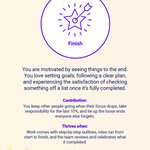
If you're motivated by Finish, you're the one on the group project who makes sure it ends at the desired destination. That earns gratitude at the deadline and a little irritation in the weeks leading up to it.
Finish is one of 32 Motivations that form the WHY behind your thoughts, decisions, and actions — and that’s the game-changer, especially in your work!
Motivations > Personality
👉 Personality tests describe how you behave.
👉 Skills assessments show what you can do.
🔥 Motivation Code reveals WHY!
Your MCode is how you’re naturally motivated, driven to win, and wired to succeed. It’s your competitive advantage. It’s your secret sauce.
Your unique motivational ranking explains:
→ How you are wired for work.
→ What you need to be successful.
→ What causes you to struggle.
→ Who you are at your best.
Have you discovered your MCode yet?
Find out what motivates you at motivationcode.com/discover-…
When Demonstrate Learning is one of your top Motivations, you want your job description to stretch you.
A rigidly defined role with no opportunity to learn and showcase your results will stall you out.
Demonstrate Learning is just one of 32 Motivations that shape who you are at your best and what drives your best work — and what leads to the opposite dynamics.
✅ Your highest-ranked Motivations are the strongest, most prominent drivers of action. They reflect the work or tasks that light you up, get you excited, and drive you to do your best.
❌ Your lowest-ranked Motivations may hardly inspire you to engage. They reflect the work and tasks you can do and may even be good at, but don’t get excited by — the projects and activities you feel “meh” about.
Do you know what does and doesn't motivate you?
Find out at motivationcode.com/discover-…
Want someone to lean into a growth opportunity instead of resisting it? Change how you frame it.
Same opportunity
+ different language
= completely different response.
To a Driver, you say:
"Here's a challenge I think you can overcome to reach our target faster."
To a Visionary, you say:
"I see an opportunity for you to develop an innovative approach that could transform how we handle these situations."
When you use someone's motivational language, you're not just communicating differently. You're demonstrating that you understand what drives them and showing you're setting them up to succeed, not waiting for them to fail.
That alignment creates psychological safety, and psychological safety accelerates trust, engagement, and performance.
Predictive Index captures two things: How you're expected to act at work, and how you naturally see yourself.
The gap between them is part of what makes PI useful, because it surfaces the adaptation happening between authentic behavior and workplace performance.
The challenge? Predictive Index doesn't tell you what that adaptation costs over time.
Behavioral adaptation is sustainable when the work itself aligns with someone's internal motivations. They flex their work style for the role, and the role gives back energy because the work engages what naturally drives them and gets them fired up.
Behavioral adaptation is not sustainable and becomes exhausting when a person's work doesn't align with what motivates them — when the day-to-day reality of the role feels draining, and they start to disengage.
The cost of that misalignment compounds even when their PI profile says they're in the right job.
The thing is, someone can be in a job that looks right on paper, one that perfectly aligns with their skills and experience, and still not like it or feel fueled by it.
That nuance is exactly what the Motivation Code assessment is built to surface.
→ The Motivation Code (or MCode) assessment starts with four personal stories of achievement and the satisfaction patterns inside those stories.
→ It then produces a stacked ranking of 32 Motivations across a spectrum of 8 Motivational Dimensions: Achiever, Driver, Influencer, Learner, Optimizer, Orchestrator, Relator, and Visionary.
→ You see which Motivations drive a person, which ones barely get them off the couch, and where each of the 8 Dimensions sits in their profile.
🔥 That motivational intelligence tells you whether someone's daily work is tapping their most prominent, satisfying Motivations or asking them to operate out of their least prominent, unsatisfying Motivations.
With the PI behavioral profile AND the MCode motivational profile, the adaptation you're looking at becomes visible. You can see whether their work is sustainable or heading toward burnout.
One bad day doesn't drive a good employee to quit. They walk out the door after hundreds of small interactions have chipped away at motivation.
❌ A manager thinks they're recognizing great work, but the employee doesn't feel seen.
❌ A manager believes they're creating growth opportunities, but the employee feels pushed toward work they don't want.
❌ A manager thinks they're empowering someone with autonomy, but the employee feels abandoned.
These moments on their own aren't big enough to send someone looking for another job.
But together, they shape how employees experience work every day. Over time, that experience becomes the deciding factor in whether they stay or leave.
That's how everyday leadership decisions become retention problems.
Managers rarely lose great people because they don't care.
They lose them because they don't understand what actually drives the people they lead, and those people don't all want and need the same things.
👉 When managers don't understand what intrinsically motivates each person, they lead everyone through the same lens—their own.
Over time, employees begin to feel misunderstood, underutilized, or disconnected from their work. The manager thinks they're doing everything right and the employee starts updating their resume.
When leaders know what energizes each employee, they can tailor feedback, delegate work more intentionally, create meaningful development opportunities, and recognize people in ways that genuinely resonate.
✅ Employees feel understood.
✅ Managers build stronger relationships.
✅ Organizations retain their best people.
That's the difference motivational intelligence makes.
What's one thing a manager did that made you want to stay?
An underdiagnosed employee pattern = A high performer who started strong and impressed everyone, is no longer delivering what they used to.
Most organizations read this as a problem with the person, but often a more accurate diagnosis is a job fit problem — the role shifted, the responsibilities changed, or the work they were doing isn't the work they are doing.
Specific signs the underlying issue is poor job fit:
→ The cadence, quality, or tone of their communication has shifted noticeably.
→ A previously reliable employee is missing deadlines or working more slowly on tasks they used to finish quickly.
→ They've gone silent in meetings and pulled back from team interactions.
→ They've started mentioning feeling frustrated, bored, underutilized, or undervalued.
→ A positive team member has started introducing friction or negativity where there wasn't any before.
When signs like these show up, the most productive next step is to have a job fit conversation and ask:
Has the role shifted away from the strengths and natural motivational drivers that made this person give it their best and stand out? Has something about the work, the manager, or the environment changed?
Even better? Review their MCode results again.
1/2
The MCode assessment reveals what motivates an individual at the deepest level — what energizes them and what drains them, and what engages them and what causes disengagement. Then run their results against the role using our Job Fit Report to see exactly where the work has diverged from their core drivers.
Most people know the Job Fit Report as a hiring tool. Still, it's just as useful for realigning an existing employee or supporting a team or company-wide reorg, which is why customers also use it when roles shift and teams get reshuffled.
With the motivational intelligence MCode delivers, you'll be able to identify what changed, why this person stopped delivering, and how to rebuild the role around the work that brings out their best, before that job fit conversation.
Check out this article on the dynamics of the right person in the wrong role, and the adjustments that get someone back to their best:
f.mtr.cool/jtgd2lbl5y
2/2
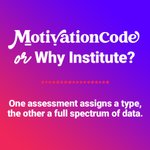
WHY Institute helps individuals find personal clarity.
Take the WHY Discovery, get your WHY statement, and walk away with an understanding of what drives your decisions. For individuals and even coaches, that clarity is so valuable. For organizations, a person's WHY statement is only sort of helpful.
That's why, at the organizational or management level, you need a tool that helps you go deeper.
The Motivation Code assessment, also called the MCode assessment, was built to go beyond individual insight and tap into the operational and people strategy questions executives, HR pros, and managers face every week:
→ Who to hire for a specific role, with a specific manager, in a specific team environment.
→ Which team members are motivationally misaligned with their current work and at risk of leaving if nothing changes.
→ How to design the next six months of a high-potential person's development so they stay engaged.
→ How to keep a high performer engaged, happy, connected, and doing their best work.
→ How to structure a team where motivational profiles complement each other instead of creating predictable friction.
→ Which leader's motivational wiring is shaping culture for better or worse across their org.
→ How to personalize your management approach and shape assignments to fit your direct reports perfectly.
That individual and team-level motivational intelligence powers Motivation Code's suite of organizational tools, including its Job Fit Report, Team Alignment Workshop, and AI-powered tools for ongoing decision-making, like MCode Coach, which plugs right into Claude AI.
So, for individuals, WHY Institute's WHY Discovery approach to personal clarity and a single why statement can be enough.
But for organizations trying to operationalize motivational intelligence across the talent lifecycle, take a look at Motivation Code, which gives you the motivational infrastructure to act on what a person's motivations reveal.
See the full comparison of WHY Institute and Motivation Code at:
motivationcode.com/compariso…
Authenticity at work isn't about bringing your whole self to the office. It's about bringing your best self.
Too often, authenticity gets reduced to personality, self-expression, or feeling comfortable enough to speak your mind.
But authenticity at work runs deeper than that.
People feel free to be their authentic selves when they feel fully seen, understood, valued, accepted, and respected for who they naturally are.
They don't have to hide their strengths, suppress what energizes them, or force themselves into someone else's definition of success.
That's one reason Boston Consulting Group found that employees who feel they can be their authentic selves at work are 2.4x less likely to walk out the door.
That kind of authenticity doesn't happen by accident.
It happens when managers understand what intrinsically motivates each employee and adjust their leadership accordingly.
→ Communication becomes more meaningful.
→ Assignments align with natural strengths.
→ Development opportunities fuel instead of drain.
→ Recognition reinforces the contributions that matter most to each individual.
→ Employees stop feeling like they have to fit someone else's mold to succeed.
Instead, they feel...
Seen for the value they bring.
→ Understood for how they're wired.
→ Accepted for who they are.
→ Respected for the unique way they contribute.
That's the difference motivational intelligence makes. MCode gives managers that intelligence. Our assessment maps what motivates each person, so leaders can lead in a way that lets people do their best work as themselves.
What helps you feel like you can truly be yourself at work?
There's a specific shift that happens when an entire team has language for how each person is wired, and it's most visible in the conversations they have without you in the room.
— The friction that used to require your mediation gets named between the two people involved.
— Your teammate who used to seem prickly is now understood as someone who needs to think before committing.
— The colleague who pushes hard on every decision gets recognized for the drive showing up that way.
— The introvert who felt overlooked now has the team's attention, because everyone sees how they contribute when given space.
For you as the team leader, that shift gives you back the hours that used to go to mediating dynamics, freeing your attention for leading the work itself. The team starts resolving its own friction using the vocabulary it shares, and the conversations you used to facilitate happen on their own.
For team leaders who want their team to develop this shared language without committing to an enterprise-wide rollout, the MCode Aligned Teams Accelerator pilot is a 30-day experience built around exactly this outcome:
motivationcode.com/enterpris…
If you're motivated by Meet Needs, people count on you, and a few take advantage of it.
You register what's missing for someone else before you register your own list, and that's wiring rather than politeness.
Meet Needs is one of 32 Motivations that form the WHY behind your thoughts, decisions, and actions — and that’s the game-changer, especially in your work!
Motivations > Personality
👉 Personality tests describe how you behave.
👉 Skills assessments show what you can do.
🔥 Motivation Code reveals WHY!
Your MCode is how you’re naturally motivated, driven to win, and wired to succeed. It’s your competitive advantage. It’s your secret sauce.
Your unique motivational ranking explains:
→ How you are wired for work.
→ What you need to be successful.
→ What causes you to struggle.
→ Who you are at your best.
Have you discovered your MCode yet?
Find out what motivates you at motivationcode.com/discover-…