

CMO @sparkfinance (Phoenix Labs) 🐱 on-chain credit infrastructure
United Kingdom
Joined July 2022
- Tweets195
- Following233
- Followers644
- Likes987








USDT borrowing rates on Aave V3 Ethereum spiked into double digits earlier today.
At the time of writing, USDT utilisation is ~96%, with $2.63B borrowed against $2.73B supplied. aavescan.com/ethereum-v3/usd…
That matters.
As utilisation approaches capacity, available liquidity becomes scarce and borrowing rates rise sharply to rebalance the market. At these levels, large withdrawals may also need to wait for liquidity to become available through new deposits or borrower repayments.
For borrowers, that creates an incentive to look for more efficient sources of liquidity.
At the time of writing, USDT borrowing on Aave was 11.22% at 5.07AM ET today. By 10:31AM it had fallen to 8.09% which is considerably higher than other options. SparkLend by comparison is 3.97% defirate.com/borrow/
That's a 4.12% percentage point difference.
On a $10M loan, that equates to roughly $412,000 in annualised interest costs if those rates persisted.
A good example of how quickly capital efficiency can diverge across onchain credit markets, and why borrowers have an incentive to move when better priced liquidity is available.
Sources: DeFi Rate for borrow rates; Aavescan for Aave V3 Ethereum USDT utilisation.

Lucky 🐈 retweeted

Ever wonder how a tri-party loan works?
The borrower posts collateral (typically Bitcoin). Spark provides the loan. @Anchorage sits in the middle, holding the collateral in custody so it never has to move to the lender or sit on an exchange.
This first clip from the Anchorage Digital Vibestream podcast explains how Atlas works within Anchorage Digital which acts as the qualified custodian and collateral manager, holding, tracking, and settling the collateral as the risk agent.
Sam then explains why this partnership made sense for Spark, and Spark's role in supplying the on-chain liquidity that funds the loan.
The result is institutional borrowing with on-chain capital and regulated custody working together.
Watch clip 1 of 3 below.

This is the direction DeFi distribution needs to go. We’ve spent years expecting users to learn wallets, bridges and protocols to access defi.
Why?
Keep the simple, familiar UX. Move the complexity underneath.

$600M+ in RLUSD/USDS volume in the first week.
$10B+ across the Stablecoin FX Layer since June 25th launch.
The bigger goal: a shared liquidity infrastructure connecting an expanding stablecoin market, with capital earning yield rather than sitting idle waiting for swaps.
Stablecoin FX is quickly becoming one of Spark’s most important pieces of infrastructure.
RLUSD Expands Liquidity and Distribution Through the Spark Stablecoin FX Layer
@Ripple’s RLUSD joins Sparks Stablecoin FX Layer: the liquidity network that has processed more than $10B in cumulative volume since launching on 25th June 2026.
Joining Paypal’s PYUSD and Tethers USDT, RLUSD expands the Stablecoin FX layer on @Uniswap V4, with RLUSD/USDS processing more than $600M in its first week, and Spark supported USDS pairs accounting for over 50% of Ethereum stable-to-stable volume on Uniswap during August.
Together with @SentoraHQ, RLUSD expands the FX Layer’s shared liquidity network, connecting stablecoins through USDS while enabling liquidity to remain productive when not required for swaps.
More stablecoins. Deeper shared liquidity. More efficient capital.
Explore the Spark Stablecoin FX Layer: paragraph.com/@spark-11/spar… (published June 25, 2026)



A good sign of where the market is heading.
Stablecoins are no longer being explained to crypto users, they're being explained to traditional investors.

One thing I've found most interesting over the past year is how quickly stablecoin infrastructure has become modular.
A year ago, the conversation centred on whether institutions would adopt stablecoins. Today, the more interesting question is what they build on top of them, and whether they choose to build every layer themselves or combine specialist infrastructure instead.
I think the next phase of competition is much less about issuing another stablecoin, and much more about creating useful financial products and the infrastructure that makes them possible.


Robinhood's announcements today show where the market is heading.
Consumer apps are increasingly being assembled from specialist infrastructure rather than rebuilt from scratch. @RobinhoodApp Earn is a good example of that trend.

Robinhood Earn is rolling out to eligible US customers.
Lend USDG onchain through a self-custody wallet and earn an estimated 7% APY.
APY subject to change.
xitter.cf/i/broadcasts/1YxNrrAME…

Every new stablecoin traditionally requires more inventory, more market making and more fragmented liquidity.
That's not just a trading problem, it's a capital allocation problem. The challenge isn't simply moving capital, it's coordinating it safely across multiple ecosystems while maintaining liquidity where and when it's needed.
The market is moving in this direction. The interesting part is who's preparing the infrastructure before everyone else needs it.
Launching a stablecoin shouldn't mean rebuilding liquidity from scratch.
The Stablecoin FX Layer, built by Spark on @uniswap v4, changes that.
Learn more: paragraph.com/@spark-11/spar…
If banks and fintechs are all launching their own stablecoins, rebuilding liquidity for every issuer simply doesn't scale.
Traditional FX has always been built on shared liquidity. It's surprising we've spent years recreating fragmented pools instead of shared infrastructure.
Introducing the Stablecoin FX Layer.
Every bank, fintech and payment provider is launching stablecoins. But every new stablecoin fragments liquidity.
Today, Spark introduces the Stablecoin FX Layer, built on @Uniswap v4, a shared liquidity infrastructure that allows stablecoins to access shared liquidity instead of building isolated pools.
The initial deployment brings approximately $150M of liquidity to Uniswap v4 across the first USDS/PYUSD and USDS/USDT pools.
This is just the beginning.
Learn more:
paragraph.com/@spark-11/spar…
The interesting part isn't just that institutions can now access Spark from BitGo custody.
It's that the operational barrier has been removed.
Instead of moving assets out of custody, introducing new wallets and governance complexity, institutions can access on-chain credit through workflows they already trust.
That's a meaningful step towards bringing larger pools of capital on-chain.

The operational simplicity here is what stands out.
A lot of institutional capital already sits in custody. Being able to deploy idle stablecoin balances into onchain savings infrastructure through existing custody workflows removes a significant operational hurdle.
This is how institutional capital starts moving onchain.
Institutional capital held in custody can now now access on-chain credit markets through structured allocation via Spark.
Through BitGo, capital can be deployed into Spark Savings vaults, where it is allocated across multiple credit venues within a single, structured system.
Most on-chain lending requires selecting a single market or pool.
Spark takes a different approach:
Capital is deployed across venues based on predefined liquidity, exposure, and allocation parameters, rather than remaining fixed within one market.
Reducing exposure to high-utilisation conditions where liquidity becomes constrained.
This is a new path for institutional capital into on-chain credit markets.
Spark is now available via @BitGo institutional wallets.
Traditional prime brokers don't assess risk one position at a time.
They assess the portfolio.
If financing is based on gross positions rather than net portfolio risk, borrowers can end up posting significantly more collateral than the risk actually warrants.
A portfolio is not a collection of isolated positions.
Yet much of crypto credit infrastructure still treats it that way.
Institutional trading firms manage exposure across exchanges, venues, and strategies simultaneously.
Evaluating each position independently can overstate the risk that actually matters: the portfolio as a whole.
That's why portfolio-based margining matters.
Spark Prime uses @ArkisXYZ technology to evaluate exposure across DeFi and CeFi venues, allowing financing decisions to reflect net portfolio risk rather than treating each position in isolation.
Read more about Spark Prime👇
paragraph.com/@spark-11/spar…
People only think about liquidity when markets break.
The real question is whether they understood the risks and structure before they deposited.
Read how @sparkfinance has built a 5 layer sequential loss absorption framework alongside bounded liquidity coordination, constrained capital movement, and multi-layered risk controls designed to protect user funds under stress.
Inside Spark’s loss absorption & risk frameworks.
Spark’s security architecture is designed around:
• bounded capital movement
• explicit loss absorption layers
• coordinated liquidity management
• multi-layered oracle systems
• constrained automation under governance-defined limits
This deep dive breaks down how Spark structures risk, liquidity, and loss absorption across Spark Savings, SparkLend, and the Spark Liquidity Layer before losses propagate toward user deposits.
Including:
• updated loss absorption waterfall
• Prime Agent risk capital
• Genesis Capital Backstop
• oracle and killswitch architecture
• programmatic liquidity coordination
• constrained allocation design under stress
Security by design.
Resilience by architecture.
See what sits between losses and user deposits: paragraph.com/@spark-11/spar…
$1B isn’t the milestone. It’s the shift.
You’re no longer just using the market...you’re influencing it.
That changes how you think about liquidity, execution, and where capital actually sits.

Liquidity is defined by how systems behave under stress.
Our co-founder Sam MacPherson breaks down how Spark is structured to manage risk across liquidity, collateral, and infrastructure
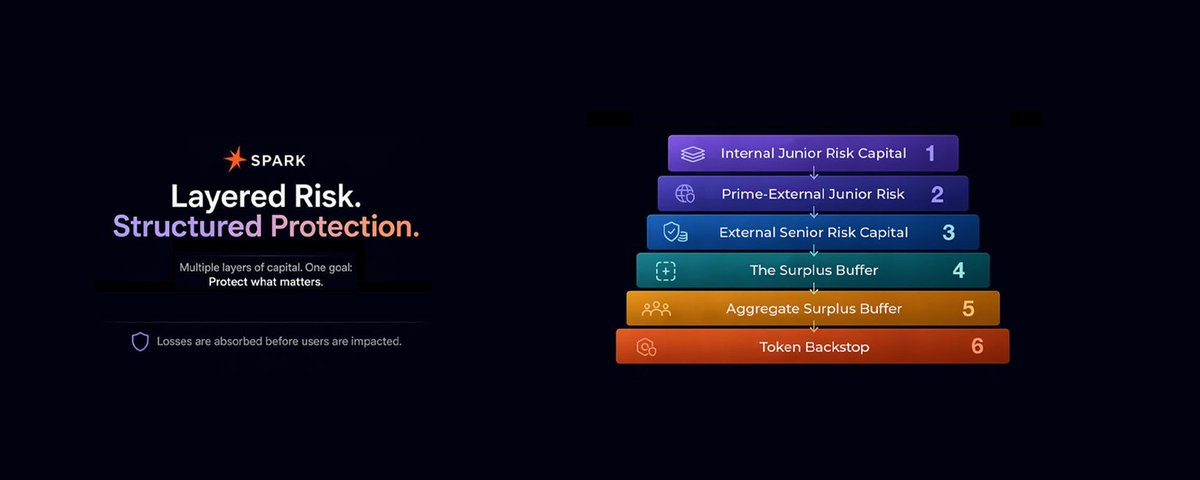
Most discussions around recent events are missing the point.
This isn’t about one protocol or one exploit.
It’s about how risk is structured in on-chain credit markets.
In many systems, collateral is treated as if it’s self-contained. But in reality, it often depends on:
– external issuers
– bridges
– underlying assumptions that sit outside the protocol
When those assumptions break, the impact doesn’t stay isolated. It flows through to wherever that collateral is used.
Collateral isn’t just an asset. It’s a dependency stack. As markets scale, this becomes harder to manage.
And more important to design for upfront