

LiveDiva retweeted

grok bot is stupidly cracked at designing hardware.....
i turned mine into a hardware lab. it’s now working on an ESP32 board with:
> ESP32-WROOM-32 and GPIO breakout headers
> USB-C power/data, a USB-UART bridge, and auto-reset
> AMS1117 3.3V power, EN/BOOT buttons, and LEDs
here’s the exact team, in build order:
1. Archie: architecture + antenna
x.ai/bot/To_CQRg_q2PYHBjemNM…
2. Volt: power
x.ai/bot/wvrapeX6Qpeg8Pa3-QR…
3. Pinout: connectors + programming
x.ai/bot/jy4bAXa_Jv5vWAlUVAm…
4. Ohm: passives + electrical rules checks
x.ai/bot/NbT2NbpQCV1uyvh1oad…
5. Trace: routing + design rules checks
x.ai/bot/Z43ZFpOw4aGO_UqeVPe…
6. Gerber: fabrication files + order draft
x.ai/bot/JrPTyHpK_E_BSptXWmm…
7. Parts Buyer: sourcing + cart
x.ai/bot/5J8Ruh6O3pHCbUUv7WE…
steal this.


LiveDiva retweeted
every “world model” that’s secretly a video model must be sweating...
one model can now create the character, animate it, and build the world around it, in actual 3D.
Viggle’s JST-2 is a full-stack, physics-native world foundation model.
it works with 3D atoms, each with a position, physical attributes and dynamics, so the scene can be more than a stream of pixels.
→ one image: a 3D character with motion built in
→ text or video: motion
→ a photo: a 3D scene you can keep expanding
characters, movement, and worlds from one model.
don’t just make the shot. make the world behind it.
watch JST-2 bring one to life ↓
🤝 Paid partnership

Today we are releasing JST-2, the world's first full-stack physics-native world foundation model.
Many world models learn in pixel/video space. We went back to first principles and built the entire model stack in 3D.
Generate a 3D scene in seconds and expand it in real time. Create characters with motion built in, all through one general architecture.
LiveDiva retweeted
grok bot just took over my printer...
1 prompt + 5 min = no more ink nags, no "printer offline", print and scan from anywhere in my house
here's the full guide step by step:
step 1 → put your computer and printer on the same wi-fi
step 2 → paste the prompt below into grok bot with a photo of your printer's label
step 3 → it finds the printer's hidden admin page on your network. you just open it once
step 4 → say yes to the cleanup: auto firmware updates off, ink upsells off, sleep fixed. all reversible
step 5 → it sets up driverless printing so every laptop and phone at home just works
step 6 → scan to a folder on your computer, no cloud account needed
the result: the printer you already own finally works like it should...
p.s: mine is from 2024
try it tonight. you're welcome
LiveDiva retweeted
everyone's predicting the next token...skyfall dreams the whole object first
SKY-001 is what they're calling the first engineering world model. on CAD and BIM tasks vs GPT-6 Astra and every frontier model they tested:
> 51-125x faster
> 150-210x cheaper
> higher IOU
it simulates the thing before anything gets built. that's how an engineer actually thinks.
18 months of work from the team out of Maluuba's deep learning lab (acquired by Microsoft)
design today. autonomous manufacturing is the bet.
@skyfallai @spisallyouneed
🤝 Paid partnership


Introducing SKY-001, the first Engineering World Model.
On CAD and BIM tasks, it beats GPT-6 Astra and every frontier model we tested:
-> 51-125x faster
- > 150-210x cheaper
-> Higher IOU than all frontier models
SKY-001 lets you dream a physical object before you build it.
18 months of work. Built by the team out of Maluuba's deep learning lab (acq. by @MSRResearch).
The first ‘AI General Engineer’ will be the backbone for Autonomous Manufacturing.
LiveDiva retweeted
if i had to make my first dollar online, i'd start with grok bot and this article...

LiveDiva retweeted
haggle bot is the most insanely powerful grok bot spacexai has ever shipped...
in its first week it found $100k+ in wasted spend
i'm turning that idea into an entire department: the Department of Grok Efficiency
here's how to build it, step by step:

LiveDiva retweeted

if you are young and ambitious. I'm begging you to read this.
grok Bot is literally a 24/7 team of agents who will help
you build and launch your first business with a matter of prompts.

LiveDiva retweeted
paste this prompt to grok bot tonight and it will help you make your first dollar online and quit your 9-to-5.


LiveDiva retweeted
how to build and launch your first product using grok bot + grok voice (step-by-step)
these exact 12 steps took serein.pro, an agentic harness for the browser, from idea to public launch in 2 days
[here is exactly what we did]
1. research ideas with scout bots on github, reddit and product hunt
2. kill ideas with a bot whose only job is to say kill or build
3. prompt with your voice
4. research before you build
5. build with cursor, cloud agents and claude
6. run ads and checkout through whop
7. host and buy your domain on vercel
8. give your bot its own email inbox
9. search x for trending hooks and distribution
10. run your crm in notion
11. read site analytics through vercel inside grok bot
12. put a chief of staff on top so nothing ships without your YES

we are looking for group of early testers for serein.pro
(for both mac and windows)
drop a comment and let me know

LiveDiva retweeted
i kept complaining to my grok bot about my browser... so it went off and built me one.
@ziwenxu_ and i took it from there. now Serein is live.
an AGENTIC HARNESS for your browser
>chat with claude code or codex right inside it
>let them control your tabs and do the work
>use the tools already on your mac
i>t's free. your browser is their workspace now.
links in the comments check it out👇
LiveDiva retweeted
serein.pro is live. 300+ downloads from ONE launch video...
and we didn't edit it. the whole video was made with the sagecut skill from @levantolabs.
serein is an agentic harness for your browser
we built the product. sage built the launch. here's the video 👇

Read this if you make videos with Claude.
I built a skill that cut my QA cost on this video from $127 to 16 cents. It was made with Claude in Remotion.
It's called SageCut. It swaps the LLM out of frame-by-frame QA and uses a multimodal decision model, Sage (@levantolabs), instead.
I'm the only video guy at Levanto. I run 3 Claude plans and have been making Remotion videos since early this year, with BlenderMCP in the mix, so the output is pro-grade with very little babysitting.
The problem: it burned through my Max plan, and a video could take 2 days.
When I dug into the workflow, the reason was that Claude subagents were reviewing every single frame. That cost a ton and added 4+ hours per video.
SageCut hands that step to Sage. Sage is great at spotting defective frames, and only those get passed to Opus 5.5 to fix.
Across 6 A/B tests the output was exactly the same, at 1/10 the QA cost and 1/4 the QA time. On this video, Sage read all 3,153 frames for 16 cents.
If you make Remotion videos, try it.
The link to skill is below.
How long does a Remotion video take you right now with Claude?
LiveDiva retweeted
grok bot pretty much replaced dots and muse for running my business...
here is why : insanely simple to set up, a MASSIVE plugin library, generous usage.
here's everything i use and what it costs:
required ($165/mo + whop's cut per sale)
> money → whop plugin
> site → vercel + github plugins
> inbox → gmail + inbox bot (drafts, never sends)
> crm → notion inboxes built with grok bot
> content → x plugin + draft-only writer bots
> video → opus 5.5 + cursor cloud agents
> numbers → notion
> oversight → chief of staff morning report + DOGE audits every bot
optional, add when you need it
> support → intercom or plain + a support inbox bot
> ads → whop ads
> email → klaviyo and grok bot routines
> books → notion
> leads → treg, hunter + scout bots
> code → builder + reviewer bots + pstack
> design → claude opus 5.5 + cursor cloud
> scheduling → routines on grok bot with content calendar built by grok bot


LiveDiva retweeted
i'm seriously considering switching full-time over to grok bot.
it's the closest thing i've found to hiring a real jarvis. i basically run a one-person company now.
62 agents. 29 scheduled routines. they write my morning newsletter, pull my market news and audit their own team for duplicate work.
[here is every grok bot that i run ]
@bot

LiveDiva retweeted
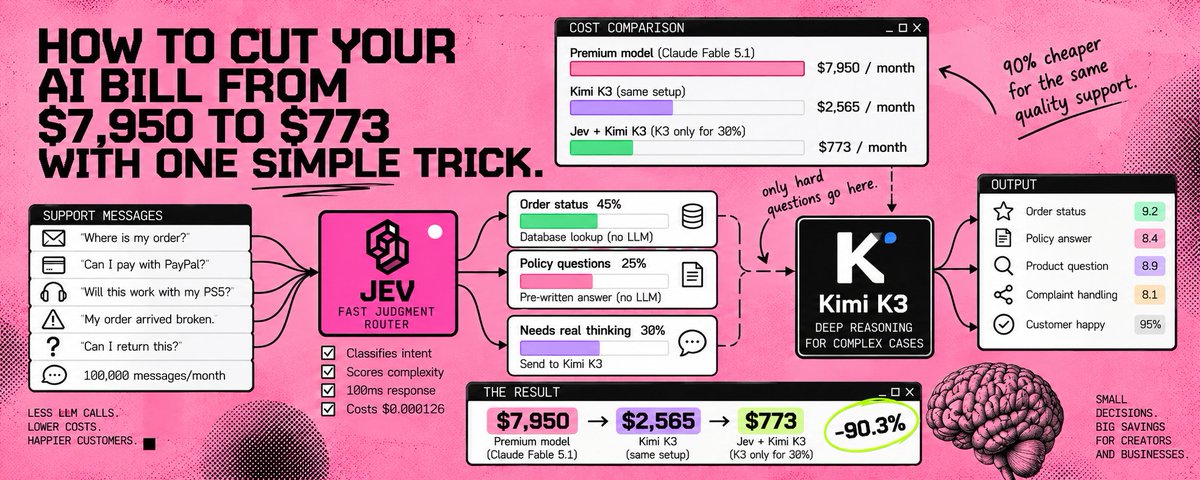
they beat jev twice in 15 days...
first drex 1.5. now drex 2.0.
jev barely had time to recover.
try it here : nace.ai/developers
🤝 Paid partnership

Introducing Drex 2.0 - our Fastest and Smartest Decision Model!
3B active parameters, super fast inference.
Try Drex 2.0: nace.ai/developers
• Up to 38% faster on 32K–128K inputs vs. Drex 1.5
• $0.06 per 1M input tokens
• Runs on @sgl_project
• $25 Sign Up Bonus
Day 0 support from @FireworksAI_HQ’s FireAttention
dedicated deployment.

LiveDiva retweeted

Introducing SubQ Snap, the first long-context decision model for real enterprise work.
Snap is the only decision model or LLM where compute per token stays constant as context grows.
• 384K tokens of multimodal context, 12x larger than Jev.
• 61.7 on Decision Index v0.2.1 vs Jev’s 57.9, outperforming on 13 of 16 enterprise benchmarks.
•Processes 100K tokens and returns a decision in under one second.
•$0.05/MM input tokens. Output is free.
Available today to anyone.
The first 10,000 sign-ups get 100M free input tokens.
We’ll likely hit capacity fast and will add users as we add compute. Compute offers welcome 🙂.
Latency will be variable as we tune the platform to this new model and category of users.
Model speeds are 80ms for minimal context, 250ms for 32k, 660ms for 100k, and 2.5 seconds for 384k.
Visit: subq.ai/
LiveDiva retweeted
my grok bot made its own DOGE
department of grok efficiency.
it audits every bot i run and finds the waste...
it checks every 6 hours, only pings me when it finds a fix, and changes nothing without my yes.
here's the exact routine i use + the grok bot link 👇
doge bot : x.ai/bot/25EViy4_34d-TBTff_L…


LiveDiva retweeted
claude projects just dropped.....
and it is hands-down the best way to work with Claude right now...
so i pointed it at my last 100 sessions and it found the work i keep repeating.
one prompt does three things, using your last 100 sessions:
→ finds work worth turning into a project
→ catches instructions and corrections you keep repeating
→ lists the tools that work actually needs
→ plans threads and routines to move it forward
run this with opus 5.5 in a local claude code session:
"read
[code.claude.com/docs/claude-…](code.claude.com/docs/en/clau…)
help me prepare a Claude Project from my 100 most recent available sessions under ~/.claude/projects/.
group sessions by project and report how many you could read. use only my original messages as evidence of preferences. exclude tool results, generated summaries and quoted material. inspect commits where useful as evidence of work.
build one setup:
set up from recent work
identify recurring work or a goal spanning several sessions. choose the strongest project candidate and explain why.
write its name, goal and paste-ready project instructions. separate repo-specific guidance for CLAUDE.md. turn repeated corrections into 'Remember: …' messages.
support recommendations with exact quotes and session references. count distinct sessions, flag conflicting instructions and label inferences.
use my tools
identify the repos, files, skills and connectors this project needs. distinguish local tools from those available to cloud threads. list missing access and setup steps without exposing credentials.
make a plan
write one small first task with a clear completion check.
→ threads: define deliverables, dependencies and verification. parallelize independent work only.
→ routines: propose recurring tasks with prompts, schedules and review criteria.
→ library: list reference files to upload and outputs threads should deliver.
recommend thread model and effort settings. explain what to check about usage and auto-continue.
finish with a setup checklist and the first message to paste into the project. don't edit files, connect tools or schedule anything yet."
review the setup. run the first task. add routines once the results are useful.
thank me later
LiveDiva retweeted
these 40 lines in claude code cut the price of my opus 5.5 workflow by 20%...
----------------------------
Merge this into ~/.claude/settings.json without touching my existing hooks, permissions, or plugins. Then create the two agent files exactly as written. Show me the resulting diff.
```json
{
"model": "opusplan",
"advisorModel": "opus",
"effortLevel": "medium",
"modelSettings": {
"claude-opus-5-5": {
"effortLevel": "high",
"autoCompactWindow": 200000
},
"claude-sonnet-5-5": {
"effortLevel": "medium",
"autoCompactWindow": 200000
},
"claude-fable-5-1": {
"effortLevel": "high",
"autoCompactWindow": 200000
}
},
"autoCompactEnabled": true,
"env": {
"CLAUDE_CODE_SUBAGENT_MODEL": "haiku",
"CLAUDE_AUTOCOMPACT_PCT_OVERRIDE": "70"
}
}
```
File 1: ~/.claude/agents/explore.md
```
---
name: explore
description: read-only code locator, returns file:line, never suggests fixes
model: haiku
tools: Read, Grep, Glob
---
find what was asked. return paths and line numbers. no fixes, no opinions.
```
File 2: ~/.claude/agents/judge.md
```
---
name: judge
description: adversarial reviewer for a diff or plan, invoked before declaring a task complete
model: opus
tools: Read, Grep, Bash
---
assume the work is wrong. find the failure case. one line per finding, severity first.
```
Then restart Claude Code. Verify with:
/model → shows opusplan
/advisor → shows opus
/agents → lists explore and judge
Daily use:
- Normal work: nothing. Sonnet types, Opus plans and advises, haiku explores.
- Before merging anything: use the judge agent on this diff
- Hard problem: /model fable, back to /model opusplan after.
- Between unrelated tasks: /clear.
Agent files go in ~/.claude/agents/ so they follow you across projects. Put them in .claude/agents/ inside a repo instead if you want them per-project.
----------------------------------------
