

Linen X Mito🇰🇷 | Dual mind of arbitrage and trading | bitmex no.17 pnl (1311 btc)
south korea
Joined October 2025
- Tweets4.6K
- Following203
- Followers6.3K
- Likes9K






Pinned Tweet
Update: We are now ranked No1 on the overall @variational_io Points Leaderboard with 44K+ points, $1.2B+ volume.
Our Current Stats
🥇 No1 on Variational points system ~ 44K+ points
🥉 No3 on total volume ~ $1.2B+ traded
- Maintaining a running position -$2.44M (Almost risk-neutral on $BTC and other Alts)
- Top trader on @Aster_DEX ~ six-figure $ASTER airdrop
- Top trader on @HyperliquidX ~ holding solid $HYPE bags
- #17 on BitMEX notional leaderboard ~ +1,300 BTC PnL
- Top trader on Binance
And we’re just getting started.
The secret is:
1. Trade Alts like $ETH, $ZEC, $LIT, etc.
2. Leverage on Referrals as well
3. Focus more on OI (Hold positions longer)
I’ll be sharing more highlights, Variational insights, and perp trading alpha, stay tuned.
Remember to Join The LinenMito Team on Variational, with the code: OMNIDAE


Being Optimistically Retarded Changed our life also
We did it with $HYPE, over 250K tokens then on main wallet
Now we will do same with @variational_io, over 93K points on main account ~ Mito
Gm Gm CB


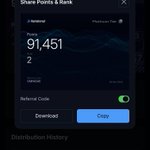
With over $5B in cumulative volume on @variational_io, here are 15 images of our points journey so far
Enjoy, and
gVAR


The New Perps Meta Could Be a Trap.
Every successful Perp DEX TGE seems to trigger a new wave of projects trying to replicate the same success. Look at what happened after $HYPE and $LIT.
A fresh batch of Perp DEXs emerged, many introducing points programmes, trading incentives and the prospect of future token airdrops but not every project delivered.
Some underdelivered on their rewards expectations, while others eventually shut down without distributing the anticipated tokens.
And we could see this cycle repeat after @variational_io $VAR TGE. Many Perps could spring up, promise many rewards only to under-deliver or even farm users and end up shutting down.
The success of one protocol doesn't guarantee the success of the next ten trying to copy its model.
A few things you should remember:
- Points are not guaranteed tokens.
- High trading incentives promises don't guarantee TGE/Airdrop
- A promising roadmap doesn't guarantee a successful TGE.
- Being early doesn't automatically mean being rewarded.
Don't feel obligated to farm every new Perp DEX that launches, be selective. Evaluate the product, team, business model and sustainability beyond the points dashboard.
The next big Perp DEX opportunity could be worth farming, but the next points programme could also be a costly distraction.
Not every shiny new protocol deserves your capital, liquidity or attention.

linenmito retweeted

没有什么「 镣铐 」 是一亿美金解决不了的。
从普通交易员视角看,最近 @variational_io 的产品体验其实优化了很多。
之前像 $SPY $QQQ 这大标的,但凡我超一个方向稍微开点仓位,整个平台就会处在 OI skew limit 中。如果我和其他大户不平,散户就开不了仓。
以至于当时我还需要自己做个监控网站,实时查看平台一共有多少额度可以供我开。
例如我想开 5m 的多单,但平台只有 1m 的做多额度,怕麻烦的我就会觉得为了这 1m 仓位,还要多管理一个平台太麻烦,容易猪脑过载,遂放弃在 var 上做这笔交易,带来的结果就是 OLP 赚不到钱,我也赚不到积分。
现在好了,融资一到位,OLP 的流动性提供能力暴涨,今晚我一共开了 15m 的 $QQQ 多单,3m 在 @binance ,12m 分 6 个号在 var 上开,全程丝滑无比。
为什么是 3m 和 2m 一个号?
因为这个仓位价值刚好卡 10X 杠杆的线。
再看执行成本这块儿:
1. 币安我的 V6 账户,用 BNB 结算手续费,taker fee 是 1.08 bp。
2. var 这边,1.9 bp 的 half spread,可以认为是 1.9 bp 的手续费,算上最高等级的 7.5% 点差返佣,大概是 1.76bp。
这个手续费刚好和币安卡 v2 账户,拿 40% 返佣的 taker 成本一致。
对于月交易量不大的小散户和无缘使用币安的交易员来说,这个执行成本就可以借助 OLP 体验到宇宙所的流动性,还是可以接受的。
虽然比币安 v6 要贵一些,但是给积分,以及我很欣赏创始人 @variational_lvs ,肥水不流外人田,哥们儿的手续费给谁赚不是赚?那不如让自己的朋友赚。
总体来说,var 在 crypto native asset 这块,大币种流动性很早就没问题了,rwa perps 的核心标的也终于不再是带着镣铐跳舞了。
这两大市场说实话,风控和安全搞扎实,产品体验做到 80 分,把 low-hanging fruit 摘完就好了,没必要花太多资源去卷细节,真没性价比。
要出奇迹,还是得把 SWAP 搞起来,尽快上美股个股,尽快开 7*24,这才是颜色不一样的烟火。


目前 @variational_io 占 RWA 全网交易量的 2%,这个数据是带着镣铐跳舞的结果,分享几点对产品的观察和思考:
1. 名义杠杆率低。
拿 $XAU $CL 这种热门大宗举例,25wu 的仓位,名义杠杆率就降到 10X 了;用 5X 杠杆,最多只能开 75wu 的仓位,和其他所相比,劣势过大,真实交易员的开仓能力是被压制的。
2. 出于 OLP 风控,skew limit 频繁。
过去两个月大家一定都经历过 $SPY $QQQ 这俩指数不能朝特定方向开仓的情况。
这是因为 OLP 限制了平台多空单的失衡金额。
为此,我甚至还做了个实时监控,来计算平台还有多少的单边额度可以开。
当要建立头寸时,我会先把 var 的额度用完,然后继续在其他交易开完剩下的。( 毕竟这有积分收益)
所以有时候,你发现不能开了,大概率是因为我开的太多了,等哥们儿开始平仓了,你就能开了。
以上两个例子,说明仅仅是我一个小卡拉米能产生的真实交易量,OI,都因为平台还处在 RWA 测试阶段,没能得到充分释放。对流动性的需求,暂时没有得到完全的满足。
那算上其他的大户,真正的鲸鱼呢?
所以待到 swap 功能上线,封印被解除,杠杆率可以看齐其他所,OI cap 被打开,平台的数据大概率会提升不少。
3. 积分激励阶段,如何评估 farmer 带来的数据泡沫?
现在所谓的 trader 和 farmer 的界限在不断模糊的。
在一个所有链上赌场都在拿 token 预期抢市场的时代红利期,就算我搞小农经济,专注套利交易,无比追求每笔交易中的绝对现金收益,哥们儿也不会傻到不去评估把交易量给哪个所,潜在收益会更大。
你觉得猿是 trader 还是 farmer?
再比如有些散户,本来可能就想 farm 两下,打一炮就走,最后架不住自己脑子聪明,撸着撸着,搞明白了价差,理解了资费,意识到了指数的力量,发现干这活儿能长期赚钱,逐步进化成了 trader。
最牛逼的 trader,就是最牛逼的 farmer。
尽管如此,还是有些小技巧可以评估一个项目是否被过度 farm ,虚假繁荣的程度。
还是拿 @variational_io 举例,它的 RWA 市场,交易量分布够广,每个票都有人在玩,这是非常好的信号。
但 $XAUT $PAXG 这俩资产的 OI 过大,说明还是有不少人,在分号持仓跟 $XAU 对冲。
这显然不是正常做套利的人,愿意冒风险开的仓位,因为根本没有赔率。
之前多次提醒过, $XAUT 和 $PAXG 的高倍合约,是可以让人灰飞烟灭的东西。
4. 即将上线的 SWAP 功能,才是平台真正的拳头产品。
目前 var 基于 @binance 流动性做的一期 RWA 合约市场,在商业上,算是个非常讨巧,四两拨千斤的产品,而且是极好的现金流生意。
OLP 用类似 「 众筹 」的模式,通过对冲散户的订单流,养起了一个高 VIP 等级的 bn 号。
再把自己的交易优势,反哺回社区,给到了普通交易员更低的手续费成本,和无许可的便捷,让很多不能 KYC bn 的交易员,也体验到了宇宙所的极致流动性。
这个视角下,币安在 RWA 赛道 25% 的交易量占比,是有 var 的一份功劳。
var 是 binance 流动性的链上 broker。
而接下来,我们会看到非常多的新台子雨后春笋般地冒出,讲 RFQ ,吹 tradfi liquidity on chain 的故事。
这些对 var 都是好事儿。
从 orderbook 到 RFQ,从 crypto-native liquidity 到 TradFi dealer liquidity,这个市场教育不可能只靠一个项目完成。
需要一堆拿了 VC 钱的项目一起烧,一起喊,一起铺概念,最后完成「 高效价格发现 」和「 最佳执行成本下的流动性获取 」两种产品理念的二分天下。
但我们要看到本质, RFQ 本身不是护城河,谁在 RFQ 背后给你报价才是护城河。
任何交易所都可以做一个 RFQ 界面,让 mm 按需报价。
但能不能拿到真正顶级 TradFi dealer 的双边流动性,能不能和他们签对手方协议,能不能在大 size 下稳定对冲,能不能把这层流动性转译成更低的 execution cost,这才是核心。
var 的差异不在于 「 它有 RFQ 」。
var 的差异在于:OLP 自己就是链上用户和 TradFi dealer 之间的 counterparty layer。
说白了,var 不是开了个 RFQ 群聊,让一堆 mm 看到你要买什么,买多少后各自喊价。
而是 OLP 先站出来当你的交易对手,能内部消化的先内部消化,消化不了的净敞口,再丢给最头部的 TradFi dealer 去对冲。
所以同样都叫 “TradFi liquidity”,含金量完全不是一回事。
大部分场子充其量解决的是“让长尾市场有人愿意报个价”。
var 解决的是“把机构级 dealer liquidity 变成链上可调用的执行能力”。
以终为始来看现在的竞争,RFQ 压根儿就不是做价格发现的产品形态,而是做极限优化 exectution cost 的产品。
而只有 var 这套,用 OLP 干脏活苦活累活,才有机会真正优化掉执行成本,给到交易员极致的交易深度和可预期的持仓成本。
更详细的解读,可以看之前的帖子:xitter.cf/Metabape/status/207421…
5. 广告时间。
写这么多,主要是因为还有 2W 个邀请码滞销。
猿哥知识付费链接:
omni.variational.io/?ref=OMN…
邀请码:
OMNIMETABAPE
白银开局,额外再加 15% 积分加成。
赏脸走码的 bro 可加 tele 群,每月领 100% 点差佣金返还。
The entire market continues to slide: $BTC, $ETH, $HYPE, altcoins, equities, and beyond.
Here's what we've been doing amid the volatility:
- We just pushed our total Variational points to 92,900, with cumulative trading volume now approaching $5B.
PS:
A quick update on positioning:
We don't know how much further the market could fall, but our portfolio is now leaning meaningfully long.
That said, our net directional exposure remains below 1x portfolio equity.
Staying measured while positioning for the next opportunity.
Not financial advice.

And one of the questions we get asked often is this; after @variational_io what next?
After $VAR, then Variational Pro
We still use lighter even after $LIT
We still use HyperLiquid even after $HYPE
And we will continue to use Variational
Join Variational now: omni.variational.io/?ref=OMN…


Congrats VARiors
Congrats Variational


Huge congratulations to the @variational_io team on this milestone.
We’re happy to share this moment with all the Varriors who have been part of the journey.
What excites us most is the push toward 24/7 swap trading, backed by a stronger capital base and an expanding network of OLP liquidity partners.
Variational’s docs already link swap cross-margin to 24/7 trading.
We see this as a step closer to the ultimate goal: a single cross-margined account spanning swaps and crypto perps.
Executing large taker trades in $BTC and $ETH through the recent volatility has reaffirmed that Variational is the best platform for us.
If cross-margin across the entire portfolio brings greater capital efficiency, we’ll have even less reason to trade elsewhere.
Looking forward to continuing this journey with the team and fellow Varriors.
The Hidden Cost of Points Farming: Will You Even Make Money In The End or You Are Being Farmed?
We've accumulated 91K+ points on @variational_io, generated approximately $5B in trading volume, and made over $2M in cumulative PnL.
And so far, we've spent considerable time navigating the perp DEX points meta; $HYPE, $LIT, $ASTER, $BP, etc. and if there's one thing we've learned, it's that accumulating points is only one part of the equation.
The real question is
How much it costs you to earn them?
What your eventual allocation could be worth?
and
Whether the entire activity makes economic sense.
Most traders calculate the potential value of their points just before an airdrop, but it is not enough.
Very few calculate the actual cost of accumulating those points, how dilution affects their eventual allocation, or whether they've unknowingly turned what looked like an attractive farming opportunity into a negative expected value game.
This is one of the biggest mistakes point farmers make in the current perp DEX farming meta.
Everyone is looking at points accumulated, leaderboard positions, potential token allocations and speculative FDVs.
But there's a much more important calculation that often gets ignored:
How much did it cost you to earn those points, and will your eventual reward justify that cost?
Let's look at it carefully
1. Early farming is often cheaper.
Here's why.
One of the biggest advantages of getting into a points campaign early is that you're competing in a much smaller pool of participants.
Think about how these campaigns typically evolve.
A protocol launches its points program. Initially, only a relatively small group of users knows about it.
Trading activity is still developing, competition for leaderboard positions is limited, and the points-to-user ratio may be more favorable.
Then attention picks up.
More traders discover the opportunity. Influencers start discussing potential allocations. Farming guides circulate. Referral programs bring in more users, and the leaderboard becomes increasingly competitive.
The same activity that might have secured a meaningful position early on may no longer produce the same relative standing later.
This is dilution.
And it doesn't necessarily mean the protocol is reducing the number of points being distributed.
It can happen simply because more participants are competing for the eventual allocation.
Consider a hypothetical campaign distributing 100 million tokens to users based on their relative points.
- Early stage: 1K participants are competing.
- Growth stage: 10K participants are competing.
- Saturation stage: 50K participants are competing.
If your relative share of the total points declines, your eventual share of the user allocation can decline too, even if your personal points balance continues increasing.
The important distinction is that accumulating more points doesn't automatically mean your expected allocation is increasing at the same rate.
The earlier you identify a promising opportunity, the more time you may have to accumulate points before competition intensifies.
Of course, early entry also comes with uncertainty. A project may change its rules, delay its launch or fail to deliver the expected opportunity. Being early is an advantage only when the underlying opportunity is worth pursuing.
2. Zero trading fees do not mean zero farming costs
This is where many traders get their calculations wrong.
They see a perp DEX advertising zero trading fees and assume they can generate volume at almost no cost.
But trading fees are only one component of execution costs.
There are several other costs that can quietly eat into your expected airdrop profits.
Let's look at them.
- Maker and taker fees
These are the explicit charges associated with executing trades.
Even small fees become significant when repeated across millions of dollars in notional volume.
- Spread
The spread is the difference between the bid and ask prices.
If $BTC is quoted at $100,000 bid and $100,010 ask, the spread is $10.
When you buy at the ask and immediately sell at the bid, you've already incurred a cost, even if the exchange charges zero explicit trading fees.
- Slippage
Slippage occurs when your actual execution price differs from the price you expected.
This can happen because of insufficient liquidity, volatility or the size of your order relative to available market depth.
A trade that looks cheap under normal market conditions may become considerably more expensive when liquidity deteriorates.
- Funding payments
Perpetual futures use funding mechanisms to help keep contract prices aligned with their underlying markets.
Depending on your position, market conditions and holding period, you may pay or receive funding.
If you're holding positions simply to maintain exposure for a farming campaign, funding can become a recurring expense.
- Market impact
This is particularly relevant when trading meaningful size.
Your own orders can move the market against you, especially when available liquidity is limited.
The larger your order relative to market depth, the more important this becomes.
These costs are not always obvious when looking at a trading dashboard.
But they matter when calculating the actual economics of farming.
3. Dilution can make farming increasingly expensive
There's another dynamic worth understanding.
As a campaign becomes popular, the competition doesn't just increase. The cost of maintaining a meaningful position can increase too.
Think about a trader who enters a campaign early and accumulates points while competition is relatively low.
Later, thousands of additional traders join.
If the campaign rewards users according to relative activity, the early trader may need to increase their activity just to maintain their position.
This creates a competitive feedback loop:
- More users discover the opportunity.
- Competition for points and leaderboard positions increases.
- More activity may be required to maintain relative standing.
- Trading costs and capital requirements can increase.
- The expected reward per unit of additional activity may decline.
This is especially important for campaigns where users are competing for a limited allocation.
You could end up spending considerably more to maintain a position that would have been cheaper to establish earlier.
However, not every points program works this way. Some use fixed point emissions, tiered rewards or other distribution formulas. Before assuming dilution, understand the actual reward mechanism.
The key is to identify how the campaign distributes value and what happens as participation grows.
4. There's also an opportunity cost nobody talks about
Suppose you have $50,000 in capital.
You could use it to trade on a perp DEX points campaign, participate in another ecosystem, or keep it available for other trading opportunities.
Even if your explicit farming costs are relatively low, your capital is still being committed to a particular strategy.
That capital may be exposed to market risk, funding costs, liquidation risk or restrictions on withdrawal.
There is also the time involved in monitoring positions, managing execution and keeping up with changing campaign rules.
And perhaps the biggest opportunity cost is missing a better opportunity elsewhere.
This doesn't mean points farming is inherently bad.
It means the true cost of participation is bigger than the fees shown on your trading history.
A trader who spends $500 to generate a speculative $2,000 allocation has not necessarily made $1,500 in profit if they also took substantial market risk or sacrificed other opportunities.
Your capital has a cost, even when the exchange charges you nothing.
Bonus
5. How we would approach a new perp DEX farming campaign
Before committing meaningful capital or generating significant volume, we would want answers to a few questions.
First: Understand the distribution.
Is the allocation fixed? Is it proportional to points? Are there tiers, multipliers, referral components or other conditions?
Without understanding how points translate into potential rewards, you're essentially farming without knowing what you're competing for.
Second: Evaluate the product.
Does the exchange offer competitive execution? Is liquidity sufficient? Are the markets useful? Would you consider trading there even without the points?
A good product like @HyperliquidX and @variational_io can make participation more attractive beyond the speculative reward.
Third: Calculate your all-in costs.
Don't stop at maker and taker fees.
Account for spread, slippage, funding, market impact and any other relevant expenses.
Fourth: Monitor dilution and competition.
Track how quickly participation is growing relative to your own points accumulation.
If your activity is increasing but your relative position is deteriorating, that's worth investigating.
Fifth: Build conservative valuation scenarios.
Don't anchor your expected airdrop value to the most bullish valuation circulating on X.
Use multiple scenarios and account for token supply, user allocation, circulating supply, unlocks and potential selling pressure.
Finally: Establish a stopping point.
Know when the marginal cost of earning additional points no longer justifies the potential marginal reward.
This is probably the most important discipline of all.
You don't have to keep farming simply because you've already invested time and capital into a campaign.
Past costs are sunk costs. Your next decision should be based on whether additional participation still makes economic sense.
The takeaway: Don't become exit liquidity for the points meta
Points farming can be an incredibly attractive opportunity.
We've seen early participants benefit substantially from identifying promising protocols before they became saturated.
But the market is becoming more competitive.
More protocols are launching campaigns, more farmers are entering, and more capital is chasing the same speculative rewards.
The days of blindly generating volume on every new perp DEX and expecting a meaningful airdrop may become increasingly difficult.
The traders who approach this systematically will have an advantage.
They'll understand the distribution before farming, calculate the cost of participation, evaluate the underlying product and adjust their strategy as competition increases.
They'll also understand that a large points balance is not the same as a profitable position.
Our approach is simple:
Don't just ask how many points you're earning. Ask how much you're paying for them, what share of the eventual rewards you could realistically receive, and whether the numbers still make sense.
Because at the end of the day, the goal isn't to become the biggest farmer on the leaderboard.
It's to make sure the farming was worth it.

Day 2 of @variational_io Trading Competition
We managed to stay top position with the legend @SystemicStratHL closely following
The market has been horrible with $BTC going sub 64K, $ETH down 1.7K and $HYPE 63
Regardless, we keep clicking
gVAR

Update on our last week's @variational_io points.
Variational’s total OI has declined by around 12% over the past two weeks.
Based on this week’s distribution, the estimated weekly reward rate is around 20 points per $1M OI.
At a conservative $1.5B TGE FDV, each point would be worth ~$42.
At 20x gross OI, this translates to:
- Weekly rewards per $1M OI: ~$840
- Required capital: $50,000
- Estimated APR: ~87.4%
Volume incentives and funding returns are excluded.
The recent decline in OI suggests less competition, while points efficiency remains attractive.
These are estimates, and actual APR will depend on TGE valuation and future OI changes.
P.S.
Despite the recent volatile price action,
our experience continues to reinforce the view that @variational_io offers the lowest taker execution costs for large $BTC and $ETH trades.

Crypto Investments That Turned $5,000 into $100,000+ 👇👇
Bitcoin ($BTC) ~ 10 years ago
Ethereum ($ETH) ~ 8 years ago
Solana ($SOL) ~ 6yrs ago
Hyperliquid ($HYPE) ~ 2 years ago
Crypto investments that could turn $5K to $100K ______ ?
🤔🤔🤔
Pay attention closely, if it happened before, it could happen again
If you are a good trader, use @variational_io
If you are a bad trader, use @variational_io
gVAR


A lot of questions lately about what comes after Variational.
We’ve tried plenty of new venues, but the largest allocations remain @variational_io and Robinhood Lighter (RH-Lighter).
Lighter core and Hyperliquid(trade. xyz) also make up meaningful parts of the portfolio, with smaller amounts on @risextrade, @arcus_xyz, and a few other perp DEXs for funding opportunities.
The main strategies remain centered on Variational, RH-Lighter, and @Lighter_xyz core, with decent estimated APR even excluding volume incentives.
The image is a compact view of our funding desk, showing the estimated APR of the portfolio currently deployed.
Point valuations and OI reward rates are based on the estimated points metrics shared on LinenMito’s X account.
The model assumes a $2.5B FDV for Variational with estimated APR around 63%. (A more conservative $1.5B assumption puts estimated portfolio APR at around 45%.)
Most of the estimated APR currently comes from OI rewards.
In our experience, funding tends to contribute a larger share of returns during bull markets.
FOMO drives demand for longs, sometimes pushing perp DEX funding to irrational levels.
At the same time, points programs tend to become more crowded, reducing the efficiency of points farming.
These conditions provide a practical reason to reduce net long exposure while still earning attractive funding APR.
Reducing long exposure in those periods has generally worked well.
The full funding desk includes more detail to handle the portfolio’s complexity, including liquidation risk management and better execution options.
A similar setup, tailored to individual needs, can help with both risk management and improving returns.
Good luck to everyone.

How to Identify Potential Winners Airdrop From the Rest of the Perp DEX Market?
Here are some of our airdrop winnings from Perp-Dexs:
$HYPE~ $20M+ From main wallet + 6Figs
$LIT ~ 6Figs
$ASTER ~ 6Figs
$BP ~ Top 5Figs
$EDGE ~ 5Figs
etc.
The next big perpDEX MIGHT not be the one with the most points, the loudest community, or the biggest trading volume today.
And if you're farming every new perp DEX that launches, there's a chance you're optimizing for the wrong thing.
We've seen this cycle before.
A new protocol launches, points go live, trading competitions begin, the leaderboard fills up, volume starts climbing, and suddenly everyone is trying to figure out which platform could produce the next $HYPE.
But here's the problem.
By the time a protocol becomes the obvious winner, the opportunity to position yourself early may already have passed.
Now the real edge is identifying which protocols have the potential to become winners BEFORE the market agrees.
And to do that, we need to look beyond the numbers everyone is posting and start looking at these👇:
1. Volume is a signal, But what kind of volume?
Volume is one of the first metrics traders look at when evaluating a perp DEX.
High volume can indicate demand, activity and growing relevance. But volume without context can be misleading.
Is the activity driven by organic traders or incentives? Is the same capital being recycled repeatedly? Are users returning because the product is good, or because the points are attractive?
None of these questions can be answered by a volume leaderboard alone.
That doesn't mean high-volume protocols should be dismissed. It means volume should be the beginning of your research, not the conclusion.
Look for consistency across multiple periods. Examine open interest, liquidity, revenue where available, and changes in activity as incentives evolve.
Most importantly, look for evidence that the platform is becoming more useful to traders over time.
The question isn't just how much a perp DEX is trading today. It's whether that activity has a reason to exist tomorrow.
2. Product-market fit will matter when the points stop
For farmers, points are often the initial attraction.
For investors, the future token is often the thesis.
But for a perp DEX to survive, someone has to want to trade there even when neither points nor token speculation is the primary motivation. Eg @HyperliquidX
This is where I think many people underestimate the importance of product-market fit.
A platform can attract thousands of users with an aggressive incentive program. Keeping them is an entirely different challenge.
Look at the actual trading experience:
- Are execution costs competitive?
- Is liquidity sufficient for the size you want to trade?
- Does the platform offer markets that traders genuinely want?
- Is the interface reliable when market conditions become stressful?
- Does it solve a problem that competing venues haven't solved as well?
These are not just questions for long-term investors. They're relevant to farmers too.
A protocol that people genuinely use has a different foundation from one whose activity depends heavily on the next rewards announcement.
Neither guarantees a successful token launch, but the former gives you more reasons to investigate its long-term potential.
Points can attract users. A good product gives them a reason to stay.
3. Understand what actually makes the product different
The perp DEX market is becoming increasingly competitive.
Zero explicit trading fees. High leverage. Points campaigns. Referral bonuses. RWA markets. Attractive interfaces.
These features can help a protocol gain traction, but many are relatively easy to replicate.
So what is the moat?
It could be superior execution, deeper liquidity, more efficient capital usage, differentiated markets, better risk management or an experience that traders genuinely prefer.
Consider @variational_io as an example.
Its approach to trading costs and its expansion into markets beyond conventional crypto perps offer useful areas to investigate. But the important question isn't simply whether another protocol offers similar features.
It's whether that competitor can deliver a comparable or better experience in practice.
The same standard should apply to every platform in this market, including Variational.
When evaluating a potential winner, ask yourself:
- What does this protocol do meaningfully better?
- How difficult would that advantage be for a competitor to reproduce?
- Is there evidence that users value the difference?
- Can the team continue improving the product as competition increases?
If the entire thesis depends on a points multiplier or a feature that five competitors already offer, you may not have identified a durable advantage.
You may have identified a temporary marketing advantage.
4. Tokenomics can make or break an otherwise promising protocol
This is where farmers need to be particularly careful.
A great product does not automatically mean a great airdrop.
And a generous airdrop allocation does not automatically mean a valuable token.
You need to understand how value is distributed, how much supply becomes liquid at launch, and what the market may be required to absorb.
Before committing significant time or capital to a campaign, investigate:
Supply and allocation: What percentage is allocated to users? How much goes to investors, the team, the treasury and future incentives?
Circulating supply: How much of the token will actually be tradable at TGE? A headline FDV can look impressive while the initial liquid supply tells a very different story.
Unlocks: When do investor and team tokens unlock? What does the vesting schedule look like, and how might future supply affect market dynamics?
Distribution methodology: Is the allocation based on points, volume, trading quality, time-weighted participation or another system? Are the rules clear enough to make a reasonable estimate?
Potential selling pressure: How many recipients might be looking to exit immediately, and what liquidity could realistically be available?
The objective isn't to predict the exact token price. That's often impossible before launch.
It's to understand the range of plausible outcomes and avoid treating an advertised allocation as guaranteed profit.
A protocol can have a successful launch and still disappoint farmers who entered at the wrong cost or built unrealistic expectations.
Don't just ask how many tokens you might receive. Ask what those tokens could realistically be worth, how much it costs you to earn them, and what assumptions your estimate depends on.
5. The real competition may be for liquidity, not users
A platform can attract a large community and still struggle to deliver a competitive trading experience.
Perpetual exchanges need more than accounts and transaction counts. They need liquidity that allows users to enter and exit positions at acceptable prices.
This is particularly important for traders operating at scale.
A venue may look attractive when markets are calm, but spreads can widen, available depth can shrink and execution can deteriorate when volatility rises.
That's why traders should look beyond headline TVL or open interest.
Investigate effective spreads, slippage at realistic order sizes, available depth and performance under different market conditions.
For farmers, liquidity also matters because it affects the cost of participating in trading-based campaigns.
If you need to trade repeatedly to earn points, even small execution costs can accumulate. A points program that looks lucrative on paper may be less attractive once you account for the actual cost of participation.
The best opportunity isn't necessarily the protocol offering the most points. It's the one where the potential reward makes sense relative to the cost, risk and uncertainty involved.
6. Revenue and sustainability matter more than announcements
At some point, every serious protocol needs to answer a difficult question:
How does this become a sustainable business?
Funding announcements can extend a team's runway. Incentives can accelerate adoption. A token can finance ecosystem development.
But none of these automatically establishes sustainable economics.
Look for evidence of recurring demand, credible revenue sources, sensible operating costs and a clear plan for maintaining the product.
Where data is available, examine how revenue relates to trading activity and whether the protocol can retain users without continually increasing subsidies.
Be careful with comparisons, too. Different venues may define revenue, fees and volume differently, making headline numbers difficult to compare directly.
For farmers, sustainability is relevant because a team that continues building and maintaining a useful product may have more reasons to support an ecosystem after the initial campaign ends.
For investors, the question is whether the token has a credible relationship to the protocol's long-term economics.
A popular product and a valuable token are not necessarily the same thing.
The protocol can win users while the token underperforms. Learn to separate the two theses.
7. Timing matters, but so does the cost of being early
Early positioning can create opportunities.
It can also mean spending months on a protocol that never produces a meaningful return.
This is particularly relevant in the current perp DEX landscape, where traders are constantly choosing between established platforms and emerging projects with uncertain token timelines.
Being early ALONE isn't an advantage by itself.
You need a thesis about why the opportunity exists, what could make it work, and what evidence would cause you to change your mind.
For farmers, that means considering the opportunity cost of your capital, time and trading activity.
Could the same capital be deployed more efficiently elsewhere? Are you taking unnecessary market risk to qualify for a speculative reward? Is the campaign still attractive after accounting for costs?
For investors, it means examining whether the market has already priced in the expected growth.
A promising protocol can still be a poor investment at an excessive valuation.
Likewise, a project with less attention may have room to grow if it demonstrates genuine product progress and a credible path to adoption.
The goal isn't to predict every winner.
It's to build a repeatable process for identifying opportunities where the potential upside justifies the uncertainty.
8. What would make you change your mind?
This is one of the most underrated parts of evaluating a protocol.
People are good at finding evidence that supports a thesis they already believe. Once they start farming a project, join its community or accumulate a large number of points, they can become emotionally invested in its success.
That makes it harder to evaluate new information objectively.
Instead, define your thesis before you become attached to the outcome.
If your thesis depends on organic growth, what would declining activity after incentives weaken?
If your thesis depends on superior execution, what happens if competitors consistently offer better fills?
If your thesis depends on a generous airdrop, what happens if the allocation methodology changes or the tokenomics disappoint?
If your thesis depends on a future token, what happens if the launch is delayed?
These aren't reasons to avoid emerging protocols. They're reasons to evaluate them honestly.
A good thesis should have conditions under which it becomes stronger and conditions under which it becomes weaker.
If no possible evidence would make you reconsider a protocol, you're probably defending a belief rather than evaluating an opportunity.

Bringing this again
There have been so many posts popping up about @variational_io lately. Some people are questioning the RFQ model, while others are raising what may be legitimate concerns.
However, not every criticism is necessarily coming from a place of genuine concern.
We've seen similar narratives around several projects in their early days:
$BTC: Just a failed state experiment.
$ZEC: Criminal-centric because of its privacy.
$HYPE: Just another CEX pretending to be a DEX.
The point is simple: there will always be something to criticize about any project, especially one challenging existing norms.
You have to do your own research, understand the fundamentals, weigh the risks, and decide what aligns with your conviction.
As traders operating at significant scale, we use Variational, enjoy the platform, and have found real value in what it offers.
Our intention is to keep using it for as long as it continues to deliver value.
You don't have to agree with every narrative. Just make sure your decisions are based on your own research and experience, not the noise.
g $VAR

The @binance hack came as a shock to us.
The screenshot below is from April (Can't share a more recent one for security reasons and how the recent market has messed with our PnLs 😁) .
We've been actively trading on Binance for years, and it remains one of our primary trading venues, with a significant portion of our portfolio held on the platform in $BTC, $ETH, and other alts.
Yesterday's incident was unexpected, especially given how much we rely on the exchange. But beyond the immediate concerns, it's another reminder of how much the industry still needs to evolve.
Crypto has come a long way, but for this industry to achieve mainstream adoption, security, infrastructure, and user trust must continue to improve.
Shoutout to @cz_binance and the entire Binance team for addressing the situation swiftly. We trust that protecting users' assets remains a top priority, and we're counting on the team to continue delivering on that responsibility.
The industry is still growing, and incidents like this remind us that there is still work to be done.

If a protocol's entire value proposition can be copied overnight, perhaps the more important question isn't who copied whom.
It's whether there was a real competitive advantage there to begin with.
A Dex Model should evolve around more reasons to use it!

New Competition on @variational_io: $18,000 Prize Pool
Variational is hosting a 3-day TradFi trading competition, with $18K up for grabs.
Here's how to enter 👇
1. Open a position with at least $1,000 in notional value on an eligible market after Oct 26, 15:00 UTC.
2. Post your TradFi PnL card on X and tag @variational_io.
3. Submit your entry through the official entry form before Oct 30, 15:00 UTC.
Eligible Markets & Competition Schedule:
📅 Day 1 Oct 27: $HOOD, $V, $STX, $TER, $SKHY
📅 Day 2 Oct 28: $GOOGL, $MSFT, $KLAC
📅 Day 3 Oct 29: $AMZN, $COIN, $MSTR, $RDDT, $SNDK
Prizes Each Day:
🏆 Largest Gain (%) : $2,500
💰 Largest Gain (%) : 2,500
📝 Best Post: $1,000
Total of $18K in total price, $6K daily
Winners will be announced after the competition concludes from the official Variational Account.
If you're already trading TradFi markets on Variational, this is another opportunity to put your trading skills to the test.
See full announcement 👇👇:

