


LidongMo retweeted

Nature research paper: Tropical land-use intensification restructures biodiversity
go.nature.com/4zxrzV9

LidongMo retweeted

New online! A multi-sensor approach to monitor trail-running impacts on soil dlvr.it/TWNYKr

LidongMo retweeted

What do 1.4 billion hectares look like? Nearly 2 billion football fields.
That's the total area used to grow food that's never eaten!
Each one of us must act now to cut #FoodLoss and #FoodWaste.
#FLWDay #COFO28

LidongMo retweeted

September issue: A Focus on forests in a warming world alongside content on rainfall, soil carbon, Himalayan dynamics, and more nature.com/ngeo/volumes/19/i…

LidongMo retweeted

Groundwater depletion associated with agriculture may be more severe than previously thought, according to a study that reanalyzes satellite-based gravity measurements to evaluate trends in terrestrial water storage across the globe. In PNAS: ow.ly/18SE50ZPInQ

ALT Global trends in terrestrial water storage from two satellite data sets across 1° equal-area mass concentrations.
LidongMo retweeted

We’re thrilled to relaunch the GSBI website! 🍄🟫🪱🌍
Our new look includes an updated website, our new logo, and refreshed information about who we are, what we do, and where we’re headed.
globalsoilbiodiversity.org
#SoilBiodiversity #LivingSoils #SoilScience

LidongMo retweeted

Online now: Configuring tree planting and forest restoration for climate adaptation dlvr.it/TVQWy1

LidongMo retweeted

🌳 These findings enhance our understanding of how climate and tree development jointly shape growth responses to density
👉️ buff.ly/hNOm68t

LidongMo retweeted

🌊 Not all nature-based solutions protect coasts equally.
Coral reefs and mangroves can significantly reduce wave heights and coastal flood risk, but their effectiveness depends on a complex mix of ecological and physical factors.
Read the full study➡️ ow.ly/SWjq50XzVEX

LidongMo retweeted

New OA Article: "Population history rather than tree age contributes to the evolutionary importance of ancient trees in an endangered conifer" rdcu.be/fBLrC
Revealed by genome analyses of Glyptostrobus pensilis.


LidongMo retweeted
Our editors write:
- Drought genes: Narrow origin yet broad action rdcu.be/fBLoz
- Saxifraga confirmed carnivorous rdcu.be/fBLpn
- Cambium needs no preprophase band rdcu.be/fBLpq
- Forest ecology: Going against gravity rdcu.be/fBLpJ

LidongMo retweeted
Lab meetings don’t always have to be so formulaic
go.nature.com/4bXAQgk

LidongMo retweeted

Landraces and wild species hold genetic diversity that could be key to developing new potato varieties, which are needed to help farmers adapt to climate change and other challenges.
🥔 Learn more on #NationalPotatoDay in this 2019 issue of Science: scim.ag/4xab4hA

ALT For thousands of years, Andean farmers have cultivated colorful landraces of domesticated potatoes, such as lioness, tunica, and tarmeña shown in this arrangement. Landraces and wild species hold genetic diversity that could be key to developing new potato varieties, which are needed to help farmers adapt to climate change and other challenges. Photo: Gustavo Ramirez
LidongMo retweeted

🛑 Stop using 5km pixels to validate point-scale flux towers!
Introducing #FluxCubes30: A 30-m, 27-year (1999-2025) spatial cutout dataset for 404 global sites. We resolve spatial mismatch & temporal truncation for Earth AI. 🌍
👇 Open Access: doi.org/10.5281/zenodo.21869…
#Landsat

LidongMo retweeted

Paleogenomic insight into the collapse, recovery, and management of American bison science.org/doi/10.1126/scie…

LidongMo retweeted

Lost solar power due to smoke blocking the sun cost Europe and North America nearly $2 billion in 2023 alone newscientist.com/article/258…

LidongMo retweeted

Last month, France experienced one of the worst wildfires in its history when towering flames bulldozed through forest and shrubland outside Bordeaux.
France is not alone. An ongoing wave of wildfires across Southern Europe has so far this year burned more than half a million hectares—an area equivalent to Grand Canyon National Park—far exceeding the area burned by August 2025, the worst year on record. The fires have displaced more than 300,000 people and taken the lives of several firefighters.
As the region heats up, countries are spending billions on firefighting efforts. But wildfire experts say a greater emphasis on preventative measures is needed to stop this year’s disaster from becoming a regular occurrence.
Learn more: scim.ag/4q7ahez

ALT How Europe can prevent a repeat of this year’s devastating wildfires
LidongMo retweeted
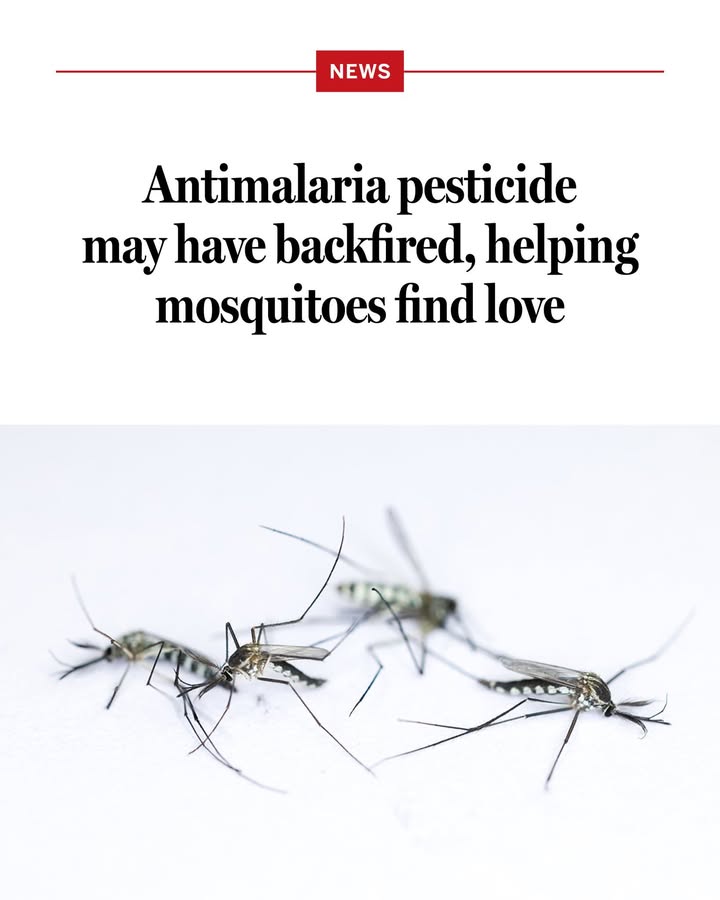
Beginning in the 1950s, malaria control programs sprayed a powerful insecticide known as dieldrin on the inside walls of homes, where Anopheles mosquitoes—the insects that spread the disease—often rested. Within a few years the bugs had developed a genetic mutation that made them impervious to the poison.
Dieldrin was eventually abandoned as resistance spread and concerns mounted over its toxicity. But the story didn’t end there.
Decades later, the mosquitoes have held onto one of the mutations that helped them survive the pesticide, despite the fact it makes them less active. A new study may explain why: The mutation appears to make Anopheles mosquitoes more sensitive to sound, which may make it easier for them to home in on mates in noisy African cities, researchers report.
What once helped the insects avoid death may now be helping them find mates. Learn more: scim.ag/4xBtRCc @NewsfromScience
LidongMo retweeted
There's something serene about a clear, moonlit night—unless you're a tiny field mouse. According to a 2024 study, the illuminated night sky can camouflage a swooping owl on the hunt, making these evenings anything but peaceful for their prey.
Learn more: scim.ag/4hlY9Uz #ScienceMagArchives

ALT When the Moon hits your eye, that’s not amore—it’s an owl on the prowl Barn owls’ white, reflective plumage camouflages the nocturnal birds on bright, moonlit nights